
MSRE: Why One Embedding is Not Enough for Your Social Identity
Multiple Social Role Embedding
The paper introduces MSRE (Multiple Social Role Embedding), a novel network embedding framework that assigns multiple role-specific latent vectors to a single node. It transitions from traditional single-embedding models to a multi-representation approach, achieving SOTA performance in link prediction and multi-label classification across major social network datasets.
TL;DR
Most graph embedding models assume you are "one thing" represented by a single vector. MSRE (Multiple Social Role Embedding) challenges this by allowing nodes to have multiple "personalities" or roles. By leveraging the sociological theory of Social Role Taking, it assigns multiple latent vectors to each user, leading to a significant jump in link prediction accuracy and classification performance over benchmarks like node2vec.
Background: The "Single Identity" Fallacy
In the world of Graph Representation Learning, we usually map a node (a person) to a single point in a high-dimensional space. However, as the authors of MSRE point out, human behavior is context-dependent. You interact with schoolmates as a student and with colleagues as an employee.
If we collapse these two distinct roles into a single vector, we create a "fuzzy" representation that doesn't accurately reflect either context. This is the Inductive Bias that MSRE aims to correct.
Methodology: How MSRE Models "Roles"
The core of MSRE is a two-stage process: Global Pre-training and Joint Inference.
1. Defining Role Representatives
The model identifies "Role Representatives" () which act as the prototypes for specific social behaviors. A person's affinity to a role is determined by a Softmax-based gating function, measuring how close their global features are to these prototypes.
2. Social Role Taking Theory
The probability of an edge between node and node isn't just a simple dot product. Instead, it is a weighted summation across all possible role pairs: This formula captures the intuition that an interaction happens when two specific roles (e.g., student-to-student) "click."
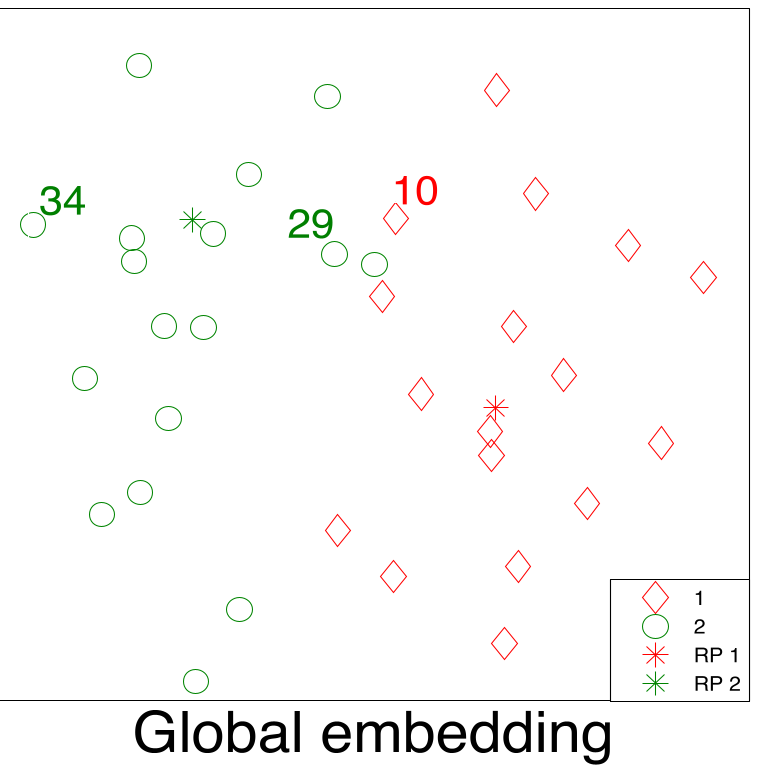 Above: Note how MSRE allows nodes with cross-role edges (like node 29 and 34) to occupy different positions in the embedding space simultaneously, whereas global embeddings force them into a compromised middle ground.
Experiments: Superior Predictive Power
The authors tested MSRE against heavyweights like LINE and node2vec on five datasets.
Key Result: Link Prediction
In the DBLP (co-authorship) dataset, MSRE was able to predict "unlikely" collaborations better than others. For instance, if Researcher A is primarily "Machine Learning" but has a minor role in "Data Mining," MSRE captures that minor role, allowing it to predict a future collaboration with Researcher B from the Data Mining field—a link that single-vector models often miss.
 Table: MSRE consistently achieves higher AUC scores, particularly in complex networks like Youtube (+5.7% over node2vec).
Critical Insight: The "Role Count" Trade-off
One fascinating aspect of the paper is the Sensitivity Analysis of the number of roles.
- Under-fitting: Having too few roles (e.g., 1) forces the model back into the "Single Identity" fallacy.
- Over-fitting: Having too many roles can lead to performance degradation as role-specific information becomes too sparse to learn effectively. The "sweet spot" usually aligns with the ground-truth social communities present in the data.
Conclusion & Future Outlook
MSRE is more than just a performance boost; it's a structural shift in how we think about node identity. By moving from Node-Level embeddings to Role-Level embeddings, we can model the nuance of human social environments.
The next frontier? Dynamic MSRE. Our roles aren't static—we graduate, change jobs, and join new communities. Handling the temporal evolution of these roles will be the key to the next generation of social recommender systems.