
MS-TLMC: Reversing General Transfer Learning for High-Efficiency Marketing Campaigns
A Multiple Source based Transfer Learning Framework for Marketing Campaigns
The paper introduces MS-TLMC, a multiple-source based transfer learning framework designed to identify customers for marketing campaigns. It employs a reverse-transfer strategy by normalizing target domain data into source domain distributions to leverage pre-existing knowledge, achieving state-of-the-art performance in both supervised and unsupervised settings.
TL;DR
Marketing campaigns are ephemeral, often lacking the labeled data required to train robust predictive models. MS-TLMC (Multiple Source based Transfer Learning for Marketing Campaigns) solves this by "reversing" the typical transfer learning flow: instead of pulling instances from a source to a target, it normalizes target data into multiple source distributions. This approach yields a massive performance boost—improving AUC by over 100% in low-labeled data scenarios—while remaining compatible with traditional ML models like XGBoost and SVM.
Problem & Motivation: The "Cold Start" of Marketing Campaigns
In the fast-paced world of digital marketing, two major obstacles prevent effective customer targeting:
- Distribution Drift: Customer behavior shifts dynamically. A model trained on a campaign from six months ago likely won't work today because the underlying data distribution has changed.
- Data Scarcity: Most campaigns are short-lived (less than 3 months). By the time you collect enough response data to train a model, the campaign is often over.
Previous SOTA methods focused on Instance-based Transfer, selecting specific samples from old campaigns that looked like the new one. However, the authors argue this is inefficient and fails if the campaign objectives (labels) differ slightly.
Methodology: The Power of Reverse Domain Mapping
The core innovation of MS-TLMC is its three-stage pipeline: Domain Transfer, Task Transfer, and Optimization.
1. Reverse Distribution Normalization (DBNorm)
Instead of finding "important samples," the authors use DBNorm. This ensures that the target data () is adjusted to match the probability density functions of the source domains (). This "reverse mapping" allows the target data to "speak the language" of previously learned models.
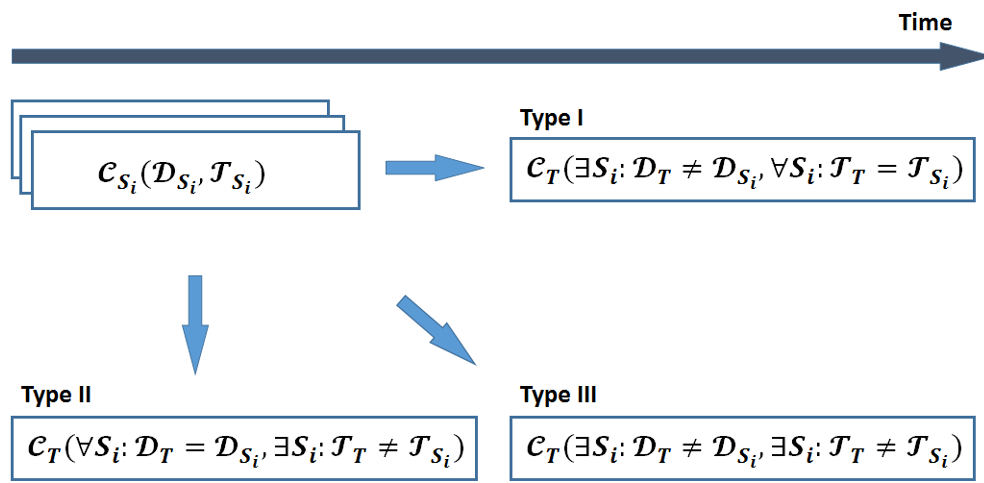 Fig 1: The three types of transfer scenarios: (I) Time-based drift, (II) Different campaign objectives, (III) Unknown domains and tasks.
2. Task Similarity Weighting
Not all source campaigns are relevant. MS-TLMC calculates a modified cosine similarity between the target's labels and the source models' predictions. If a source model performs poorly on the target data, its weight is reduced or zeroed out via a max(0, sim) threshold.
3. Robust Optimization
To handle the "messiness" of real-world marketing data, the framework uses:
- Huber Loss: More robust to outliers than MSE.
- Weighting Function (): Specifically designed to handle the extreme class imbalance (response rates as low as 0.2%).
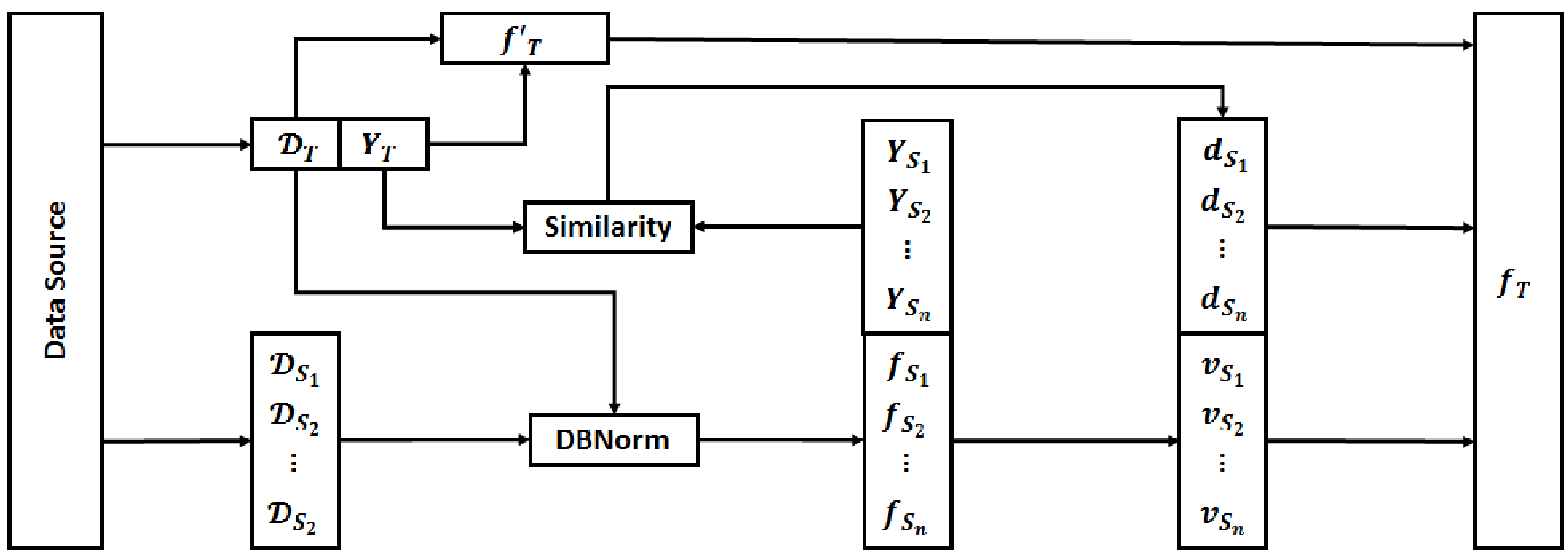 Fig 2: The working process of MS-TLMC, highlighting the movement of target data into source domain spaces.
Experiments & Results
The authors validated MS-TLMC using 10 real-world campaigns from the Commonwealth Bank of Australia.
SOTA Comparison
Compared to Scalable Transfer Learning (STL), MS-TLMC showed a dominant lead in Unsupervised and Semi-supervised tasks. As shown in the table below, when only 40% of data is labeled, MS-TLMC achieves an AUC of 0.691, while the baseline sits at a mere 0.274.

Compatibility & Stability
One of the framework's strongest selling points is its "plug-and-play" nature. Whether using Logistic Regression, SVM, or XGBoost as the base learner (), the MS-TLMC wrapper consistently elevated performance, making even "weaker" models competitive with modern gradient boosting trees.
Critical Analysis & Conclusion
Takeaway
MS-TLMC proves that in industry settings where tabular data dominates and deep learning often overfits, statistical alignment (distribution matching) is a superior strategy for transfer learning. It successfully bridges the gap between different campaign types and time-frames.
Limitations & Future Work
- Convergence: The efficiency test showed that as the number of source domains increases, the epochs to converge also rise, though not exponentially.
- Scope: Currently optimized for binary classification. The authors identify extending this framework to Regression problems (e.g., predicting spend amount rather than just "will respond") as a key future direction.
In summary, for any data scientist managing a portfolio of marketing tasks, MS-TLMC provides a mathematically rigorous way to ensure that "no data is left behind," turning old campaign history into a powerful predictive engine for the future.