
Multiplicative Latent Factors: Decoding the Hidden Geometry of Social Networks
Multiplicative latent factor models for description and prediction of social networks
This paper introduces a Multiplicative Latent Factor Model for social network analysis, combining regression terms with sender-and-receiver-specific latent factors. Utilizing Singular Value Decomposition (SVD) and the principle of exchangeability, the method achieves State-of-the-Art performance in link prediction and network visualization.
TL;DR
Peter D. Hoff's seminal work moves beyond simple "popularity" metrics in social network analysis. By introducing multiplicative latent factors—where each node is represented by sender and receiver vectors—the model captures complex dependencies like clustering and transitivity. In practical tests, this approach nearly doubled the accuracy of link prediction in international conflict data.
Background: The Failure of Independence
In standard statistical modeling, we often assume that observations are independent. In a social network, this would mean the tie from Country A to Country B has nothing to do with the tie from Country A to Country C. This is fundamentally false.
Networks are defined by:
- Heterogeneity: Some nodes are "hubs."
- Reciprocity: If I link to you, you are likely to link back.
- Transitivity: The "friend of a friend is a friend" logic.
Previous models (like or simple additive random effects) either suffered from estimation instability or were too "stiff" to capture these higher-order structures.
Methodology: The Geometry of Interaction
The core innovation is the decomposition of the interaction matrix (the matrix of effects not explained by covariates like GDP or Distance).
1. Matrix Decomposition Perspective
Hoff treats the network structure as a noisy matrix that can be decomposed via Singular Value Decomposition (SVD): By using a reduced-rank approximation (selecting dimensions), we can represent the log-odds of a link as: Here, represents the latent characteristics of node as an aggressor (sender), and represents its characteristics as a target (receiver).
2. The Theory of Exchangeability
Why is this mathematically sound? Hoff invokes Theorem 1 (Aldous 1981) regarding Row-and-Column Exchangeability (RCE). It states that if the labels of nodes are arbitrary, the interaction must be a function of row-specific, column-specific, and dyad-specific variables. The multiplicative form is the most natural way to capture the "similarity" or "compatibility" between these latent profiles.

Experiments: Tracking Global Conflict
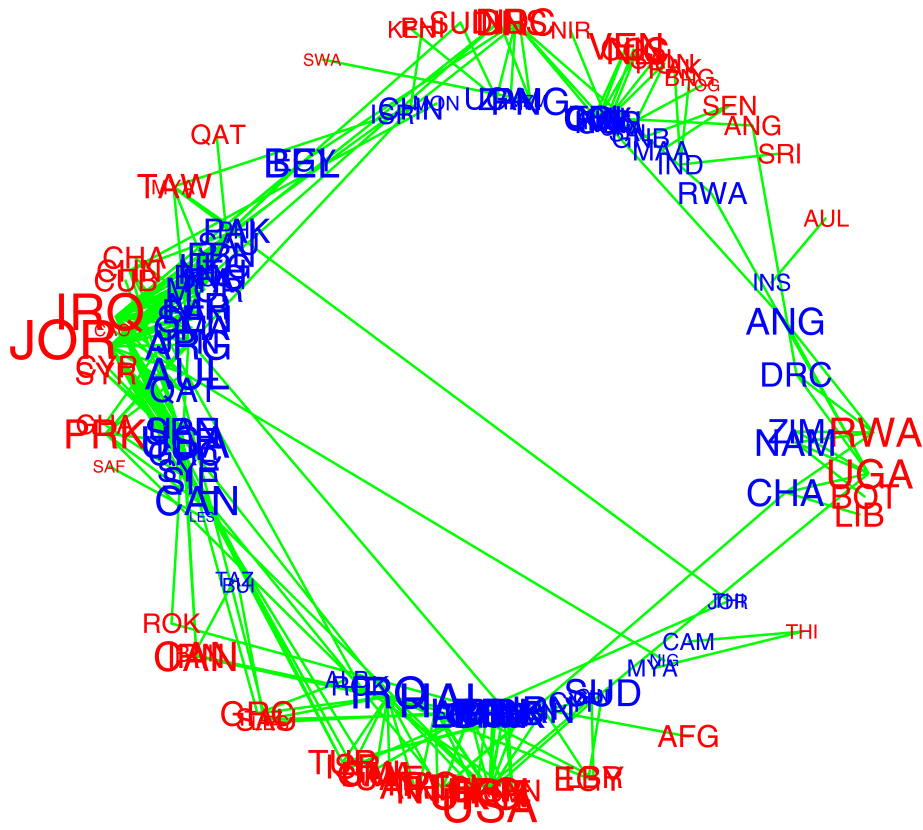
The model was applied to 130 nations during 1990–2000. While population and distance explained some conflicts, the Latent Factors revealed the deeper "geopolitical weather."
Visualization of the Latent Space
By plotting and , the model visually clusters nations. Middle Eastern conflicts and African conflicts appear as distinct "regions" in the latent space, even if the raw geographic data didn't explicitly group them that way.
Link Prediction: The Ultimate Test
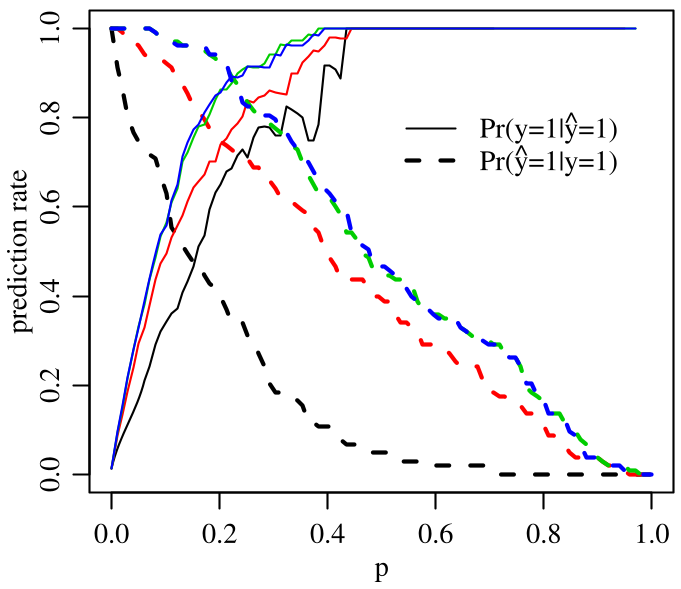
Using a 2-fold cross-validation, the author hid half the network and asked the model to "guess" the missing links.
- K=0 (Standard Regression): Poor performance; failed to capture the structure.
- K=2 (Latent Factors): Recovered 90% of missing links within the top 100 candidates.
The "Receiver Operating Characteristic" logic shown below highlights how adding even 1 or 2 latent dimensions (K=1, K=2) creates a massive jump in predictive power.
Critical Insight & Conclusion
The genius of this work lies in its balance. It doesn't throw away the "explainable" parts (regression on population/distance) but recognizes that there is a "latent manifold" of social interaction that covariates cannot reach.
Takeaway for Practitioners: When modeling relational data, if your "Independence Assumption" is screaming in pain, don't just add more features. Map your entities into a latent space where their products define their relationships. This is the precursor to modern embedding techniques in Graph ML.
Limitations: The MCMC estimation can be computationally expensive as the number of nodes () grows to the millions, suggesting a need for variational inference or stochastic gradient approaches in big-data contexts.