
Robotics as the New Microscope: Accelerating Ethology with Multirobot Systems
How Multirobot Systems Research will Accelerate our Understanding of Social Animal Behavior
This paper explores the bidirectional synergy between multirobot systems and ethology, specifically how robotics algorithms for tracking, recognition, and modeling can accelerate our understanding of social animal behavior. Key contributions include an MCMC-based particle filter for tracking hundreds of identical agents and the use of Input/Output Hidden Markov Models (IOHMMs) to learn executable behavioral models directly from observation.
TL;DR
Researchers are pivoting from "bio-inspired robotics" to "robot-assisted biology." By applying multi-target tracking, automated behavior labeling, and IOHMM-based learning, this work transforms raw video into executable models—simulation-ready programs that describe the "software" running inside social animals like ants and monkeys.
Background: The Scalability Crisis in Ethology
For decades, the study of social insects has been a manual labor of love. Biologists often require two people just to log the activity of a single ant: one to watch, and one to write. In a colony of hundreds, this approach fails to capture the complex, high-frequency interactions that drive collective decision-making.
The authors argue that robotics researchers are uniquely positioned to solve this. Why? Because the problems we solve for robot teams—localization, intent recognition, and decentralized control—are the exact mechanisms biologists are trying to decode in nature.
1. Tracking: Dealing with "Particle Hijacking"
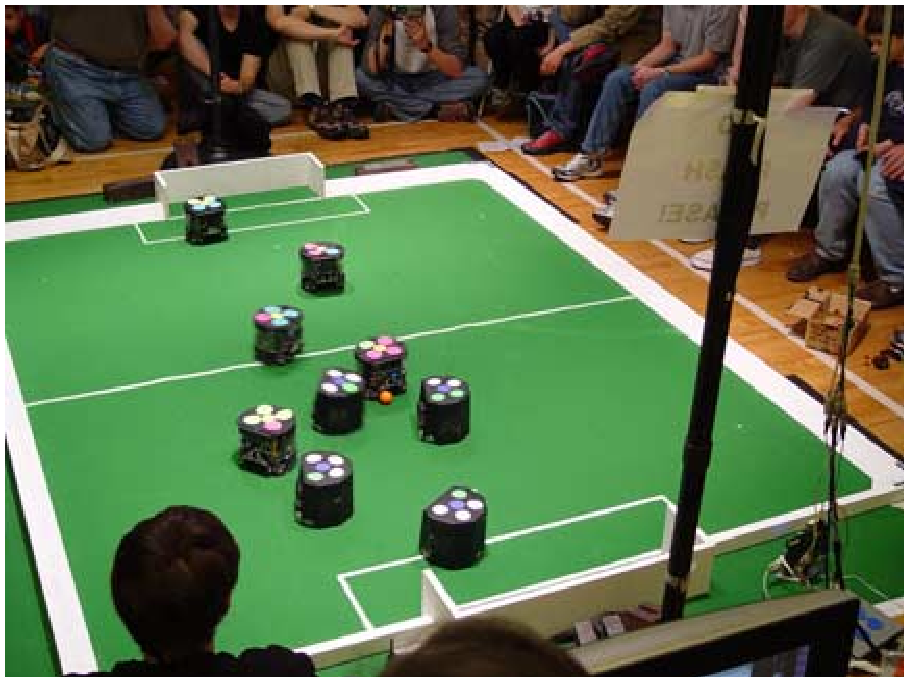
Tracing the path of 20 identical ants is a nightmare for computer vision. When two ants cross paths, standard trackers often swap their IDs—a phenomenon the authors call "particle hijacking."
To solve this, the team implemented a Joint Particle Filter. Instead of tracking ants independently, they track one "meta-state" containing all ant positions. To avoid the exponential computational explosion this usually causes, they utilized Markov Chain Monte Carlo (MCMC) sampling. This allows the algorithm to focus its "attention" (particles) on ants currently interacting, while using fewer resources on isolated individuals.
2. Automatic Recognition: Beyond Human Speed
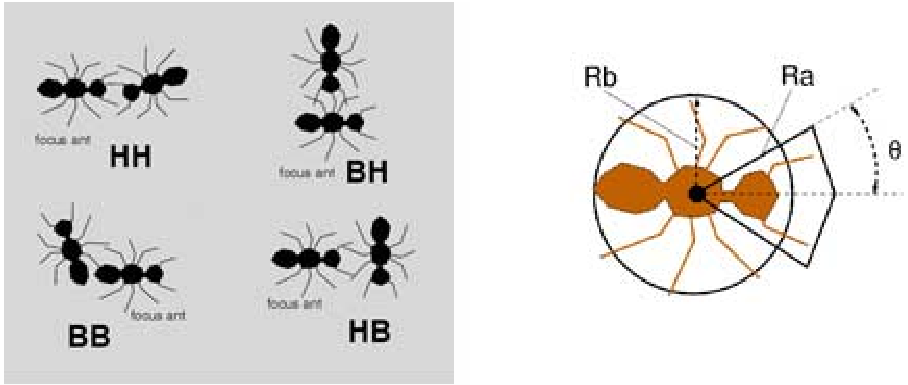
Once trajectories are recorded, the next step is identifying what the animals are doing. The authors focuses on four types of encounters: Head-to-Head (HH), Head-to-Body (HB), Body-to-Head (BH), and Body-to-Body (BB).
They tested two methods:
- Geometric Models: Defining polygonal "sensory fields" around the head and antennae.
- Trainable Models: Using human-labeled clips to train a classifier based on features like relative velocity and orientation.
The Result: The computer was remarkably consistent. While humans missed 29% of encounters (false negatives) due to fatigue or speed, the computer missed nearly 0%.
3. The Holy Grail: Executable Models
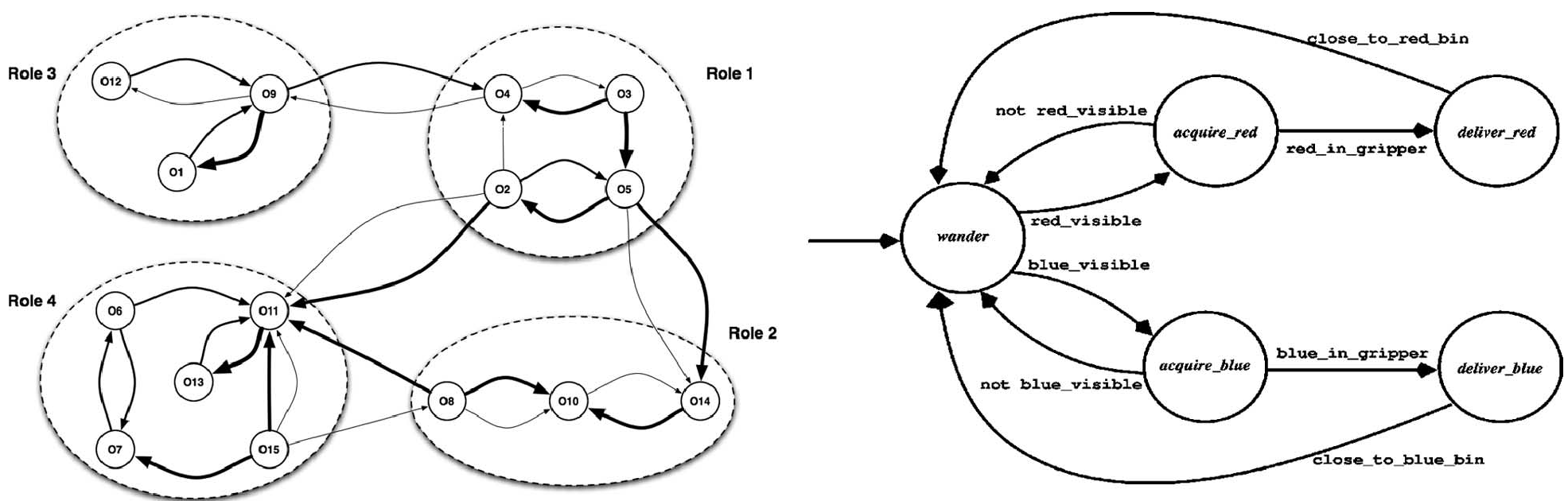
The most profound contribution of this paper is the concept of the Executable Model. A typical biological model is a flow chart (an ethogram). However, an executable model is a control program.
By using Input/Output Hidden Markov Models (IOHMMs), the researchers can learn the "switching logic" of an animal.
- Input: Perceptual triggers (e.g., "Do I see a food item?").
- Output: Low-level behavioral assemblages (e.g., "Wander," "Move-to-Goal").
By training on observed trajectories, the IOHMM learns which sensory inputs trigger specific behaviors. The resulting model can be plugged back into a simulator. If the simulated "digital ants" behave like the real ones, the biological hypothesis is validated.
Experimental Insight: Ants Aren't Random
Using these tools, the authors debunked a common "null hypothesis" that ant encounters are just the result of random Brownian motion.
Through automated analysis of 5,055 encounters, they found that when ant density doubles, Head-to-Head (HH) encounters nearly double (+93%), while other encounter types only increase by ~30%. This suggests ants aren't just bumping into each other; they are actively seeking HH interactions to exchange information, while potentially avoiding "low-value" body collisions to maintain efficiency.
Critical Analysis & Future Outlook
While the vision-based tracking is currently limited to controlled laboratory settings with high contrast, the transition to scanning laser range finders (Lidar) for outdoor monkey tracking shows the roadmap for field biology.
The current limitation is the assumption that we already know the "primitive" behaviors (the library of actions). The next frontier in this research is unsupervised behavior discovery: using machine learning to identify the primitive actions themselves without any human bias.
Conclusion: This work represents a shift toward "Engineering-Science" for biology. By treating animals as agents with executable code, we move closer to a rigorous, quantitative understanding of the "social algorithms" that govern life on Earth.