
Multiscale Local Community Detection: Navigating the Hierarchical Fabric of Social Networks
Multiscale Local Community Detection in Social Networks
This paper introduces a novel multiscale local community detection method for social networks. It proposes a new local modularity metric called "LQ" and provides an algorithm that enables the discovery of communities at various granularities (scales) from a single starting node without requiring global network information.
TL;DR
Most local community detection algorithms find only one "best" community. However, social structures are hierarchical. This paper introduces a new local modularity metric, LQ, and a dual-expansion algorithm that allows a user to "zoom out" from a single seed node to discover multiple layers of community membership—from small cliques to large thematic groups—using only local information.
Background: The Limits of Local Vision
In the study of complex networks, we often lack the "God's Eye View." Global information (the total number of nodes and edges) is frequently incomplete or too costly to compute. Local community detection solves this by starting from a single node and exploring its neighbors.
The catch? Most existing metrics—like Clauset’s R or Luo’s M—only identify a single scale. But if you are a scholar, you belong to a research group (small scale), a department (medium scale), and a scientific field (large scale). Single-scale methods miss this rich context.
The Invention of LQ: Bridging Global and Local
The authors propose LQ, a metric inspired by Newman’s global modularity .
Where is internal edges, is the sum of degrees, and is the local edge context. The beauty of this paper lies in its mathematical proof: the authors demonstrate that maximizing is equivalent to maximizing the ratio of internal to external edges (). This provides a solid theoretical foundation for while enabling it to be used in a multiscale framework.
How It Works: The "Look-Ahead" Expansion
The algorithm operates through two distinct expansion phases:
- Candidate Expansion (): The algorithm temporarily "relaxes" its strictness. By adjusting the parameter (the estimated network size), it forces the community to look beyond its immediate tight-knit neighbors.
- Stable Merging (): Once new candidates are found, the algorithm uses a merging criterion (DLQ) to see if these new nodes form a stable higher-level community. If the modularity gain is positive, the "Local Community" () expands to the next scale.
 Figure 1: Conceptual visualization of local community expansion from a starting node.
Performance: Capturing Every Layer
The researchers tested their approach on LFR benchmark networks—synthetic graphs designed to simulate hierarchical social structures.
- Accuracy: On 4th-scale macro-communities, the method achieved perfect F-scores (1.0) on several datasets where baseline methods (R, M) couldn't even "see" the larger structure.
- Intuition: In the Dolphins dataset, beginning at node 25, the algorithm successfully identified three distinct scales of association, outperforming previous benchmarks that got stuck at the first layer.
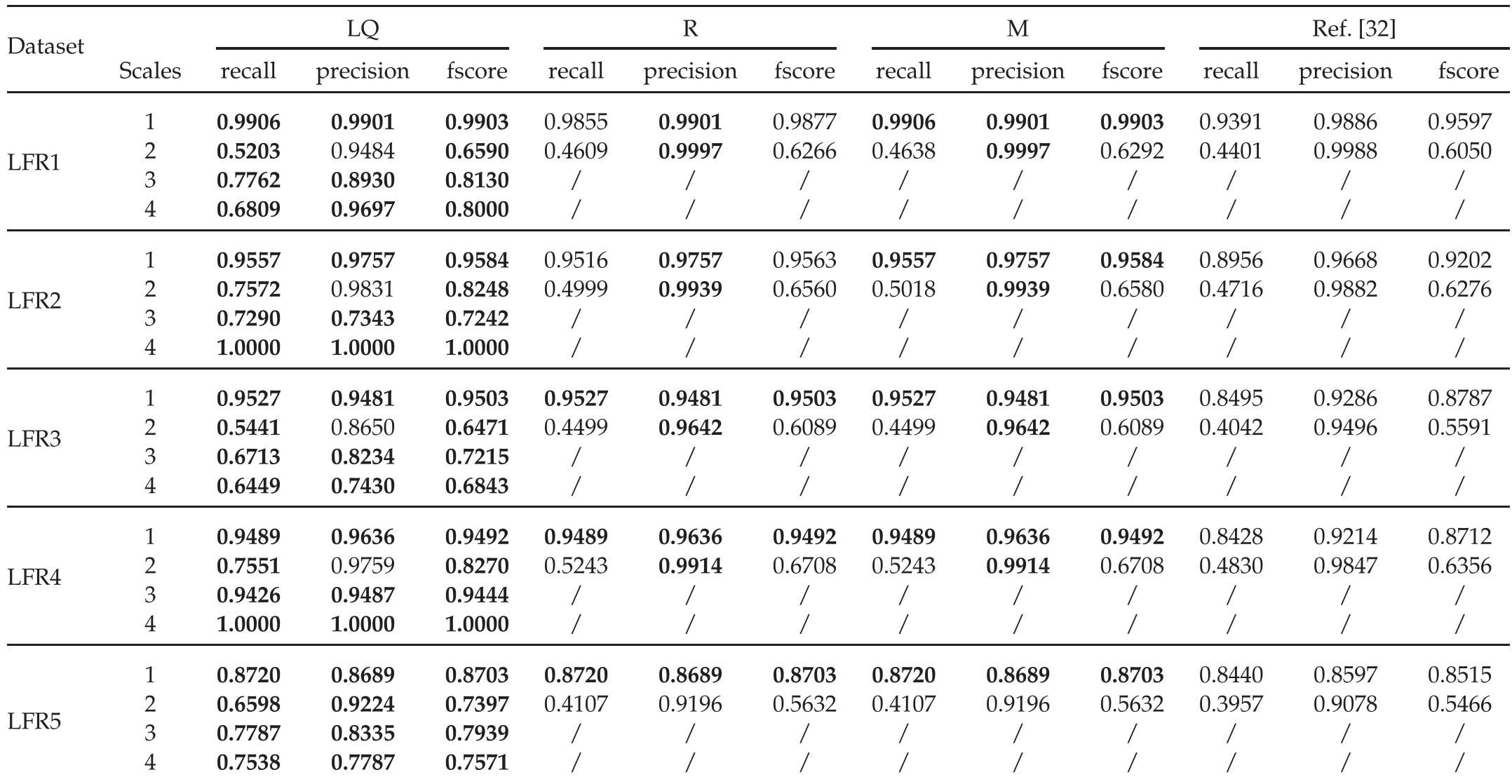 Table 1: Quantitative comparison showing LQ outperforming R and M methods across multiple scales in LFR datasets.
Critical Insights: Beyond the Formulas
The real value of this work is the solution to the Resolution Limit in a local context. By mathematically proving that they could control the scale of detection by adjusting the "virtual" network size , the researchers have provided a knob that users can turn to explore different social resolutions.
Limitations: While powerful, the method's time complexity is approximately . In extremely dense or massive graphs (like the full Twitter/X follow graph), the expansion process might still prove computationally heavy if too many scales are requested.
Conclusion
Multiscale local community detection is a significant leap toward more "human-like" AI social analysis. Instead of putting a node in a single box, we can now see the multiple worlds it inhabits. This work lays the groundwork for more nuanced recommendation engines and social influence models.