
PRIMIO: Optimizing Big Healthcare Data through Intelligent VM Migration in Smart Cities
SPECIAL SECTION ON ADVANCES OF MULTISENSORY SERVICES AND TECHNOLOGIES FOR HEALTHCARE IN SMART CITIES
The paper proposes PRIMIO, a mobility-aware and resource-aware joint Virtual Machine (VM) migration model for heterogeneous Mobile Cloud Computing (MCC) systems. It utilizes Ant Colony Optimization (ACO) to optimize real-time Smart Healthcare data processing in Smart Cities, achieving superior task execution efficiency and resource utilization.
TL;DR
As Smart Cities evolve, real-time healthcare applications require massive data processing with zero-latency. This paper introduces PRIMIO (PRioritized meta-heurIstic virtual Machine migratIOn), a system that uses Ant Colony Optimization to move Virtual Machines (VMs) across cloudlets. Unlike previous methods, it doesn't just look at one user; it looks at the whole system to reduce task delays and save server resources simultaneously.
Background: The Mobile Healthcare Bottleneck
In a Smart City, a "Smart Healthcare" application might help a blind user navigate using image processing or monitor a patient's vitals in real-time. These tasks are offloaded to Cloudlets (small-scale clouds near the user). However, when the user moves, the distance between the device and the cloudlet increases, causing lag—a critical failure for life-saving medical apps.
The problem is two-fold:
- Mobility: How do we move the VM to a closer cloudlet without interrupting the service?
- Resource Efficiency: How do we avoid "Over-provisioning" (allocating a 4GB VM when only 2GB is needed) which wastes expensive urban infrastructure?
Methodology: The PRIMIO Framework
The core innovation of PRIMIO is moving away from "Single VM Migration" to a "Joint VM Migration" approach.
1. Urgency Selection
Not every VM needs to move immediately. PRIMIO calculates an Urgency Factor () using two penalties:
- Required Execution Time Penalty: How much extra time the task needs.
- Deadline Penalty: How close the task is to failing its hard deadline.
2. Ant Colony Optimization (ACO)
The migration problem is NP-hard (like the bin-packing problem). PRIMIO uses ACO, a meta-heuristic inspired by how ants find the shortest path to food.
- Pheromones: Represent the "desirability" of moving a specific VM to a specific cloudlet.
- Local Heuristic: Factors in both the estimated completion time and the risk of wasting resources.
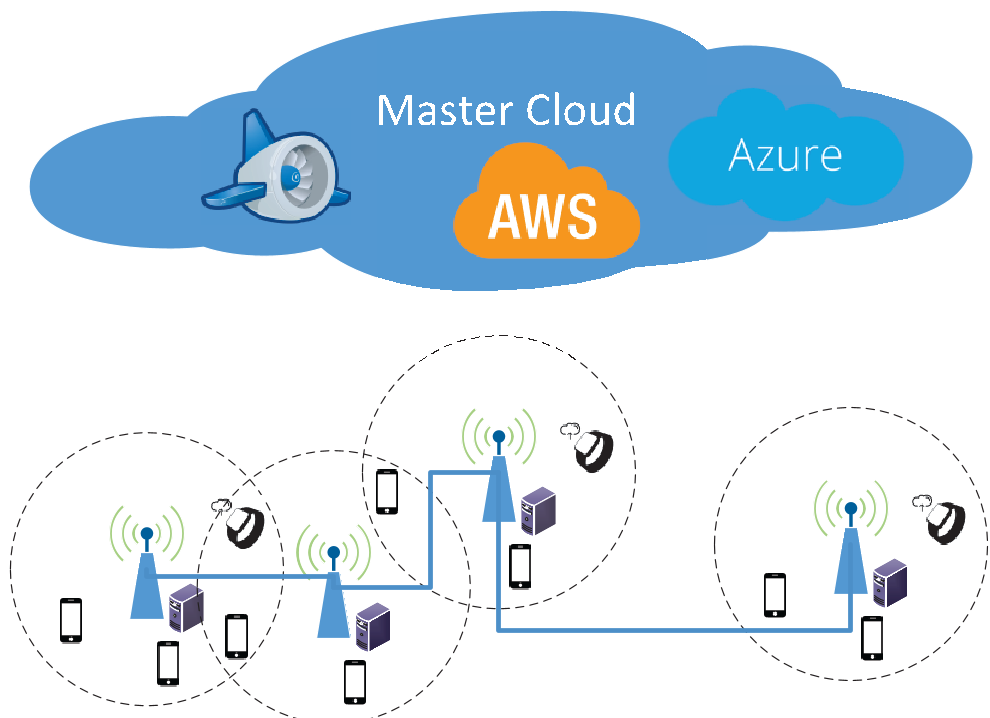 Figure 1: The three-tier architecture connecting Mobile Devices, Cloudlets, and the Master Cloud.
Experiments & Results
The authors tested PRIMIO using a test-bed of 10 cloudlets and various Android devices. They compared it against GAVMM (Genetic Algorithm based), Task-Centric, and Greedy policies.
Key Findings:
- Reduced Latency: As mobility increases, PRIMIO keeps the completion time steady while other methods spike.
- resource Efficiency: While greedy methods often over-allocate resources by up to 40% to ensure speed, PRIMIO keeps over-provisioning significantly lower by remapping the set of VMs more intelligently.
- Reliability: PRIMIO achieved a higher percentage of tasks completed within their deadlines compared to state-of-the-art heuristic models.
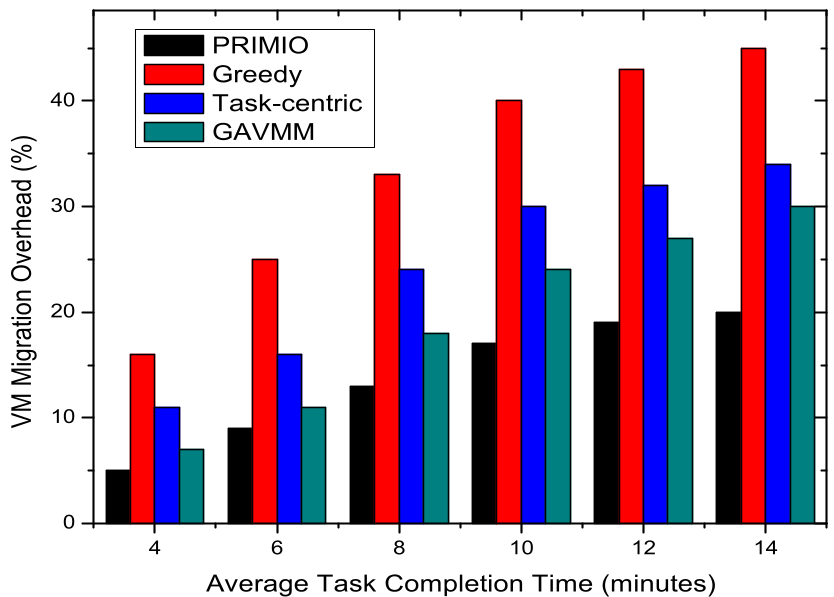 Figure 2: Impacts of mobility speed on (a) Completion Time, (b) Resource Over-provisioning, (c) Success Rate, and (d) Overhead.
Critical Insight: Why Joint Migration Matters
Most existing systems optimize for the individual user. If User A moves, move User A's VM. PRIMIO argues that this is selfish and inefficient. By treating VM migration as a collaborative remapping of all active tasks, the system can find "space" for everyone, much like a tetris game where all blocks are moved to optimize the remaining gaps.
Conclusion & Future Outlook
PRIMIO proves that meta-heuristics like Ant Colony Optimization are robust enough to handle the chaotic movement of people in a city. However, as we look toward the future, the authors suggest exploring Edge Computing and Crowdsourcing to further reduce the gap between medical sensors and the processing power they require.
Takeaway: For Smart City architects, the lesson is clear: don't just build faster clouds; build smarter migration engines that understand user movement.