
Priority-Based Ranking: Bridging Social Ties and Item Tags for Better Recommendations
A multistep priority-based ranking for top-N recommendation using social and tag information
The paper introduces a novel multistep priority-based ranking methodology for top-N recommendation that integrates user-item ratings, social networks, and item tags. By utilizing a unique scoring mechanism to calculate user and item priorities, the method achieves significant improvements in recommendation accuracy and specifically addresses the challenges of cold-start scenarios.
TL;DR
This paper presents a robust multistep ranking algorithm that tackles the "Cold-Start" and "Sparsity" problems in recommender systems. By combining who you know (Social Network) with what they like (Item Tags), the authors create a priority-based scoring system that outperforms traditional Matrix Factorization (SVD) and Bayesian Personalized Ranking (BPR) methods on real-world datasets like Last.fm and LibraryThing.
The Core Challenge: The Sparsity Wall
Modern recommender systems often hit a wall: Data Sparsity. If a user has only rated two or three items, how can an algorithm possibly know what they want next? Traditional Collaborative Filtering (CF) struggles here because it relies on overlapping patterns between users. If there's no overlap, there's no recommendation.
The authors argue that the solution lies in Side Information. We aren't just rows in a matrix; we are nodes in a social network, and the items we buy aren't just IDs—they have descriptive tags (e.g., "Jazz", "Portable", "Sci-Fi").
Methodology: The Five Steps to Priority
The proposed architecture moves away from complex latent factor optimization and toward a logically transparent, priority-driven workflow.
1. The Social Harvest
The algorithm first looks at the target user's neighbors in a social graph. It collects every item those neighbors have interacted with. This forms the "candidate pool."
2. Feature Mapping
It builds a User-Feature Matrix. Instead of tracking items, it tracks how many times a user (or their neighbor) has interacted with a specific tag. This transforms sparse item interactions into a denser representation of "interests."
3. Calculating User Priority
Not all friends have the same taste. The algorithm calculates the distance between the target user's tag-profile vector and their neighbors' vectors.
- Intuition: If your friend shares your love for "Classical" and "Opera" tags, their influence (Priority) on your recommendations should be higher.
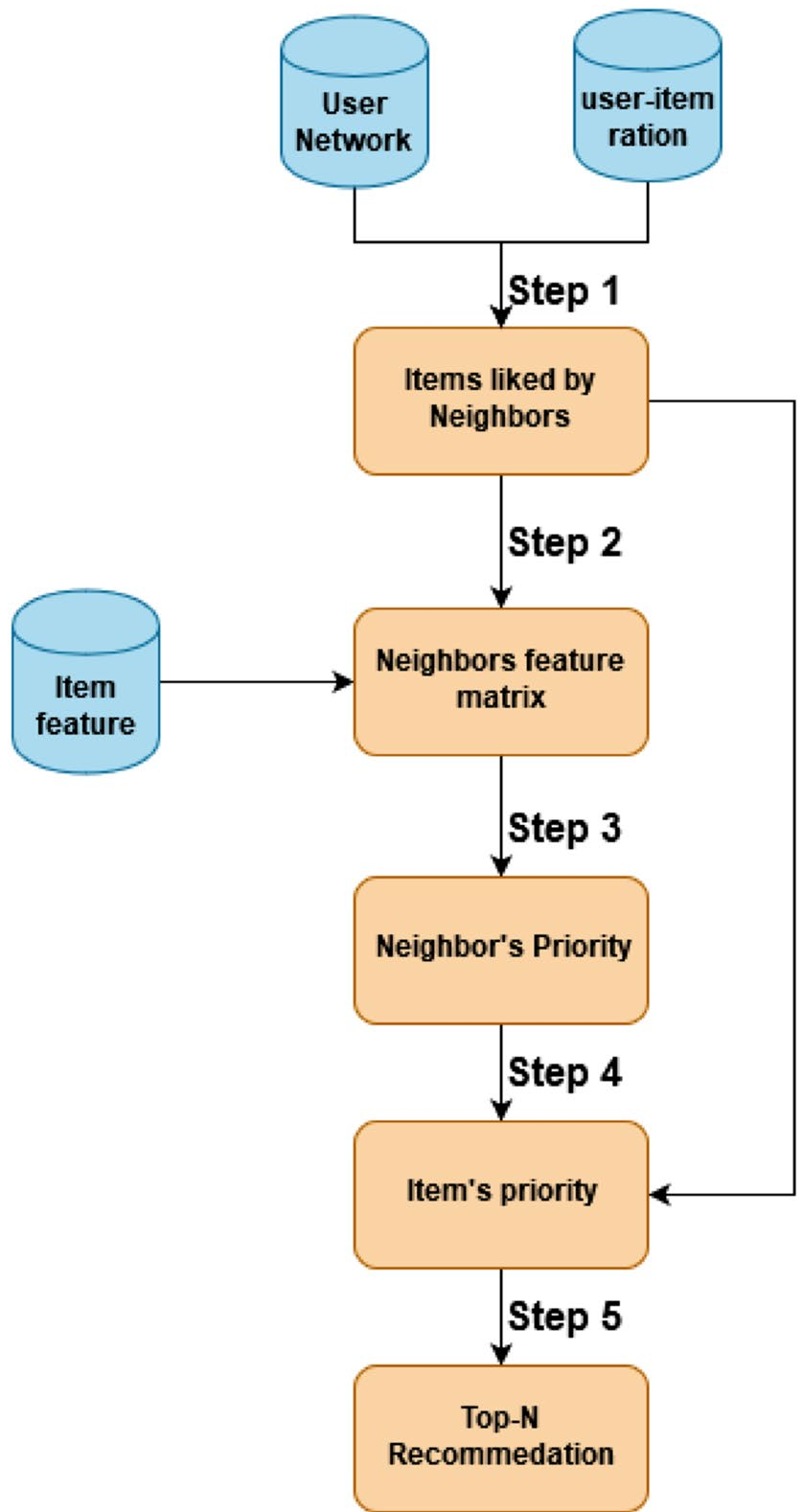 Fig 1: The Proposed Multi-step Architecture Workflow.
4. Item Priority & Ranking
An item's final score is the sum of the priorities of all neighbors who rated it. This creates a weighted voting system where "closer" friends have more say in what you see.
Experimental Showdown
The authors tested the method against heavyweights like SBPR (Social Bayesian Personalized Ranking) and SVD.
Key Findings:
- Superior Accuracy: On the Last.fm dataset, the proposed method achieved a Hit-Rate@5 of 0.1286, significantly higher than SBPR (0.0619).
- Quality of Ranking: The ARHR (Average Reciprocal Hit-Rank) was consistently higher, meaning when the system got it right, the "correct" item was usually near the very top of the list.
- Cold-Start Success: For users with almost no history, the inclusion of social ties and tags provided a much-needed "jumpstart" for personalization.
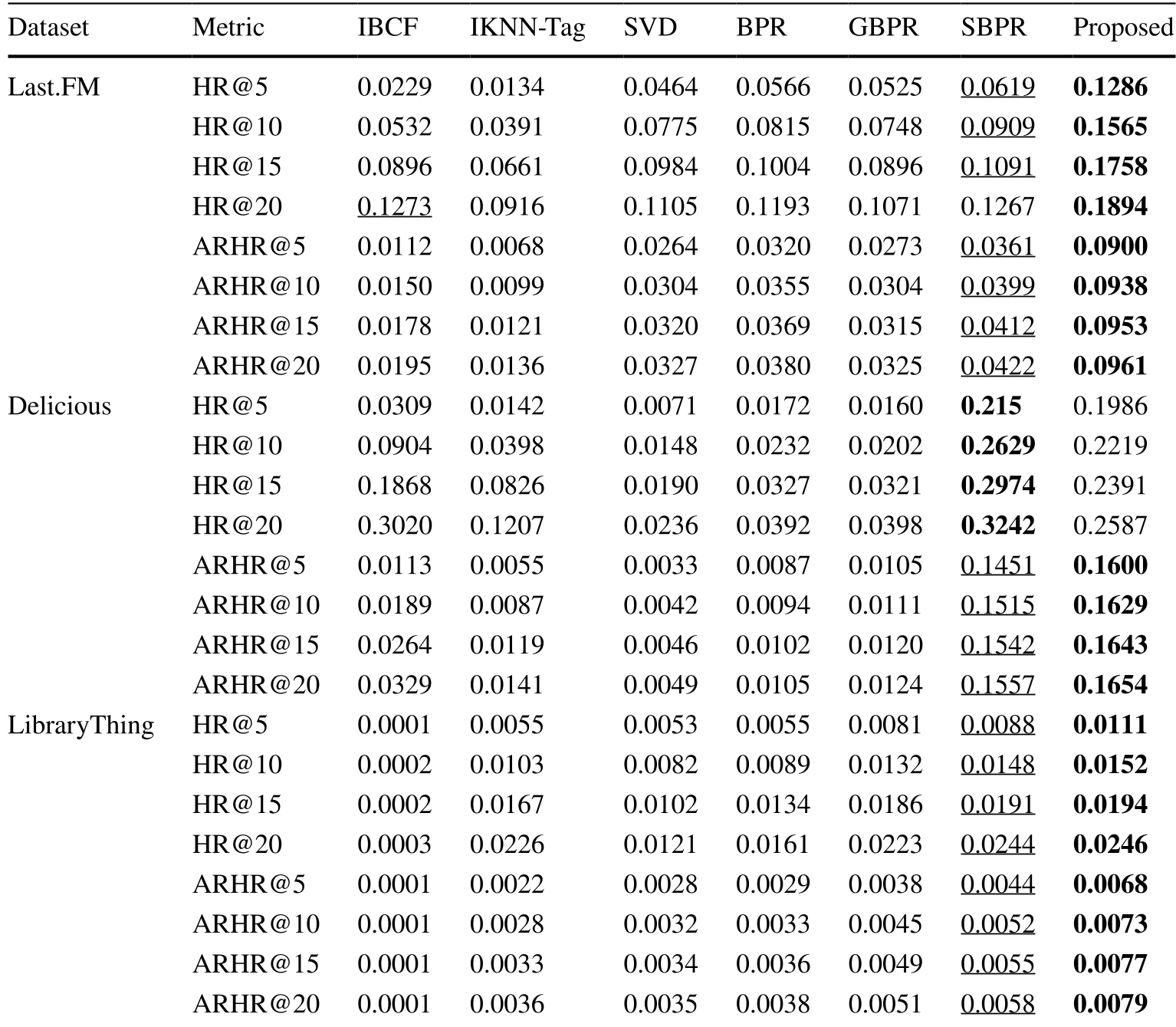 Table 1: Performance comparison across three major datasets. Note the bold values highlighting the proposed method's dominance in ARHR metrics.
Critical Insights & Limitations
Why does this work? Unlike Matrix Factorization, which can "overfit" to sparse latent dimensions, this priority-based method acts as a sophisticated K-Nearest Neighbor (KNN) variant. It uses social ties as a hard filter and tags as a soft similarity measure.
Limitations:
- Computational Cost: While the logic is simple, calculating distances for users with thousands of social connections (high-degree nodes) can be expensive.
- Tag Quality: The system is highly dependent on the quality and cleanliness of item tags.
Future Outlook
This work paves the way for "explainable" AI in recommendations. Because the system is built on priorities and distances in tag-space, a service could actually tell the user: "We are recommending this jazz album because your friends who also like 'Acoustic' music enjoyed it."
Integrating this priority logic into modern Graph Neural Networks (GNNs) could be the next frontier, combining the heuristic strengths of this paper with the deep learning power of 2024-era AI.