
MORE: Capturing the "Power of Many" through Multivariate Relation Aggregation
Multivariate Relations Aggregation Learning in Social Networks
The paper introduces MORE (Multivariate relatiOnship aggRegation lEarning), a novel graph learning framework designed to capture higher-order dependencies in social and academic networks. By utilizing Network Motifs to represent multivariate relations and aggregating them with node attributes, the method achieves superior node classification performance and significantly faster convergence compared to traditional Graph Convolutional Networks (GCN).
Executive Summary
TL;DR: Most Graph Neural Networks (GNNs) see the world through pairs of nodes (binary relations). The MORE (Multivariate relatiOnship aggRegation lEarning) model breaks this limitation by explicitly modeling multivariate relations using Network Motifs. By combining these structural "motifs" with traditional node attributes, MORE achieves higher accuracy in node classification while reducing training time by up to 80%.
Background: In the landscape of graph learning, we have moved from simple embeddings to deep convolutional layers. However, MORE identifies a critical "blind spot" in the current SOTA: the failure to recognize that a group of three or four friends is fundamentally different from three separate pairs of friends.
The Motivation: Why Binary Relations aren't Enough
In a social network, if Alice, Bob, and Cindy are all part of a single project team, a standard GCN represents this as three edges: (Alice-Bob), (Bob-Cindy), and (Alice-Cindy). But what if Cindy is the leader and the others don't actually interact? The binary representation over-expresses their relationship.
The authors argue that multivariate relations (interpersonal, social, or logical) are the "fundamental units" of networks. Existing GNNs omit this high-order information during the neighborhood diffusion process, leading to "diluted" features and slow convergence.
Methodology: The MORE Framework
The core innovation of MORE lies in its dual-pathway architecture that treats structure as a first-class citizen alongside attributes.
1. Feature Extraction (The "Motif" Secret)
Instead of just using the adjacency matrix, MORE calculates the Node Motif Degree (NMD). It looks for specific low-order subgraphs (3-node and 4-node motifs):
- M31 (Triangle): Represents ternary closure (if A knows B and B knows C, A likely knows C).
- M41-M43: Represents more complex cliques and paths.
2. The Dual-Tensor Pipeline
- Attribute Feature Tensor (AFT): Captures the "What" (node labels, text features).
- Structural Feature Tensor (SFT): Captures the "How" (motif counts, node degrees).
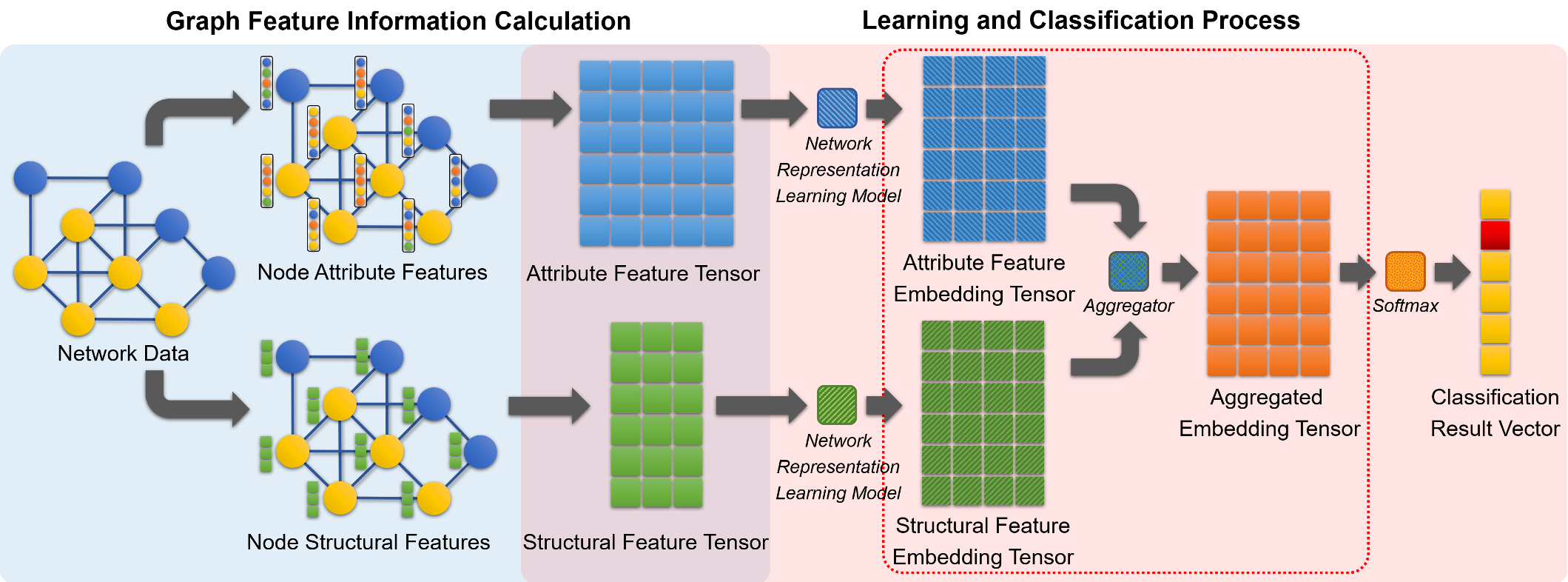 Figure 1: The MORE framework illustrating the parallel processing of attribute and structural features before aggregation.
3. Aggregation Strategies
Authors tested three ways to fuse these paths:
- Hadamard (HA): Element-wise product. Best for capturing implicit biases.
- Summation (SU): Element-wise addition. Stable and fast.
- Connection (CO): Concatenation. Preserves the most information but increases dimensionality.
Experiments: Speed Meets Precision
The authors tested MORE across social, citation, and transportation networks. The results were striking in two dimensions:
1. Accuracy Boost
In the Email-Eucore dataset (which is naturally dense with motifs), MORE reached 61.5% accuracy compared to GCN’s 51.5%.
2. The Efficiency Miracle
Traditional GCNs often require hundreds of iterations to "smooth" features across the graph. Because MORE starts with high-order structural information already encoded, it converges much faster.
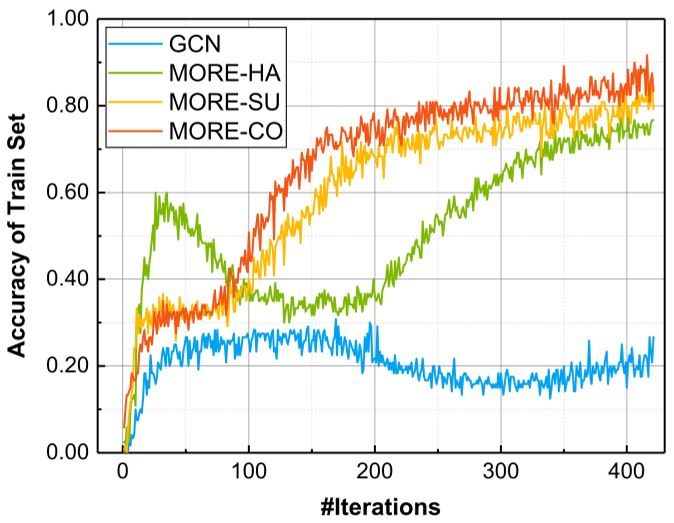 Figure 2: Convergence comparison showing MORE (HA, SU, CO) reaching higher accuracy significantly faster than the baseline GCN.
Key Metric: In several tests, the Overall Iteration Time (OIT) for MORE was only about 1/5th of the time required by GCN.
Critical Analysis & Conclusion
Takeaway: MORE proves that "Structure is Feature." By pre-calculating motifs, we offload the heavy lifting of discovering high-order patterns from the neural network to the preprocessing stage, leading to a much more efficient learning process.
Limitations:
- Preprocessing Overhead: While training is fast, counting motifs in massive graphs can be computationally expensive (though this is a one-time cost).
- Undirected Constraint: The current model is limited to undirected graphs, missing out on the rich information found in directed motifs (like hierarchies).
Future Outlook: The MORE framework is "pluggable." Future researchers could replace the internal GCN layers with Graph Attention Networks (GAT) or apply this motif-based logic to large-scale industrial graphs for fraud detection and recommendation systems.
Summary for the Reader: If your graph data involves strong "community" or "group" structures (like Slack teams or co-authorship), using a motif-aware model like MORE is a no-brainer for both performance and production efficiency.