
Multivariate Temporal Link Prediction: Beyond Static Snapshots in Social Networks
Multivariate temporal Link Prediction in evolving social networks
This paper introduces a novel Multivariate Time Series Link Prediction method using a Vector Autoregression (VAR) model to predict future connections in evolving social networks. By integrating temporal network evolution, node similarities, and connectivity information, it achieves SOTA performance on DBLP co-authorship datasets, reaching an AUC of 0.93.
TL;DR
Link prediction is often treated as a static classification task, but real-world networks are living, breathing entities. This paper proposes a Multivariate Time Series approach using Vector Autoregression (VAR) to combine node similarity metrics with historical connectivity. By analyzing how these features evolve together, the model achieves up to a 10% AUC improvement over traditional ARIMA and static topological methods in co-authorship networks.
Problem & Motivation: The Static Fallacy
Most link prediction algorithms suffer from "temporal blindness." They look at a snapshot of a network at time and predict links at using static metrics like Common Neighbors (CN) or Adamic/Adar (AA).
The industry's shift toward temporal models initially led to Univariate Time Series (like ARIMA or Moving Averages). However, these methods have a fatal flaw: they usually only look at the history of a specific link's existence. If two nodes have never been connected before, a univariate model has no historical "signal" to work with, making it nearly impossible to predict the birth of entirely new connections.
The authors' Insight: The emergence of a link is not just about its own past, but the co-evolution of several topological indicators. If the "Resource Allocation" index and "Common Neighbors" score for a pair of nodes are both rising over time, that trend is a multivariate signal of an impending connection.
Methodology: The VAR Framework
The core contribution is the application of the Vector Autoregression (VAR) model. Unlike univariate models that track one variable, VAR tracks a vector of variables , capturing how each variable influences its own future and the future of all other variables in the system.
1. Data Structuring
The network is sliced into yearly snapshots . For every pair of nodes, the authors extract:
- Link Occurrence: Whether a link existed (or its weight, e.g., number of co-authored papers).
- Similarity Scores: Multiple metrics calculated at each timestep (CN, AA, JC, PA, RA).
2. The Multivariate Model
The model is defined as: Where is a vector containing both the connectivity and the topological similarity scores. This allows the model to capture the covariance structure—for example, how a change in the Jaccard Coefficient at predicts a link occurrence at time .
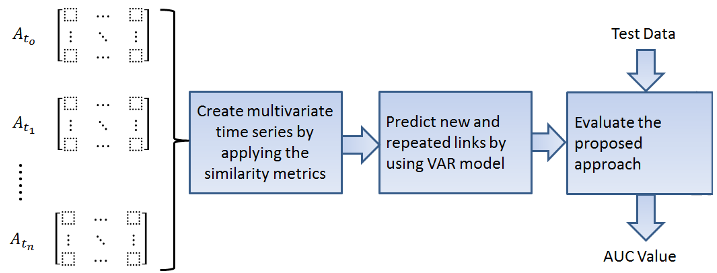 Fig. 1: Overview of the Multivariate Time Series Link Prediction method, showing the transition from graph snapshots to VAR modeling.
Experiments & Results
The authors tested their method on the DBLP co-authorship dataset (2003–2013). They evaluated two scenarios:
- Repeated & New Links: Predicting both recurring collaborations and first-time partnerships.
- Only New Links: A "cold-start" scenario predicting links that never appeared in the history.
Key Performance Gains
- Weighted vs. Unweighted: Weighted graphs (incorporating the number of papers co-authored) consistently outperformed unweighted ones, highlighting that edge "strength" is a vital temporal signal.
- VAR vs. ARIMA: The Multivariate VAR model significantly outperformed the univariate ARIMA model. Using all similarity metrics in the VAR model ("All" column in the tables) yielded the highest AUC.
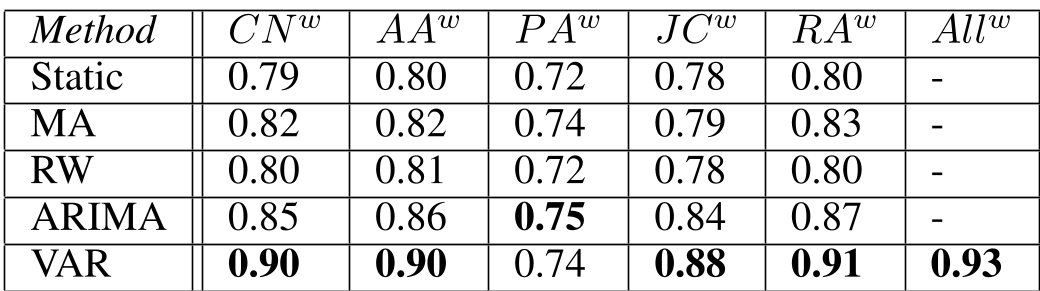 Table 1: AUC results for Weighted Networks. Note the VAR model achieving 0.93 AUC when combining all metrics (Allw), a significant lead over static and univariate baselines.
Critical Analysis & Conclusion
Takeaways
The study proves that the temporal trajectory of node similarities (like AA and RA) is more predictive than their absolute values at a single point in time. By using VAR, the model successfully "learns" the dynamics of how researchers move closer together in the social space before they actually collaborate.
Limitations & Future Work
- Computational Complexity: Building a VAR model for every pair of nodes in a massive network is computationally expensive. Future work should look at dimensionality reduction or localized VAR modeling.
- Global Metrics: This paper focused on local neighborhood metrics. Future iterations could benefit from including global metrics like Katz Centrality or PageRank evolution.
In summary, this work shifts the link prediction paradigm from "Which nodes are similar now?" to "How is the relationship between these nodes evolving?" — a distinction that is crucial for any real-world recommendation or surveillance system.