
MWT: Harnessing Multiwavelets for High-Precision Operator Learning in PDEs
Multiwavelet-based Operator Learning for Differential Equations
The paper introduces the Multiwavelet-based Neural Operator (MWT), a novel framework for learning mappings between infinite-dimensional function spaces to solve partial differential equations (PDEs). MWT compresses the operator's integral kernel using fine-grained multiwavelets and achieves state-of-the-art (SOTA) performance across benchmarks like the KdV, Burgers’, Darcy Flow, and Navier-Stokes equations.
TL;DR
The Multiwavelet-based Neural Operator (MWT) represents a significant leap in data-driven PDE solving. By leveraging the vanishing moments of multiwavelets to sparsify integral kernels, it outperforms existing methods like Fourier Neural Operators (FNO) by up to an order of magnitude in accuracy while remaining completely resolution-independent.
Problem & Motivation: Beyond Fixed Grids
Solving Partial Differential Equations (PDEs) is the backbone of modern engineering—from aircraft design to modeling complex fluids. Traditional Numerical Solvers are robust but computationally expensive. Recent Deep Learning approaches like PINNs (Physics-Informed Neural Networks) are limited to single instances of PDEs, while early Neural Operators often struggle with high-frequency signals and lack a compact representation of the underlying physics.
The authors' core insight is that most PDE operators can be expressed as integral operators. If the kernel of this operator is smooth (away from the diagonal), it can be represented very sparsely in a wavelet domain. Multiwavelets, which combine the locality of wavelets with the high-order approximation of orthogonal polynomials (OPs), provide the perfect tool for this compression.
Methodology: The Core Mechanism
The MWT architecture operates on the principle of Multi-Resolution Analysis (MRA). Instead of a standard CNN or Fourier Transform, it uses a hierarchical decomposition:
- Multiwavelet Decomposition: The input signal is projected onto a sequence of polynomial subspaces (e.g., Legendre or Chebyshev).
- Kernel Learning in Wavelet Domain: Four compact neural networks () learn the projected kernel's behavior across different scales.
- Non-Standard Form: By decoupling scales, the model can reuse the same learned parameters for different resolutions, ensuring the model is "resolution-independent" by design.
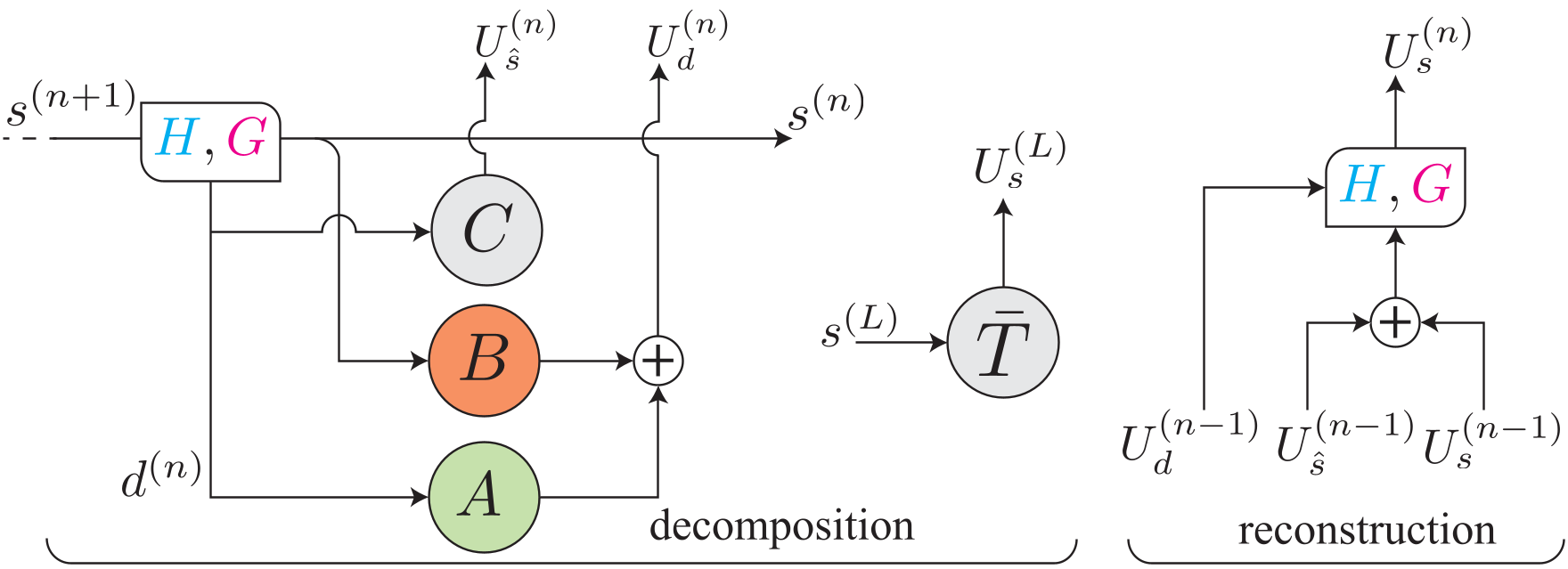 Figure: The MWT architecture utilizing decomposition and reconstruction cells with scale-independent neural networks.
Why It Works: The Sparsity of Smoothness
The paper draws on the theory of Calderón-Zygmund Operators. Because the multiwavelet basis has vanishing moments, it effectively "zeros out" the smooth parts of the kernel, focusing the neural networks' capacity on the singular/informative diagonal components. This is why MWT remains robust even when the input signal has high fluctuations ().
Experimental Results: Setting a New Standard
MWT was tested against heavyweights like FNO and MGNO. The results were strikingly superior:
- KdV Equation: Relative error reduction from ~0.012 to 0.0033.
- Burgers’ Equation: Significant lead in precision across all spatial resolutions.
- Resolution Generalization: MWT can be trained on a sparse 256-point grid and accurately predict a dense 8192-point grid, a feat traditional CNNs cannot achieve.
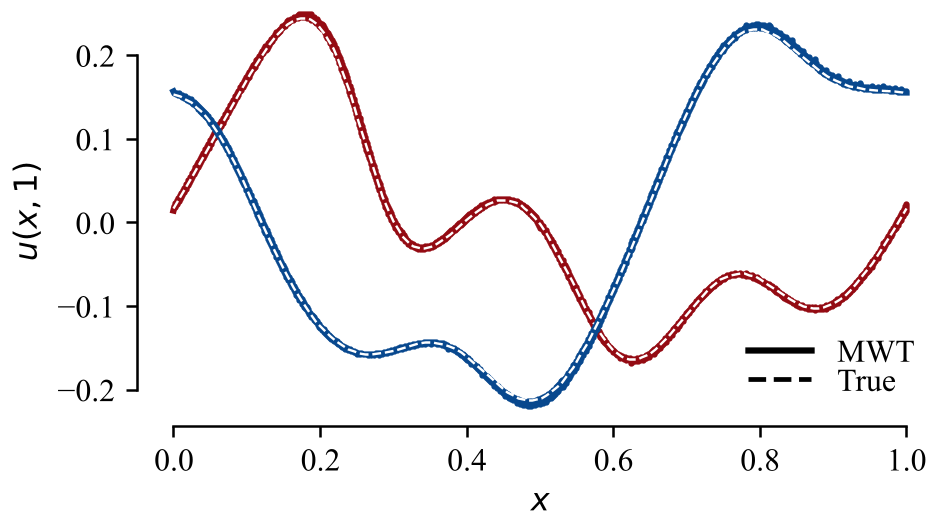 Figure: High-resolution prediction results showcasing MWT's ability to maintain accuracy across scales.
Critical Insight & Conclusion
The true value of MWT lies in its numerical efficiency. By exploiting the mathematical properties of pseudo-differential operators (specifically that vanishing moments are required for sparsification), the authors provide a rigorous foundation for choosing model hyperparameters (like polynomial degree ).
While modern AI often relies on "brute force" scaling, this paper proves that incorporating classical mathematical insights—like wavelet-based kernel compression—can lead to more efficient, accurate, and generalized models for the physical sciences.