
MUSES: Reimagining Enterprise Security through Self-Adaptive Computational Intelligence
MUSES: a corporate user-centric system which applies computational intelligence methods
This paper introduces MUSES (Multiplatform Usable Endpoint Security system), a corporate security framework that utilizes computational intelligence to manage "Bring Your Own Device" (BYOD) risks. It integrates a server-side Risk and Trust Analysis Engine (RT2AE) with client-side monitoring to provide real-time, context-aware security enforcement across mobile and desktop platforms.
TL;DR
The rise of Bring Your Own Device (BYOD) has shattered the traditional perimeter of corporate security. This paper presents MUSES, a multiplatform system that moves away from static security rules toward a user-centric, self-adaptive model. By leveraging computational intelligence, MUSES analyzes user behavior and context in real-time to predict risks and dynamically refine security policies without hindering productivity.
The BYOD Dilemma: Why Static Policies Fail
In the modern workplace, the line between personal and professional data is blurred. Employees access sensitive company assets from diverse locations—airports, homes, or cafes—using personal tablets and smartphones.
The authors identify a critical gap: Human behavior is the primary security hazard. Existing solutions (like IBM’s Hosted Mobile Security or Samsung KNOX) are often platform-dependent or rely on rigid, manual policy definitions. These systems cannot adapt to the nuance of a user's context, such as whether a "risky" action at an airport might actually be a necessary business "opportunity."
Methodology: The Intelligence Behind the Shield
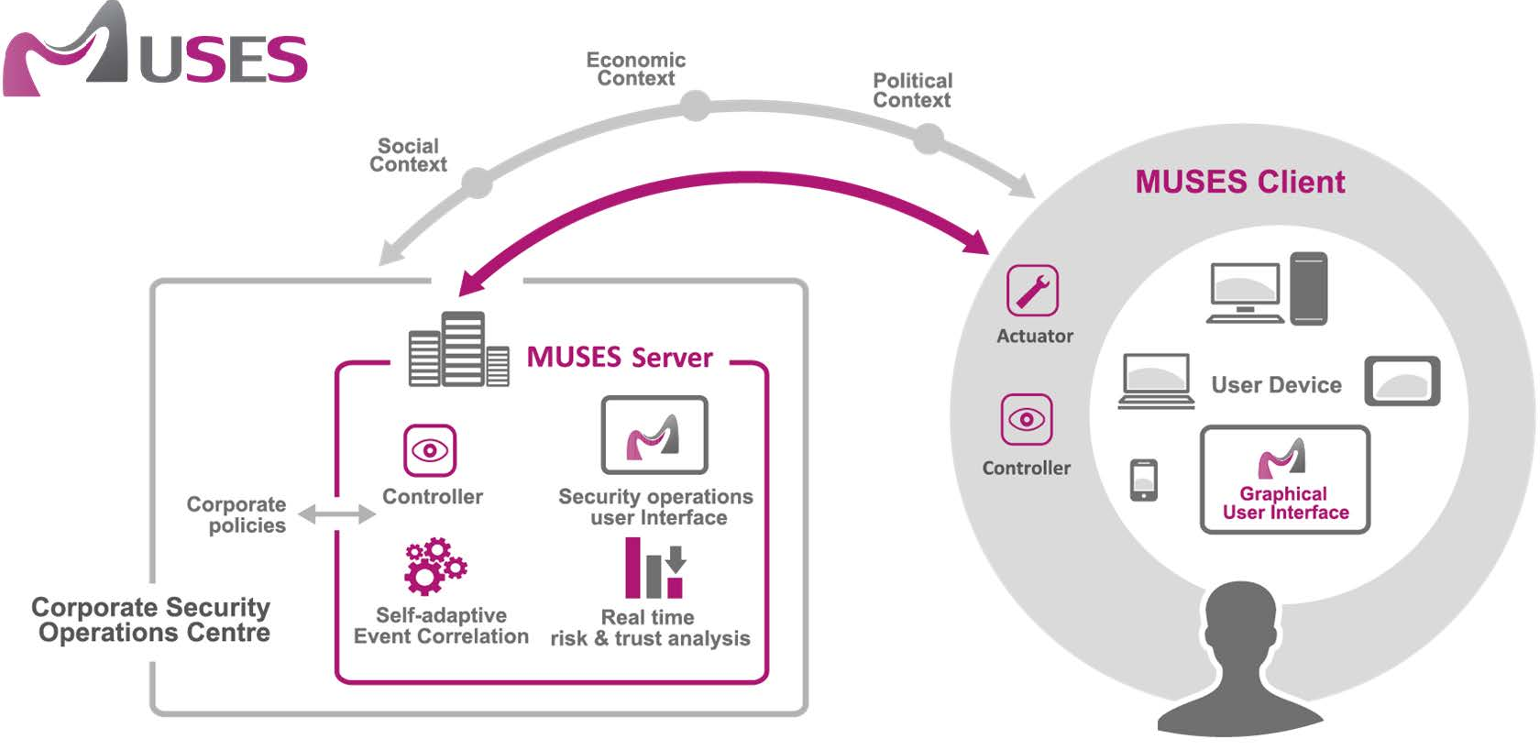
MUSES operates on a sophisticated client/server architecture designed for high-power processing and real-time responsiveness.
1. The Dynamic Architecture
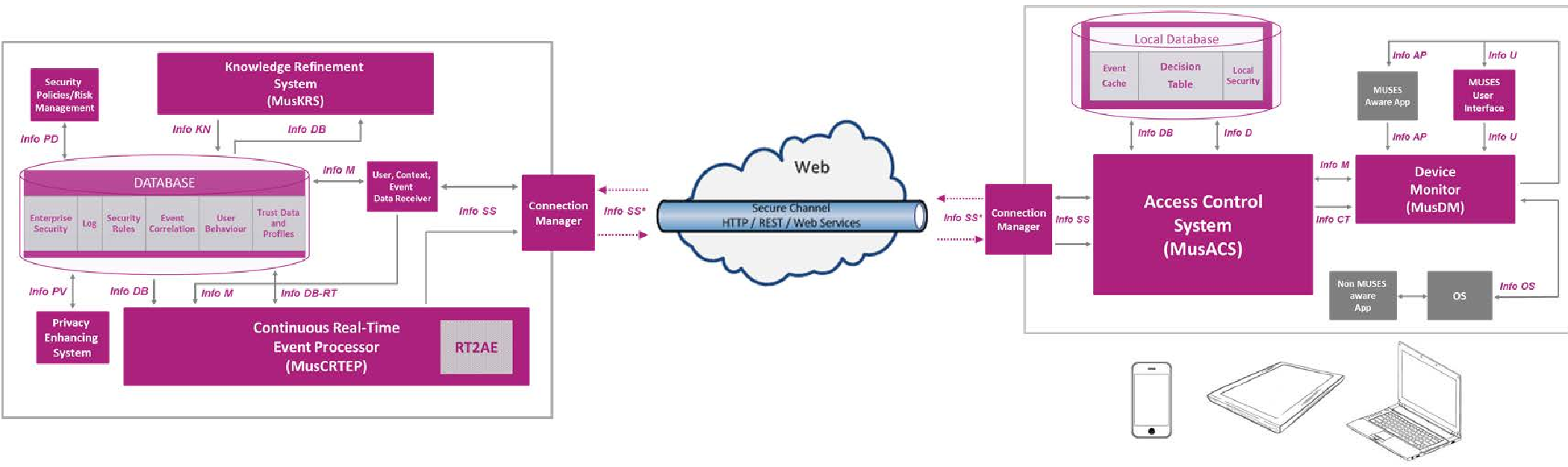
The system is split into two halves:
- The Client Side (Device): Features a
Device Monitor(MusDM) and aDecision Maker(MusACS). It can operate offline by consulting a local "Decision Table" of rules. - The Server Side (SOC): Houses the heavy machinery—the
Event Correlation moduleand theRisk and Trust Analysis Engine(RT2AE).
2. Computational Intelligence as the Engine
The core innovation lies in the Knowledge Refinement System (MusKRS). Unlike traditional systems that wait for an admin to update a policy, MUSES uses:
- Genetic Algorithms: To optimize security parameters.
- Genetic Programming: To literally evolve and rewrite security rules based on observed threats.
- Pattern Recognition & Clustering: To identify "normal" vs. "dangerous" user behavior profiles.
Real-World Advantages: Beyond the State of the Art
MUSES provides several "Value-First" improvements over current SOTA products:
- Platform Independence: While competitors focus solely on mobile (iOS/Android), MUSES covers the entire ecosystem, including corporate PCs and laptops.
- Contextual Awareness: It doesn't just look at what is being accessed, but where, how, and by whom. It calculates an "opportunity" value—if the risk is low and the potential work benefit is high, the system allows the action.
- Self-Adaptation: The system learns from historical data. If a particular user behavior pattern leads to a vulnerability, MUSES updates the ruleset for the entire organization automatically.
Critical Insight & Conclusion
The true value of MUSES is its recognition that security must be usable. By employing non-intrusive monitoring and automated rule refinement, it reduces the friction between IT departments and employees.
Limitations: While the paper outlines a robust architecture, the computational overhead of Genetic Programming on the server side could lead to latency issues in massive organizations with millions of events per second. Future iterations would likely need to explore more efficient Transformer-based behavior modeling to complement the evolutionary approaches.
In conclusion, MUSES represents a significant step toward Autonomous Security Operations, where the system doesn't just defend the perimeter—it understands the user.