
From Bytes to Feelings: Scaling Music Emotion Annotation via Machine Learning
Music emotion annotation by machine learning
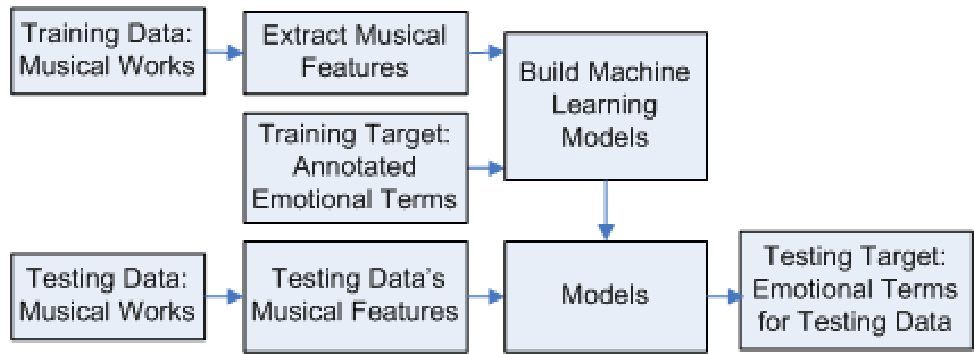
This paper introduces a machine learning framework for automated music emotion annotation, transforming the task from manual labeling to a scalable computational process. Using the Random Forests algorithm and 17 acoustic features, the authors propose the THETA (THesaurus in Emotional Term Annotation) model, which successfully supports a vocabulary of over 97 emotional terms, effectively treating emotion retrieval as a text search task.
TL;DR
Music is inherently emotional, yet most digital libraries only allow searches by "Artist" or "Genre." This paper presents a breakthrough in automated music emotion annotation, transforming the subjective task of describing a song's "vibe" into a scalable machine learning problem. By using Hybrid Sampling and Semantic Thesaurus expansion, the authors achieved up to an 18x performance boost in identifying rare emotional labels.
Perspective: Why Annotation is Harder than Classification
In the world of Music Information Retrieval (MIR), most researchers focus on Mood Classification. This is a "one-to-one" task: is this song Happy or Sad?
However, the authors argue that human emotion is far more granular. A single piece—like Beethoven’s Moonlight Sonata—is not just "Calm"; it is romantic, loving, and relaxing. This requires Emotion Annotation, a one-to-many relationship involving hundreds of potential terms. The challenge is two-fold:
- The Long Tail: Most emotional terms (like "gloomy") have very few examples in a database compared to neutral ones.
- Semantic Fuzziness: Is "cheerful" the same as "happy"? Standard models often fail to see the connection.
Methodology: The THETA Framework
The core innovation lies in the THETA (THesaurus in Emotional Term Annotation) model. Instead of building one giant, complex model, the authors broke the problem down into multiple 2-class problems. Each emotional term (e.g., "Whimsical") gets its own specialized detector.
1. Feature Extraction
The model analyzes 17 specific acoustic features, including:
- Temporal: Perceptual tempo and articulation.
- Spectral: Roughness, spectral flux, and harmonicity.
- Dynamics: Perceived intensity and loudness.
2. Solving the Data Imbalance
To prevent the model from simply guessing "No" for every rare emotion, the authors used:
- Hybrid Sampling: Reducing the majority (negative) samples while duplicating the minority (positive) samples.
- Data-Driven Thresholds: Instead of a fixed 50% confidence cutoff, the model adjusts its sensitivity. If a term is rare, the "barrier to entry" for that label is lowered.
3. The Power of Synonyms
By using a thesaurus, the model treats "Happy" and "Cheerful" as part of the same emotional family. If a training song is labeled "Happy," the model uses that information to improve its "Cheerful" detector, effectively "augmenting" the data set without requiring new manual labor.
Results: Efficiency at Scale
The impact of these optimizations is most visible in the "T4" tier—emotions with fewer than 20 training samples. The baseline model was nearly blind to these, but the THETA model saw an 18-fold increase in F-measure.
| Tier | Baseline F-measure | THETA F-measure | Improvement |
|---|---|---|---|
| T1 (Common) | 0.24 | 0.62 | 2.6x |
| T4 (Rare) | 0.00 | 0.18 | Inf (Significant) |

The computational efficiency is equally impressive. Building a model for a new emotional term takes only 7.2 seconds. To support a massive vocabulary of 4,000 emotional words, a system could be trained in just 8 hours—a task that would take humans years to complete manually.
Critical Analysis & Conclusion
This work represents a vital bridge between Acoustics and Semantics. By moving away from rigid classification and toward fluid annotation, the authors have made "Query by Emotion" a tangible reality.
Limitations: While the F-measure of 0.62 is excellent for the era/method, it suggests there is still room for improvement, particularly in capturing the temporal evolution of emotion (how a song changes from the intro to the chorus).
Future Outlook: With the rise of Large Language Models (LLMs) and better audio embeddings (like CLAP or L3), we can expect these "hand-crafted" features to be replaced by neural embeddings. However, the core logic of this paper—handling imbalanced concepts via semantic relationships—remains a gold standard for MIR research.
In the future, you won't search for "Pop Music"; you'll search for "something nostalgic yet hopeful for a rainy Tuesday," and thanks to automated annotation, your player will know exactly what you mean.