
Decoding the Heart of Music: Identifying Fine-Grained Emotions via Lyrical Text Mining
Music Emotion Identification from Lyrics
This paper introduces a method for Music Emotion Identification from lyrics by mapping textual data to 23 discrete emotion categories based on psychological models. Utilizing the General Inquirer for feature transformation and the DECORATE ensemble algorithm, the system achieves a 67% classification accuracy on a multi-class task, significantly outperforming traditional baseline expectations for fine-grained emotion detection.
TL;DR
Researchers have moved beyond simple "happy or sad" sentiment analysis to develop a machine learning framework capable of classifying song lyrics into 23 distinct emotion categories. By leveraging psychological feature extraction instead of raw word counts, the "EMO" system achieves a 67% accuracy rate while providing "human-comprehensible" rules that explain why a song feels a certain way.
Perspective: From Human Experts to Machine Intuition
In the digital music era, services like Allmusic.com rely on PhD-level experts to manually tag songs with "moods." This paper challenges that bottleneck. It situates itself as a bridge between Linguistics, Psychology, and Machine Learning, arguing that the true emotional value of music is locked within the poetic structure of its lyrics—data that acoustic algorithms often overlook.
The "Lyrical Sparseness" Problem
Why is it so hard for AI to understand lyrics?
- Vocabulary Explosions: Every subculture creates its own slang, making "Bag-of-Words" models too high-dimensional.
- Zipf’s Law: The most emotionally charged words often appear the least frequently, making them hard for traditional statistical models to learn.
- The Black Box: Most AIs can tell you a song is "Negative," but they can't tell you if it's "Anger," "Sadness," or "Guilt."
Methodology: Mapping Lyrics to Psychology
The authors bypassed raw text complexity by using the General Inquirer (GI). Instead of tracking words like "heart" or "tear," the system tracks 182 psychological tags such as Passive, Loss of Well-being, or Gains from Affection.
The Emotion Model
They refined 168 Allmusic moods into a hierarchical 23-emotion model based on the PANAS-X scale. This allows the model to differentiate between subtle states like Hostility and Alienation.
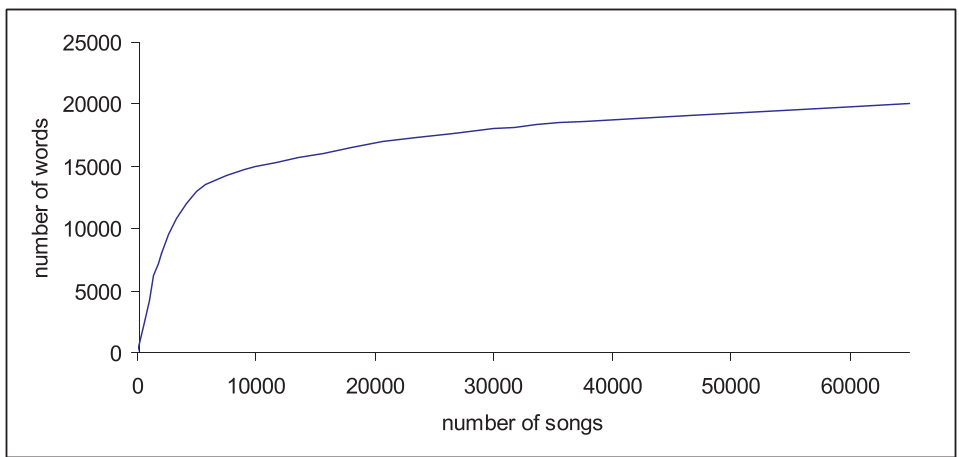 Figure 1 demonstrates the challenge of feature sparseness in lyrics—the unique word count grows steadily, requiring sophisticated dimensionality reduction.
Human-Comprehensible Results
Using the DECORATE algorithm, the researchers achieved a cross-validated accuracy of 67%. Unlike modern deep learning which offers a single probability, this system provides interpretable logic.
Example Logic Mined by the System:
- Love: Defined by words relating to Gains in Friendship and a notable absence of "knowing-type" or "political" words.
- Sadness: Strongly correlated with Loss of Well-being and a lack of Color or Relationship tags.
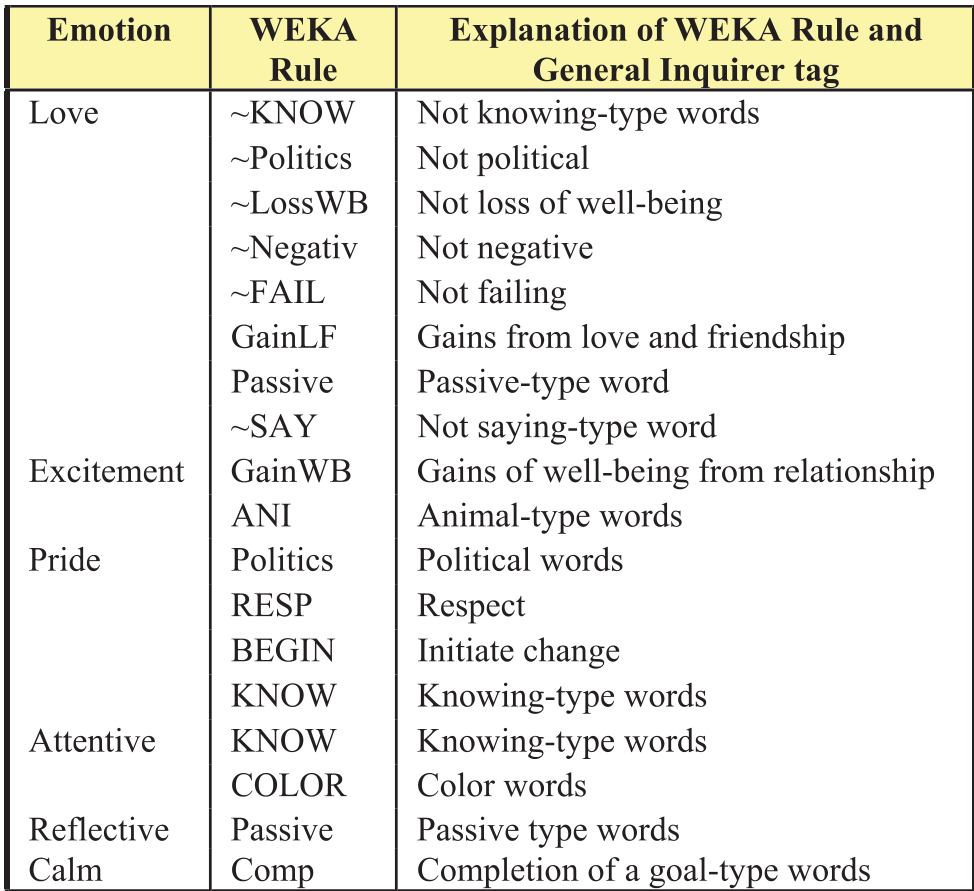 Table 2 shows the WEKA rules that explain how the AI identifies positive emotions like Love and Pride.
Critical Insight: Lyrics vs. Acoustics
The paper reveals a fascinating technical "blind spot": Acoustic features are excellent at identifying positive/negative valence but struggle to distinguish between specific negative emotions (e.g., distinguishing "Sad" from "Fear" through sound alone is difficult). Lyrical text, however, excels here. By combining both, the "EMO" system mimics the human brain's own multi-level processing of musical meaning.
Conclusion and Future Outlook
This work marks a shift toward Explainable AI (XAI) in the arts. By proving that 23 emotion categories can be mapped with high accuracy using psychological features, the authors pave the way for more intuitive music discovery engines. The next frontier? Fusing these lyrical insights with raw audio waveforms to create a truly "empathetic" music recommendation system.
Limitations
While 67% is impressive for a 23-class problem, the model still struggles with "like-valenced" emotions (e.g., distinguishing between different types of annoyance). Additionally, its reliance on fixed lexicons may miss the evolving nature of modern slang and metaphorical language.