
HMER: Revolutionizing Music Emotion Recognition via Hierarchical Multi-View Learning
15381_Music Emotion Recognition by Multi-label Multi-layer Multi-instance Multi-view Learning.
The paper introduces HMER (Hierarchical Music Emotion Recognition), a novel hierarchical Bayesian model that treats music emotion recognition as a Multi-label Multi-layer Multi-instance Multi-view learning problem. By utilizing synchronized lyrics (LRC) and audio features, it captures emotion dynamics across a song-segment-sentence hierarchy, achieving significant SOTA improvements in F1 score and MAP.
TL;DR
Music is rarely a singular emotional experience; it is a journey that shifts from verse to chorus. HMER (Hierarchical Music Emotion Recognition) breaks the "one-song-one-emotion" bottleneck by modeling music as a Song-Segment-Sentence hierarchy. By combining audio prototypes with synchronized lyrics, it achieves a massive 326% improvement in ranking precision over traditional multi-label methods.
The Problem: The Emotional "Average" Fallacy
Most music recommendation systems treat a song as a single data point. They average the features of a 4-minute track, effectively "blurring" the emotional content. If a song starts with a "reflective" intro and builds to an "ambitious" rock climax, a traditional model sees a muddy average that represents neither.
The technical challenge lies in the fact that while we have song-level labels (from experts or tags), we lack fine-grained labels for every segment. This is a classic Multi-Instance Learning (MIL) problem: we know the "bag" (the song) has certain labels, but we don't know exactly which "instances" (segments/sentences) triggered them.
Methodology: The Hierarchical Approach
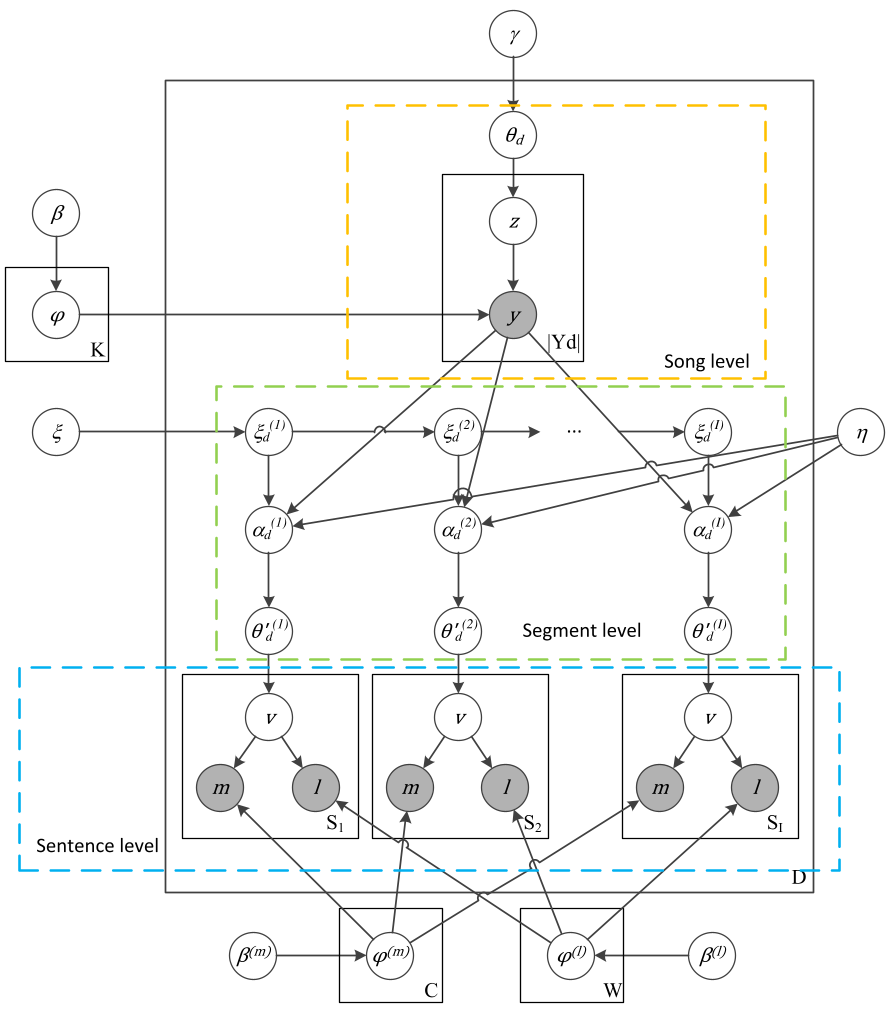
The authors suggest that music emotion dynamics follow a specific structure:
- Between Segments: Emotion varies significantly.
- Within Segments: Emotion is mostly consistent.
- Within Sentences: Emotion is almost always consistent.
1. The HMER Architecture
HMER models this via a hierarchical Bayesian framework. It uses LRC files (lyrics with timestamps) to synchronize text and audio at the sentence level.
2. Multi-View & Multi-Layer
Unlike prior works that only look at audio or only look at song-level lyrics, HMER uses:
- Music View: Mel-Frequency Cepstral Coefficients (MFCC) clustered into a "bag of prototypes."
- Lyrics View: Word count vectors from the synchronized sentence.
- Markov Correlations: It uses a parameter to ensure that emotion transitions between segments are smooth and logically correlated, rather than treating segments as independent "bags."
Experiments & Results
The researchers tested HMER against a battery of baselines, including Binary Relevance (BR), Label Powerset (LP), and the previous heavyweight M3LDA.
Performance Jump
The results were conclusive. By acknowledging that emotions are tied to specific sentences and segments, HMER-ξ reached an F1 score of 0.164 and a MAP@10 of 0.230.
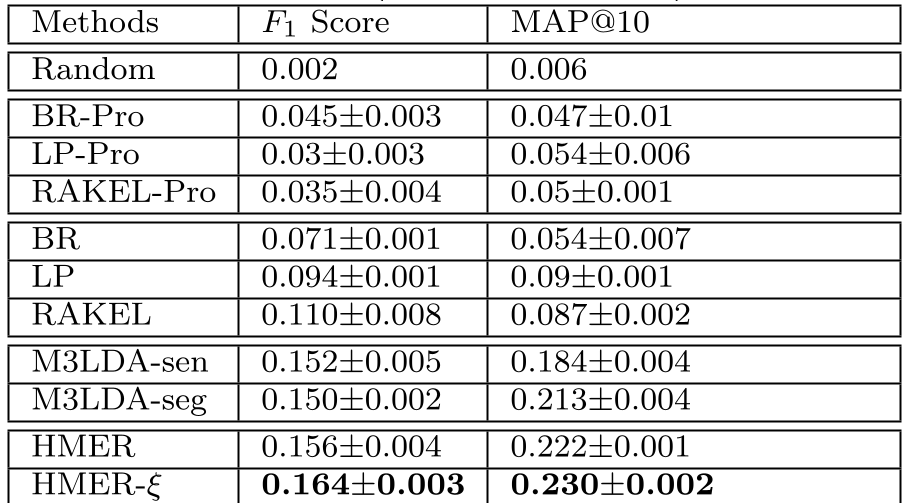
Key Takeaway from the Table: Single-instance models (BR, LP, RAKEL) struggle significantly because they try to map song-level features to multiple potentially conflicting labels. HMER’s ability to assign "happy" to one segment and "sad" to another within the same song allows it to build much cleaner correlations.
Qualitative Insights
The model also successfully clustered emotions into five major "Topics":
- Happy/Carefree
- Acerbic/Sarcastic
- Sentimental/Soothing
- Aggressive/Angry
- Sad/Somber
Critical Analysis & Conclusion
Why it works
HMER succeeds because it respects the physics of music. Music is a temporal art. By aligning the "shorthand of emotion" (lyrics) with the acoustic signatures at the sentence level, the model reduces the noise inherent in global feature extraction.
Limitations
- Computational Cost: Being an iterative Bayesian model, it is slower than simple trees or regressions. It is currently best suited for offline indexing rather than real-time stream processing.
- Data Dependency: It relies on LRC files. While common for popular songs, obscure or instrumental tracks remain a challenge.
Future Outlook
The authors suggest extending this to Music Videos, adding a third "Visual View." Imagine a system that not only understands the mood of the beat and the lyrics but also the color grading and cinematography of the video—truly holistic multi-modal AI.
Final Summary: HMER proves that in the world of affective computing, the local structure is just as important as the global label.