
Sentimeter-Br2: Harmonizing Music Recommendations with Social Media Sentiments
19207_Music recommendation system based on user's sentiments extracted from social networks.
The paper introduces a music recommendation framework that leverages a specialized sentiment intensity metric, Sentimeter-Br2, to analyze user-generated text from social networks (Facebook and Twitter). The system dynamically adjusts song recommendations based on real-time emotional states, categorized into happiness, sadness, anger, romance, and gentleness.
TL;DR
This research presents a novel music recommendation framework that moves beyond static user profiles by analyzing real-time social media posts from Facebook and Twitter. Using a refined sentiment metric called Sentimeter-Br2, the system detects a user's current emotional state and recommends music that matches their "vibe," resulting in a massive jump in user satisfaction from 27.5% to 72.5%.
Background: Why Your Music Player Doesn't "Get" You
Most music recommendation engines are stuck in the past. They know what you liked last year, but they don't know you had a terrible morning. Traditional methods often try to analyze song lyrics, which is a nightmare for AI because lyrics are metaphorical and subjective. Conversely, the "Sentimeter-Br2" approach suggests that the easiest way to know how someone feels is to look at what they are currently typing on social media.
Methodology: The Sentimeter-Br2 Engine
The core innovation lies in the Sentimeter-Br2 metric. Unlike simple "positive vs. negative" counters, this system understands linguistic nuance:
- Verbal Tenses: A verb in the present tense ("I am sad") carries more weight than one in the past tense ("I was sad").
- N-Grams & Adverbs: By looking at word combinations and intensifiers (e.g., "very happy"), the system calculates a more precise sentiment intensity score.
- Dynamic Feedback Loop: The system regularly scrapes posts via PHP and JSON, mapping scores to five categories: Happiness, Sadness, Anger, Romance, and Gentleness.
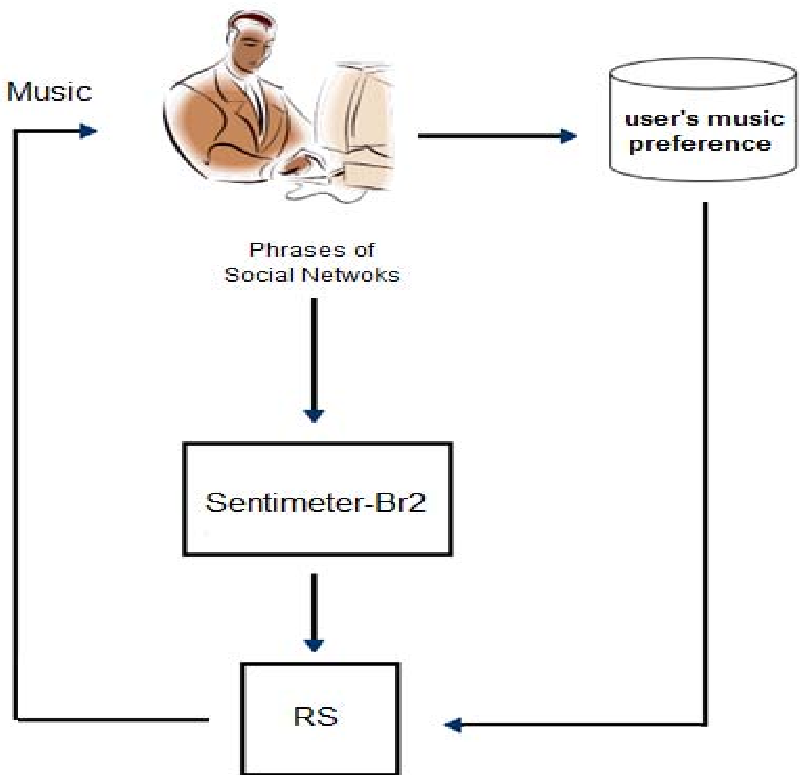 Fig 1. The cyclic framework extracting social media phrases to feed the Recommendation System (RS).
Experiments: Real-World Validation
The researchers conducted a 3-week subjective test with 40 participants. The goal was to compare the Proposed RS (Sentiment-aware) against a Traditional RS (Profile-based).
The findings were striking:
- When users posted negative sentiments, their moods tended to persist for a period of time, making "sad" or "gentle" recommendations highly effective.
- Performance Gap: The sentiment-aware system was rated "Good" by 29 users, while the traditional system only received "Good" ratings from 11 users.
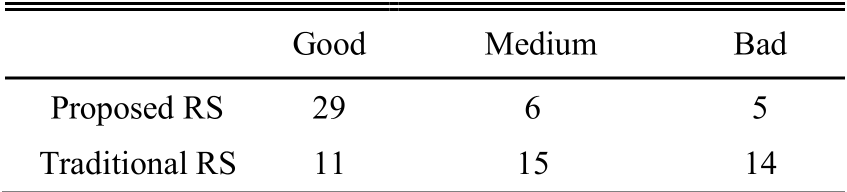 Table 1. Subjective performance results showing the superiority of the Proposed RS over Traditional RS.
Critical Insight: The Value of Emotional Context
The study highlights a significant shift in recommendation philosophy: Emotional Context > Historical Preference. While historical logs tell us what a user normally likes, real-time sentiment tells us what they need right now.
Limitations & Future Work
- Privacy Concerns: Scraping social media data requires high levels of user trust and data permissions.
- Platform Specificity: The current study focuses on text-based platforms. Future versions could integrate multimodal data (emojis, images) to further refine intensity scores.
- Cross-Domain Application: This logic isn't limited to music. Imagine an e-commerce site that suggests "comfort food" or "stress-relief" products when it detects a negative sentiment spike in your recent posts.
Conclusion
By bridge the gap between social media expression and algorithmic recommendation, this paper provides a blueprint for more empathetic AI systems. Sentimeter-Br2 proves that understanding how a user says something is just as important as what they are saying.