
Beyond the Social Echo: Decoding the Orthogonality of Musician Networks and Audio Similarity
6559_Analysis and Exploitation of Musician Social Networks for Recommendation and Discovery.
This paper investigates the relationship between social network structures and audio content similarity within the MySpace artist subnetwork. By employing complex network analysis and Mel-frequency cepstral coefficients (MFCCs), the authors explore whether "social distance" correlates with "acoustic distance" to improve music recommendation and discovery.
TL;DR
Does an artist sound like their friends? This research dives into the MySpace artist network to find out. By comparing the social "top friends" graph with MFCC-based audio similarity, the authors discover that these two worlds are surprisingly independent (orthogonal). However, combining them allows for the creation of far more accurate "musical communities" and smarter playlists than using either data source alone.
The "Silo" Problem in Music Discovery
In the landscape of Music Information Retrieval (MIR), we have two dominant tribes: those who follow the Social Graph (who do you follow?) and those who follow the Signal (what does the waveform look like?).
The problem is that the industry has largely treated these as parallel tracks. If you are in a "Hip-Hop" social circle, does that automatically mean your music is acoustically similar to your peers? Prior to this study, the empirical link between the topology of a social network and the physical properties of the music produced by its nodes remained a "black box."
Methodology: Mapping the MySpace Jungle
The researchers performed a massive "Snowball Sampling" of MySpace, capturing a representative subset of the artist subnetwork. This wasn't just a list of names; it was a complex directed graph where "Top Friends" indicated high-value social capital.
1. The Social Metrics
The team looked at two primary graph metrics:
- Geodesic Distance: The shortest path between two artists in the network.
- Maximum Flow: A measure of the "bandwidth" of connections between a source and a sink, effectively identifying how tightly two artists are bound within the broader community structure.
2. The Acoustic Metrics
They extracted Mel-frequency cepstral coefficients (MFCCs) and used Gaussian Mixture Models (GMMs) compared via Earth Mover’s Distance (EMD) to determine how similar two artists actually sound.
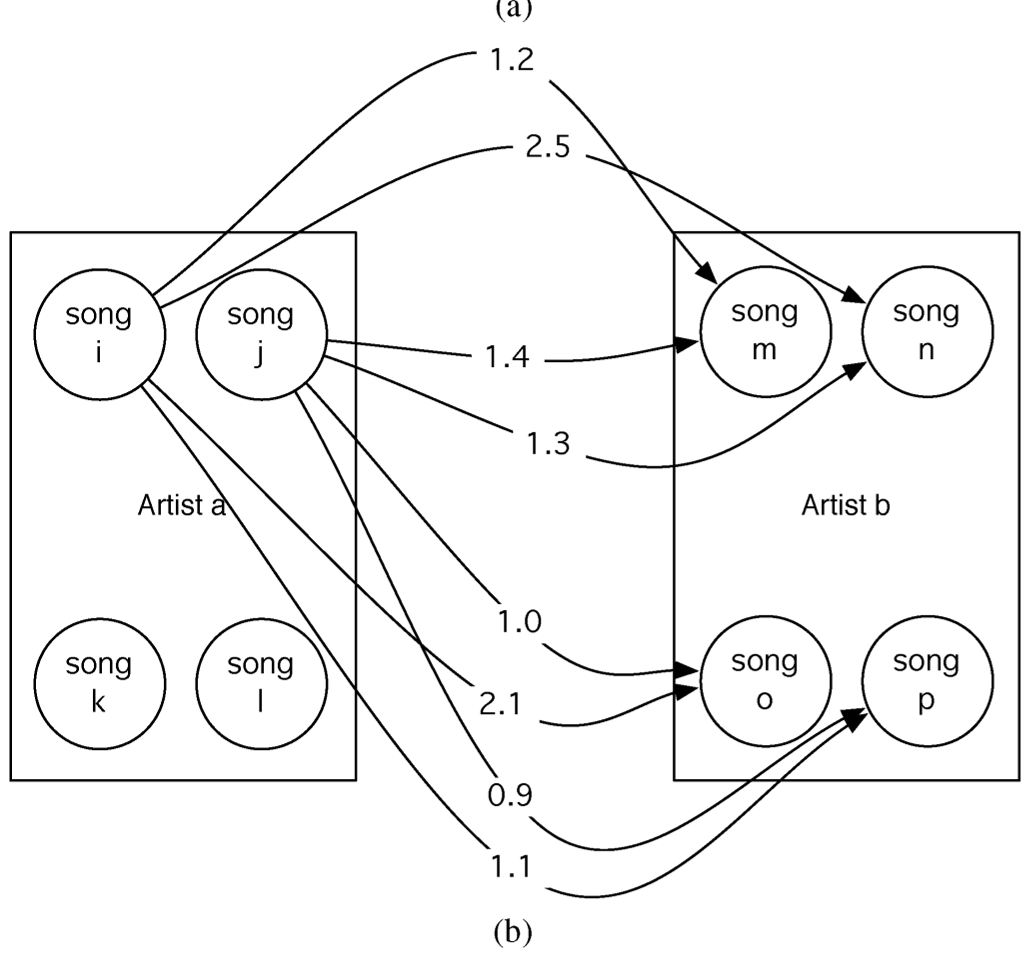 Fig 1: The dual representation of relationships—(a) the direct artist social graph and (b) the expanded song-centric graph.
The "Insight" Moment: Independence is a Strength
The most striking finding of the paper is the orthogonality of the results.
The correlation between social distance and acoustic distance was found to be virtually zero (). Using Information Theory, the authors showed that knowing an artist's social position provides almost no information about their acoustic profile.
Why is this good news? If they were highly correlated, one would be redundant. Because they are independent, a recommendation system that combines both is pulling from two different "knowledge wells," significantly increasing the diversity and accuracy of the results.
Community Detection and Genre Entropy
To prove this value, the authors ran community detection algorithms like Walktrap and Greedy Modularity. They introduced Genre Entropy () to measure how "pure" a community is. If a community identifies a group that all play "Jazz," the entropy is 0.
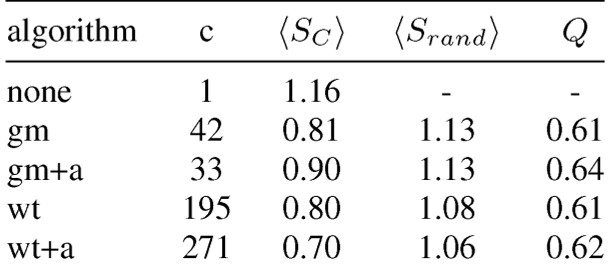 Table 1: Performance of community detection algorithms. Note that 'wt+a' (Walktrap + Audio) achieves the lowest entropy (0.70), proving that audio weights enhance social clustering.
Critical Analysis & Future Outlook
While the paper successfully proves that social and acoustic worlds are distinct, it also highlights a limitation: the "Hip-Hop Hub" effect. Their sample was heavily biased towards specific genres, likely due to the nature of MySpace's user base in the late 2000s.
The Takeaway for Modern AI: This work laid the foundation for what we now see in Spotify's "Discover Weekly" or "Radio" features. It suggests that the "sweet spot" for recommendation isn't just finding a song that sounds like the last one, but finding a song that is socially validated within a cluster that is acoustically coherent.
Conclusion
The MySpace artist network is a "crowd-sourced tangle," but within that tangle lies a structured map of human culture. By refusing to treat social data and audio signals as mutually exclusive, the researchers opened the door to a more "transparent" and multidimensional form of music discovery.