
Beyond the Algorithm: Harmonizing Social Ties and Acoustic Signatures in Music Discovery
3337_Analysis and Exploitation of Musician Social Networks for Recommendation and Discovery.
This paper investigates the relationship between social network structures and acoustic content similarity within the MySpace artist subnetwork. It proposes a hybrid recommendation framework by combining graph theory metrics (Geodesic distance, Max Flow) with audio signal processing (MFCC-GMM) to improve music discovery.
TL;DR
Researchers have long debated whether your musical "social circle" defines your sound. This paper conducts a deep dive into the MySpace artist network, proving that while social connections and acoustic similarity are surprisingly independent (orthogonal), combining them creates a powerful engine for discovering cohesive musical communities and generating superior playlists.
The "Silo" Problem in Recommendation
Most discovery engines are binary: they either use Collaborative Filtering (social/behavioral data) or Content-Based Filtering (audio signals). The former often suffers from popularity bias and the "cold start" problem, while the latter can feel clinical and detached from cultural context. This study explores the "MySpace" ecosystem—the de facto standard for artist promotion at the time—to see if the crowd-sourced tangle of "Top Friends" can be mathematically reconciled with the timber and rhythm of the music itself.
Methodology: Mapping the Musician's Universe
The researchers employed a multi-step pipeline to bridge these two worlds:
- Network Sampling: Using "Snowball Sampling," they crawled over 15,000 artist nodes, focusing on "Top Friends" to filter out social noise and spam.
- Acoustic Modeling: They extracted Mel-frequency cepstral coefficients (MFCCs) to model the "timbre" of each artist, creating Gaussian Mixture Models (GMMs) for every node.
- Cross-Domain Metric: They calculated the Earth Mover’s Distance (EMD) between artists—a measure of the "work" needed to transform one sound distribution into another.
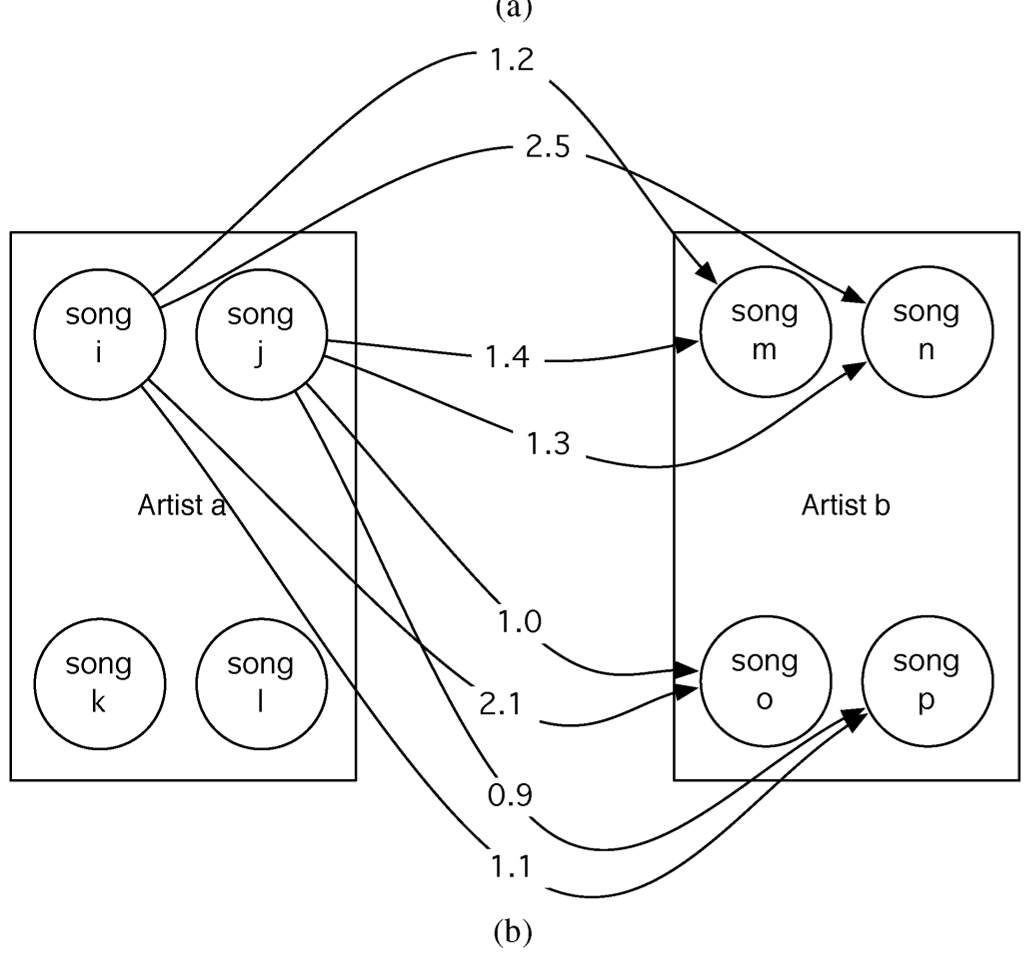 Fig 1: Representing the shift from artist-level social graphs to song-expanded relational models.
Key Insight: The Orthogonality of Sound and Socials
One of the paper's most striking findings is that Geodesic distance (the number of "hops" between artists) has almost zero correlation with how similar they sound. Essentially, you don't necessarily sound like your friends. Using Information Theory, the authors showed that knowing an artist's social position reduces uncertainty about their sound by a negligible 0.1 to 0.4 bits.
However, this independence is actually a benefit. Because they capture different information, the two metrics can be used in tandem to cover the "blind spots" of each other.
Experimental Results: Genre Entropy & Playlists
To prove the value of this hybrid approach, the authors measured Genre Entropy. A lower entropy means a community is more musically "pure."
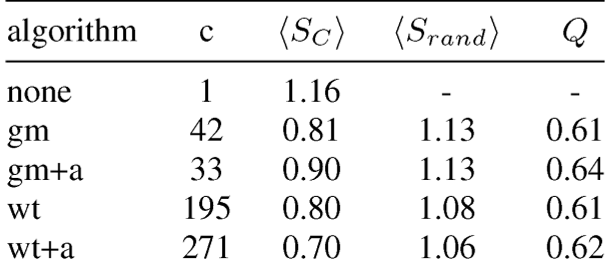 Table 1: Comparison of community detection algorithms. Note how "wt+a" (Walktrap + Audio) achieves the lowest entropy (0.70).
By weighting social edges with audio similarity, the Walktrap algorithm was able to identify communities that were significantly more homogeneous in terms of genre than the social graph alone. This led to the creation of "Max Flow Playlists," which find paths between artists that are both socially connected and acoustically consistent.
Critical Analysis & Future Outlook
Contribution: The paper successfully moves MIR (Music Information Retrieval) from simple signal processing to "Network Ecology." It demonstrates that "Social Playlists" provide a necessary balance between the chaos of random discovery and the boredom of perfectly similar acoustic tracks.
Limitations: The reliance on MySpace’s self-applied genre tags carries inherent human bias. Furthermore, MFCCs primarily capture timbre, potentially ignoring higher-level structural elements like harmony or lyrics.
The Future: As we move into an era of Graph Neural Networks (GNNs), this paper’s intuition remains more relevant than ever. The future of discovery isn't just a better audio filter; it's the ability to navigate the complex social manifold where music lives and breathes.
Conclusion
If you want to find your next favorite artist, don't just look at who they sound like. Look at who their "Top Friends" are, and let the mathematics of Network Flow guide you through the noise.