
MCAR: Optimizing Mobile Social Networks through Mutual Community Intelligence
A mutual-community-aware routing protocol for mobile social networks
The paper introduces the Mutual-Community-Aware Routing (MCAR) protocol for Mobile Social Networks (MSNs), which leverages people's community preferences to optimize data forwarding. It achieves a superior balance between delivery ratio, latency, and resource consumption compared to classical protocols like Epidemic, LABEL, and BUBBLE.
TL;DR
Mobile Social Networks (MSNs) are often disconnected, making traditional routing protocols useless. The Mutual-Community-Aware Routing (MCAR) protocol solves this by quantifying how likely two people are to meet based on their "favorite spots" (communities). By calculating a Social Contact Probability (SCP), MCAR delivers data more reliably than single-copy protocols and more efficiently than flooding-based methods.
Contextual Positioning
In the landscape of Delay Tolerant Networks (DTNs), routing is a game of "blind trust" in relays. This paper sits at the intersection of Social Network Analysis (SNA) and Opportunistic Networking, transforming human daily routines into a mathematical metric for reliable packet delivery.
The Core Problem: The Efficiency-Latency Trade-off
Traditional routing in MSNs typically falls into two extremes:
- Epidemic (Flooding): High delivery rates, but destroys network resources by creating infinite copies.
- Social-based (LABEL/BUBBLE): High efficiency, but often results in high latency because they only consider direct social labels or "popularity" (Centrality) rather than specific meeting probabilities in shared locations.
The authors identify a crucial insight: 90% of human mobility can be captured by just a few "Preferred Communities" (PCs). If we know two people visit the same mall or office, we can predict their "Social Contact Probability" even if they haven't met recently.
Methodology: Quantifying the "Social Encounter"
The MCAR protocol operates through a clever mathematical abstraction of human behavior.
1. Social Contact Probability (SCP)
The protocol defines the relationship between two nodes ( and ) via a mutual community () as: This formula calculates the likelihood of an encounter by multiplying the individual probabilities of each node visiting that specific community.
2. The Two-Phase Protocol
- Phase 1 (Knowledge Exchange): When nodes meet, they synchronize their "PC Tables." This decentralized gossip mechanism ensures that nodes eventually learn the mobility preferences of distant targets.
- Phase 2 (Forwarding Logic): A single-copy strategy. A node forwards a message ONLY if the encountered node has a higher SCP to the destination than itself.
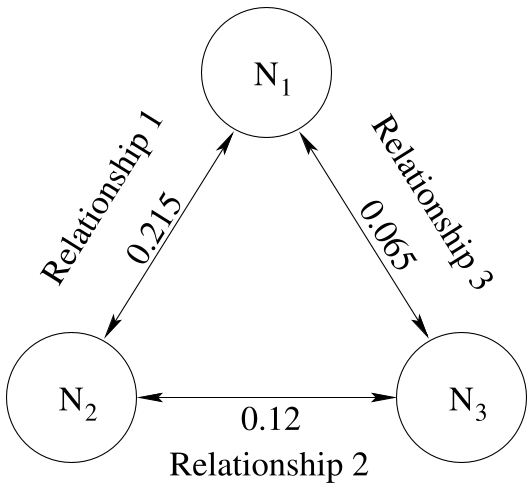 Fig 1: Abstracting physical community visits into a social relationship graph.
Performance and Experimental Results
The authors tested MCAR against a custom mobility model that incorporates the Random Waypoint effect and Social Preferences.
Key Findings:
- Delivery Success: MCAR outperforms LABEL and BUBBLE in delivery ratio, nearing the performance of the resource-heavy Epidemic protocol as time progresses.
- Resource Efficiency: Unlike Epidemic routing, which shows exponential buffer growth, MCAR's buffer usage remains stable and low.
- Latency vs. Hops: MCAR achieves a "sweet spot"—lower latency than BUBBLE/LABEL while maintaining a lower hop count, meaning data takes a more direct social path.
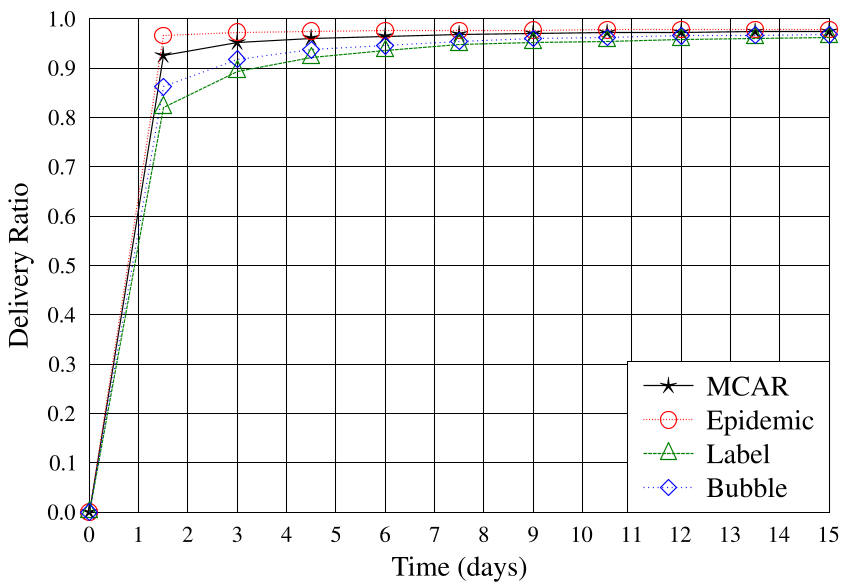 Fig 2: MCAR (solid line with circles) significantly outperforms other single-copy protocols in delivery ratio over time.
Critical Insight & Conclusion
The genius of MCAR is that it doesn't just look at who you know (Labels), but where you go (Communities). By treating physical locations as the "connective tissue" of a social network, it creates a routing metric that is both predictive and lightweight.
Takeaway: For future infrastructure-less networks (like post-disaster comms or localized IoT), leveraging Mutual-Community awareness is far more effective than simple flooding or static social grouping.
Limitations: The model assumes users are willing to share their "Preferred Community" lists, which raises significant privacy concerns in a real-world deployment. Future iterations would likely need to incorporate Differential Privacy or Zero-Knowledge Proofs for PC list exchanges.