
When Helping Hands Reveal Secrets: The Anatomy of Mutual-Friend Based Attacks
Mutual-friend based attacks in social network systems
This paper introduces and analyzes "Mutual-Friend Based (MFB) Attacks," a privacy exploit targeting Online Social Networks (SNSs). It demonstrates how restricted friend lists can be compromised using the seemingly harmless "mutual friend" query feature found in platforms like LinkedIn and Facebook.
TL;DR
The "Mutual Friends" feature, intended to help users connect on platforms like LinkedIn or Facebook, inadvertently serves as a powerful side-channel for privacy leaks. This paper proves that an attacker can reconstruct a user's "hidden" friend list with over 80% accuracy just by performing strategic mutual-friend queries, even if the victim has strict privacy settings enabled.
Contextual Positioning
While most research focuses on De-anonymization (matching anonymous users to identities) or Link Prediction (guessing future connections), this work targets Link Disclosure. It falls into a critical niche: exploiting "intended functionality" to bypass "intended security."
The Core Intuition: Why Privacy Fails
The research identifies a logical paradox in SNS architecture. A user (Alice) may set her friend list to "Private" to hide her connection to a specific recruiter. However, the system allows her boss (Bob) to query "Mutual Friends between me and the recruiter." If Alice is the result, her "Private" connection is instantly exposed.
The authors argue that this isn't just an edge case but a systematic vulnerability rooted in Mutual Friend Structures.
Methodology: Graph Triangulation
The paper decomposes the attack into two primary categories based on the attacker's visibility of the target.
1. Basic Attack Structures (BAS)
The authors identify specific graph motifs that leak information:
- Linear Structures: Utilizing a middle-man to confirm the connection between a target and a hidden third party.
- 3-Clique Structures: Using the mutual connection within a tight-knit subgroup to confirm high-probability links.
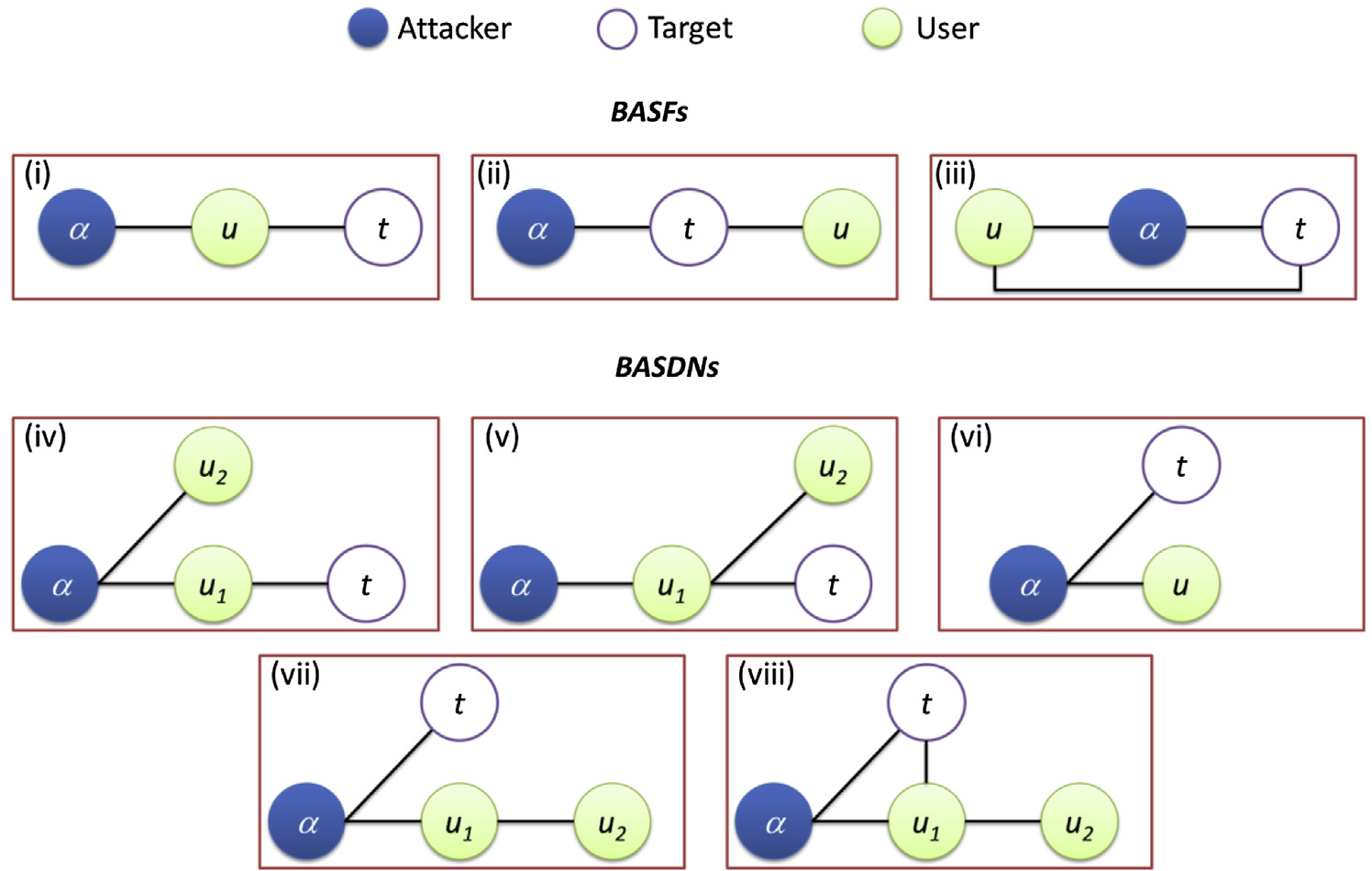
2. Exploiting Implicit Groups
A "Brute Force" query of the entire network is inefficient and likely to be flagged. Instead, the authors suggest querying Implicit Groups—users who share public attributes with the victim (e.g., attending the same university or working at the same company). This focuses the "search space" on the people most likely to be the victim's friends.
Performance & Experiments
The researchers tested their methodology on a legacy Facebook dataset (New Orleans network) consisting of ~63k users and 1.5M links.
- Friend Exposure: When using groups based on user attributes (like professional affiliations), attackers achieved a 64.6% to 76.1% exposure rate of the victim’s friends.
- Distant Neighbors: While a single attacker node struggles to map 2nd and 3rd-degree neighbors, a Multi-Node Attack (controlling several accounts) successfully identified 67.2% of a target's distant neighborhood.

Deep Insight: The Policy Conflict
The authors conclude that the vulnerability is caused by Policy Conflicts.
- User A wants to hide their friend list.
- User B (a friend of A) has a setting that allows public mutual friend queries.
Current SNS platforms lack the "negotiation" mechanism to resolve these conflicting intentions. When User B's "allow" policy meets User A's "deny" policy, the system defaults to exposure to maintain functionality.
Conclusion & Future Outlook
This paper serves as a wake-up call for designers of social graph APIs. To defend against MFB attacks, platforms must:
- Limit the frequency and scope of mutual friend queries.
- Implement "negotiated privacy" where the visibility of a link requires the consent of both parties involved.
- Consider adding "noise" or limiting searchability for users who opt for high-privacy profiles.
Ultimately, the work reminds us that in a connected world, your privacy is not just in your hands—it is also in the hands of everyone you know.