
Mutual Privacy: Redefining Security in Social Participatory Sensing
Mutual Privacy Preserving $k$ -Means Clustering in Social Participatory Sensing
This paper introduces a robust mutual privacy-preserving k-means clustering scheme designed for social participatory sensing. It features two novel algorithms that utilize additive homomorphic encryption and random perturbation to protect both individual participant data and community cluster characteristics, achieving k-means convergence without revealing intermediate results.
TL;DR
In the era of Big Data, Social Participatory Sensing allows communities to build collective "maps" of health, location, or activity. However, the conflict between data utility and privacy is sharp. This paper presents a novel k-means clustering architecture that provides mutual privacy—ensuring that neither the users’ raw data nor the community’s cluster centers are ever exposed, even under extreme collusion scenarios.
The Motivation: Why Encryption Isn't Enough
Most current privacy-preserving k-means solutions focus solely on the participant. They treat the "Data Analyst" (the server) as a trusted entity or assume that participants won't talk to each other. However, in real-world social networks:
- Cluster Centers are Secrets: Knowing the "average" health or location of a specific cluster can stigmatize groups or reveal sensitive community distributions.
- Intermediate Leaks: During the iterative k-means process, leaking which users belong to which cluster can allow an attacker to reconstruct the dataset.
- Collusion: If the server colludes with a few malicious users, traditional systems often collapse, revealing the private data of honest participants.
Methodology: The Two-Stage Shield
The authors propose a dual-algorithm iteration that keeps all parties "in the dark" about everything except their final result.
Stage 1: Finding the Nearest Cluster (Blindly)
Instead of sending cluster centers to the user, the Data Analyst sends randomly perturbed differences. The user calculates their distance to cluster centers using these perturbed values. Because the perturbation factor is positive, the sign of the distance comparison remains the same, allowing the user to find the nearest cluster without ever knowing the actual coordinates of the centers.
Stage 2: Updating Centers via Homomorphic Slicing
To update centers, the sum of all points in a cluster must be calculated. The authors use the Paillier Cryptosystem, which is additively homomorphic (the product of ciphertexts equals the ciphertext of the sum).
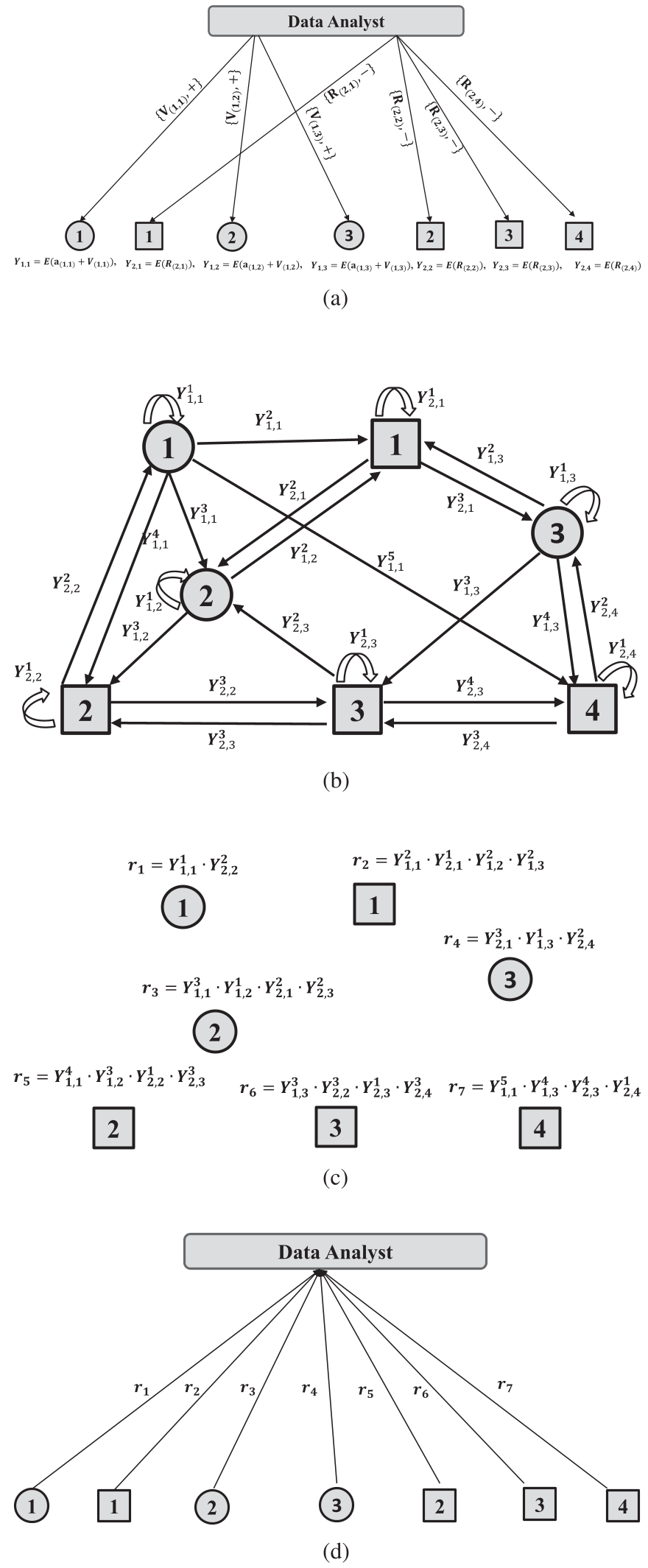 Figure 1: The slicing and distribution process for secure center computation.
To prevent the analyst from seeing individual contributions, each user "slices" their encrypted data into pieces, shares pieces with other users, and keeps one. The analyst eventually receives aggregated "shuffles," ensuring they only see the final sum for each cluster after decryption.
Experimental Results: Security without Sacrifice
The researchers tested their scheme against three diverse datasets: Health data (blood pressure), Location traces, and Smartphone activity.
- Accuracy: In all cases, the privacy-preserving centers converged to almost the exact same points as a standard, non-private k-means algorithm.
- Precision: Evaluation metrics for location and health data showed Accuracy and Recall scores exceeding 98-99%.
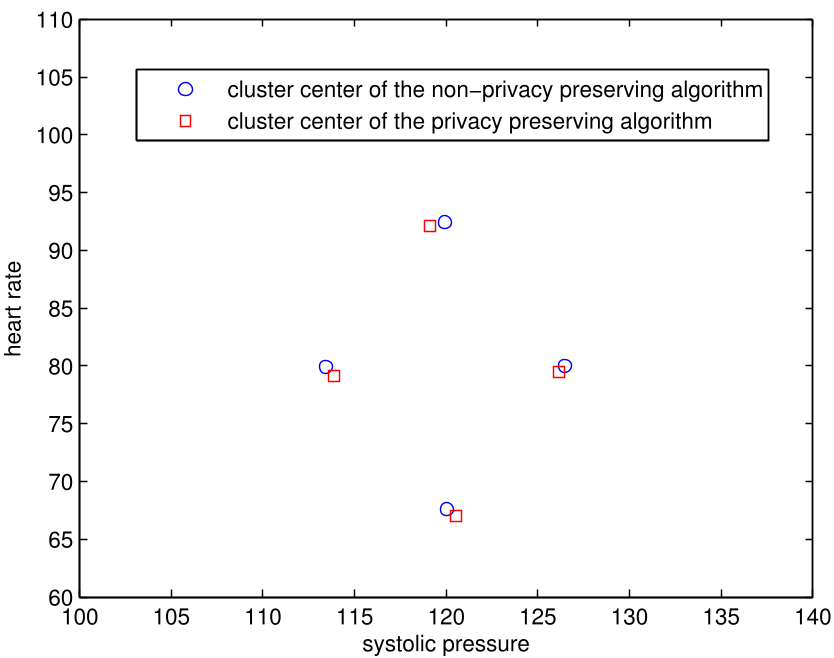 Figure 2: The calculated cluster centers (blue) perfectly align with the general k-means centers (red).
Critical Insight: The "Why" Behind the Success
The genius of this approach lies in its Collusion Resistance. By combining homomorphic encryption with a decentralized data-slicing step, the authors create a "zero-trust" environment. Even if the Data Analyst gains access to participants' accounts, the remaining participant's data remains safe because their "secret slice" was never shared with the colluding parties.
Conclusion and Future Outlook
This paper moves beyond simple data anonymization. It provides a blueprint for Mutual Privacy, a prerequisite for any truly secure social sensing application. While the computational overhead of Paillier encryption is higher than standard math, the authors prove it is manageable for the benefits of total privacy. Future work will likely look into applying these mutual privacy principles to more "fuzzy" or non-linear clustering models like GMM.
Key Takeaway: In the future of social sensing, privacy isn't just about hiding who you are; it's about hiding the very patterns the community creates together.