
My Tai-Chi Book: Deepening Social Connection through Virtual-Physical Integration
My Tai-Chi book: a virtual-physical social network platform
The paper introduces "My Tai-Chi Book," a novel virtual-physical social network platform that integrates Body Area Sensor Networks (BSNs) with conventional web-based social networks. It enables users to share real-time physical motions and gestures, exemplified through a collective Tai-Chi exercise application.
TL;DR
"My Tai-Chi Book" is a pioneering platform that merges wearable Body Sensor Networks (BSNs) with social media to allow users to interact via physical gestures. By capturing real-time skeletal data, the system enables remote group exercises like Tai-Chi, moving social interaction beyond the static limitations of text and video into the realm of embodied digital presence.
The Problem: The "Virtual-Physical" Gap
Most modern social media platforms—Facebook, Twitter, and YouTube—are fundamentally "virtual" and "passive." Communications are mediated via keyboards and screens. While these platforms connect us globally, they separate our digital lives from our physical bodies.
The authors identify a missing spectrum in social networking: the Physical Community. Unlike camera-based systems that require expensive setups and specific environments, this work envisions a world where your physical "pose" and "movement" become data points as shareable as a status update.
Methodology: The 3-Tier Architecture
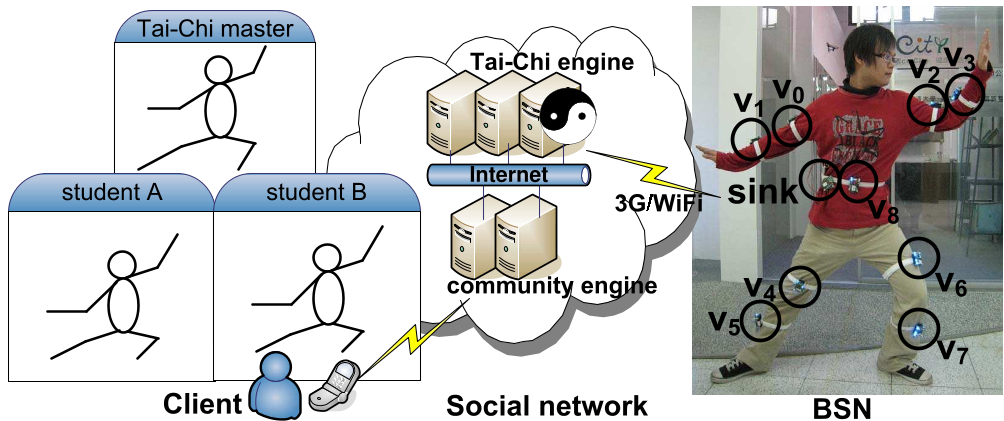
The system bridge the physical and virtual worlds using three core components:
1. The Body Sensor Network (BSN)
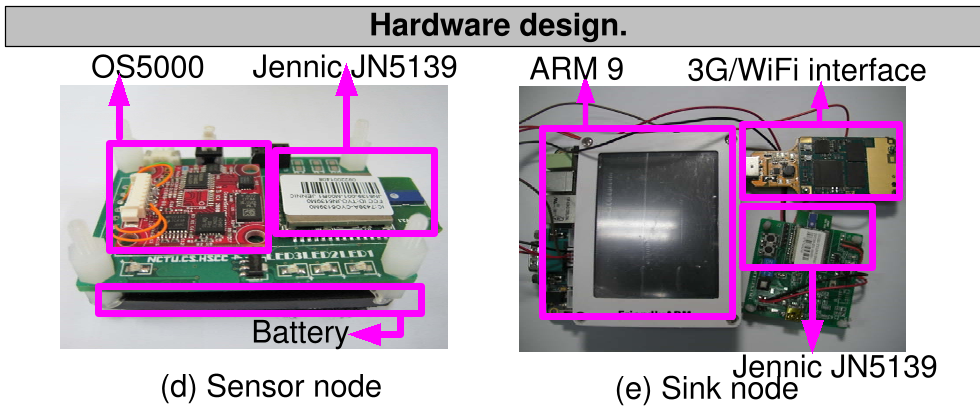
The user wears a BSN consisting of 9 sensor nodes (v0 to v8). Each node is equipped with:
- A 3-axes accelerometer.
- A digital compass (OS5000).
- A wireless module (Jennic JN5139) used for data transmission at 30Hz.
This ensemble captures the orientation and movement of limbs, allowing the system to calculate the relative angles () of the human skeletal structure.
2. The Tai-Chi & Community Engine
The "Tai-Chi Engine" acts as the brain. It takes raw sensory data and maps it to a human body model. It leverages local databases to store these movements, allowing for "make-up classes" where students can follow a master's recorded motion history.
3. Client Rendering
Using 3D graphic libraries, the data is rendered on a web interface (integrated into Facebook). This allows a "Tai-Chi Master" to lead a class where students see a 3D avatar of the master and themselves, ensuring they are following the forms correctly.
Experiments and Results
The demonstration involved a master and two students. The researchers monitored the x-axis acceleration logs of several key nodes (v0 to v3) over a 30-second frame. The results indicated that the sensors were sensitive enough to differentiate between subtle Tai-Chi transitions, and students were able to effectively mirror the master's movements in the virtual space.
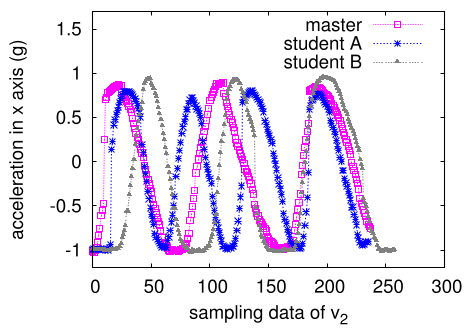 Figure 5 illustrates the high level of synchronization achievable between the master and his students using the BSN data.
Critical Analysis & Conclusion
Takeaway
This paper, published in early 2010, was remarkably prescient. It accurately predicted the trend towards Pervasive Computing, where social networks are no longer just apps on a phone, but integrated layers of our physical reality. The transition from "keyboard-based" interaction to "motion-based" interaction is a cornerstone of current XR (Extended Reality) development.
Limitations
- Hardware Bulk: Wearing 9 nodes is cumbersome for a casual user compared to today's single-smartwatch or vision-based tracking solutions.
- Connectivity: The 2010-era 3G/WiFi interface likely faced latency issues that would be solved today by 5G or better edge computing.
Future Outlook
While this research used Tai-Chi as a case study, the underlying "Virtual-Physical" framework applies to remote physical therapy, dance training, and even industrial safety monitoring. By turning the human body into an input device, "My Tai-Chi Book" laid the groundwork for the modern embodied Metaverse.