
My3: Breaking the Big-Brother Monopoly with Decentralized Social Replication
My3: A highly-available P2P-based online social network
The paper introduces My3, a decentralized P2P online social network (OSN) designed to provide user-controlled privacy and high data availability. It utilizes a "Trusted Proxy Set" (TPS) and specialized replication algorithms to ensure profile accessibility even when the owner is offline.
TL;DR
My3 is a privacy-centric, P2P-based social network that eliminates the need for a central authority (like Facebook). By leveraging the "trust" between friends and analyzing their online habits, it creates a highly available replication system that ensures your profile stays online even when you are not, all while keeping you in total control of your data.
The Motivation: Escaping the "Big-Brother" Data Silos
Mainstream Online Social Networks (OSNs) operate on a centralized model where a single entity controls the servers, the data, and the access. This "Big-Brother" architecture leads to two critical failures:
- Privacy Erosion: Service providers mine user data for targeted advertising and business intelligence without explicit user transparency.
- Lack of Control: Users cannot dictate who stores their data or how it is processed.
While decentralized alternatives exist, they often fail because data disappears when a user goes offline. My3 addresses this by asking: Can we use our friends' resources to keep the network alive?
Methodology: Social Trust Meets Predictive Availability
The core innovation of My3 lies in its Trusted Proxy Set (TPS). Instead of a server farm, your profile is stored on the devices of friends you actually trust.
1. The Online Time Graph
My3 doesn't just pick friends at random; it analyzes geographical locations (time zones) and online patterns. It builds an Online Time Graph where:
- Vertices are friends.
- Edges represent overlaps in online time windows.
- The Goal: Ensure that for every friend who wants to see your profile, there is at least one trusted proxy who is online at the same time as .
2. Replication Strategies
The system offers two distinct algorithms to manage these proxies:
- MNR (Minimize Number of Replicas): Uses the Minimum Connected Dominating Set (MCDS) theory to find the smallest number of trusted friends needed to cover the entire social circle. This minimizes storage overhead.
- MAC (Minimize Access Cost): Prioritizes low latency by placing data on trusted nodes that are geographically/network-wise "closest" to each friend.
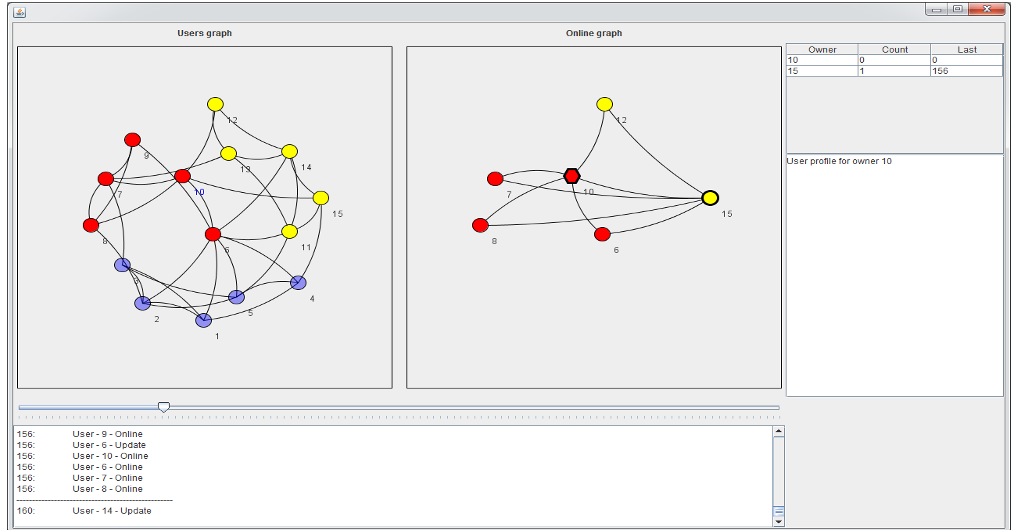 Fig 1: The My3 Visualization showing the Social Graph (left) and the Online Time Graph (right) for a specific user.
System Mechanics & Results
My3 utilizes a Distributed Hash Table (DHT) to store metadata, such as current IP addresses, making it easy for clients to find the TPS members.
- Update Propagation: When a friend leaves a comment or update on a replica (mount point), the system propagates these changes across the TPS.
- Eventual Consistency: Even if multiple friends update different replicas simultaneously, the system ensures that all replicas eventually converge to the same state.
The demonstration proves that social trust is a viable substitute for centralized infrastructure. By utilizing the predictable nature of human online behavior (e.g., office hours, time zones), My3 maintains profile availability that rivals centralized services without the privacy trade-offs.
Critical Analysis & Conclusion
Takeaway: My3 successfully shifts the OSN paradigm from "service-provider-as-trust-anchor" to "community-as-trust-anchor." It provides a mathematically grounded way to ensure data availability in a P2P environment.
Limitations:
- Scalability of Trust: As a user’s social circle grows, finding a "connected" graph of only trusted friends who cover all time slots might become difficult.
- Mobile Constraints: The paper was written when mobile data and battery were major constraints; today, the cost of being a "proxy" on a smartphone might be a barrier to entry.
Future Outlook: The principles of My3—predictable availability and social replication—are more relevant than ever as we move toward "Web3" and local-first software. Integrating these concepts into modern protocols like IPFS could provide the privacy and uptime that current decentralized networks still struggle to balance.