
Decoding the Social Commercial: Classifying Profiles to Safeguard Privacy
Classification of commercial and personal profiles on MySpace
This paper presents a classification framework to distinguish between commercial and personal profiles on MySpace using a C4.5 (J48) decision tree algorithm. The authors leverage unique publishing characteristics and metadata—such as age distribution and friend-to-publisher ratios—to achieve a classification accuracy of up to 96.42%, subsequently applying this to a Privacy-Preserving Data Publishing (PPDP) service.
TL;DR
As social networks like MySpace (and their modern successors) evolved into marketing hubs, the line between personal interaction and commercial branding blurred. This paper introduces a robust methodology to automatically detect commercial profiles using decision trees and proposes a "Privacy Avatar"—a proxy system that interacts with commercial entities on behalf of users to maintain their anonymity and block targeted tracking.
Problem & Motivation
The rise of "Branding" on social media has turned personal spaces into data goldmines for corporations. While users expect a peer-to-peer experience, they are often interacting with commercial entities designed to harvest data for systems like Facebook’s (at the time) Beacon advertisement system.
The authors' core insight is that commercial profiles behave differently than humans. For instance, a band or a product page might have thousands of "friends," but the interaction (wall posts) is often a "one-and-done" event rather than a continuous dialogue. By identifying these structural fingerprints, we can build tools that automatically wall off commercial trackers.
Methodology: The C4.5 Decision Tree
The researchers opted for the J48 algorithm (a Java implementation of Ross Quinlan’s C4.5). The beauty of this approach lies in its "Information Entropy" calculation—it mathematically determines which attribute (Age, Gender, or Friend Count) provides the cleanest "split" to identify a commercial account.
Breaking Down the Indicators
- Gender Neutrality: Commercial profiles are overwhelmingly "Gender Neutral" (99.9% public).
- Age Anomalies: While humans cluster between ages 15-30, commercial accounts often default to "Age 0" or extreme outliers.
- The "Active Friend" Gap: In personal accounts, friends often post repeatedly. In commercial accounts, the "Publisher vs. Friend" ratio is skewed; they have massive friend lists but very few repeat publishers.
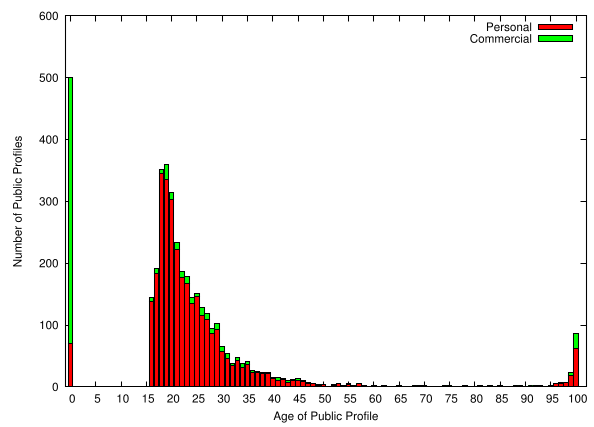 Fig 1. Note the distinct clustering of commercial vs. personal accounts across demographic lines.
Experimental Results
The study compared the J48 classifier against Neural Networks (NN), Support Vector Machines (SVM), and Naive Bayesian models. J48 emerged as the clear winner, maintaining high precision even when the number of attributes was reduced to simplify the data collection "cost."
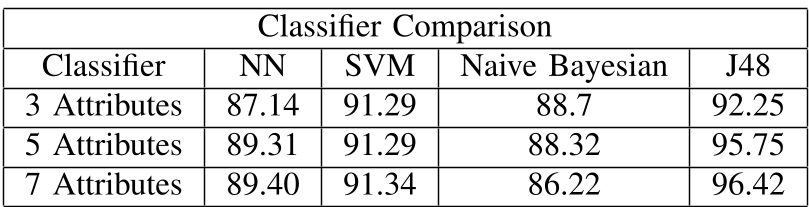 Table 1. The J48 classifier achieves superior accuracy (up to 96.42%) compared to more complex models.
Practical Application: The Privacy Avatar
The most innovative part of this work is the Privacy Avatar Architecture. Instead of just warning the user, the system uses a transparent proxy. When a user tries to post on a "commercial" wall, the Avatar intercepts the request and posts as a generic, anonymous entity.
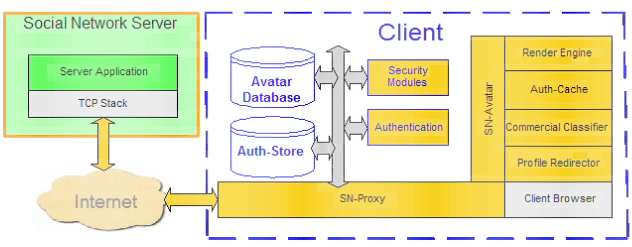 Fig 2. The Archeritecture of the Avatar system, showing the intercept/impersonate/re-render loop.
This creates a "buffer zone" where:
- The OSN sees the Avatar's data.
- The User stays anonymous.
- The System filters out SPAM and Malware before it reaches the user's actual wall.
Critical Analysis & Conclusion
This paper provides a foundational look at how structural metadata is often more revealing than content. While modern platforms have more sophisticated bots, the fundamental principle—that commercial behavior leaves a distinct mathematical footprint in "friendship" graphs—remains valid.
Limitations: The study is specific to the MySpace era. Modern LLM-driven bots could easily spoof the "age" and "comment frequency" patterns described here. However, the concept of a Privacy Avatar is more relevant than ever in an age of pervasive tracking and "shadow profiles." Future work could involve using these avatars to provide a layer of protection against modern AI-based social engineering.