
MySpace Archeology: Deciphering the DNA of Early Social Networking
Analysis of MySpace user profiles
This paper performs a large-scale empirical analysis of MySpace user profiles to characterize social networking behaviors. Utilizing a dataset of 1.9 million profiles collected over 12 weeks, the study identifies distinct user classes based on participation levels and highlights the prevalence of extensive personal data sharing among active users.
TL;DR
This seminal 2009 study by Luisa Massari provides a technical autopsy of MySpace at its peak. By analyzing 1.9 million profiles, the research uncovers the mathematical distribution of digital fame and self-disclosure. It reveals that while most users are moderately active, they are surprisingly "open books," sharing over 50% of their private details—a precursor to the modern privacy crisis.
Background Positioning
In the Web 2.0 evolution, this work stands as a transition from simple graph theory to systematic workload characterization. Unlike studies that only look at "who follows whom," Massari dives into the content of the profile—age, location, and the "Amount of Details"—to categorize the human behavior driving the servers.
The Problem: The Myth of the Passive User
Prior research suggested social networks were dominated by "lurkers" (passive users). Massari challenges this by looking at interaction depth. The difficulty lies in the "long tail" of social data: how do you meaningfully compare a user with 2 friends to an "influencer" with 29,000? Most existing models failed to integrate the intensity of personal data disclosure as a primary variable.
Methodology: The Geometry of Social Behavior
The core innovation is the application of K-means clustering across three critical dimensions:
- Social Reach: Number of Friends.
- Engagement Intensity: Number of Comments.
- Self-Disclosure Index: The "Amount of Details"—a calculated percentage of optional fields filled (e.g., income, religion, education).
The User Segmentation Model
The author identifies four distinct "Species" of users inhabiting the MySpace ecosystem:
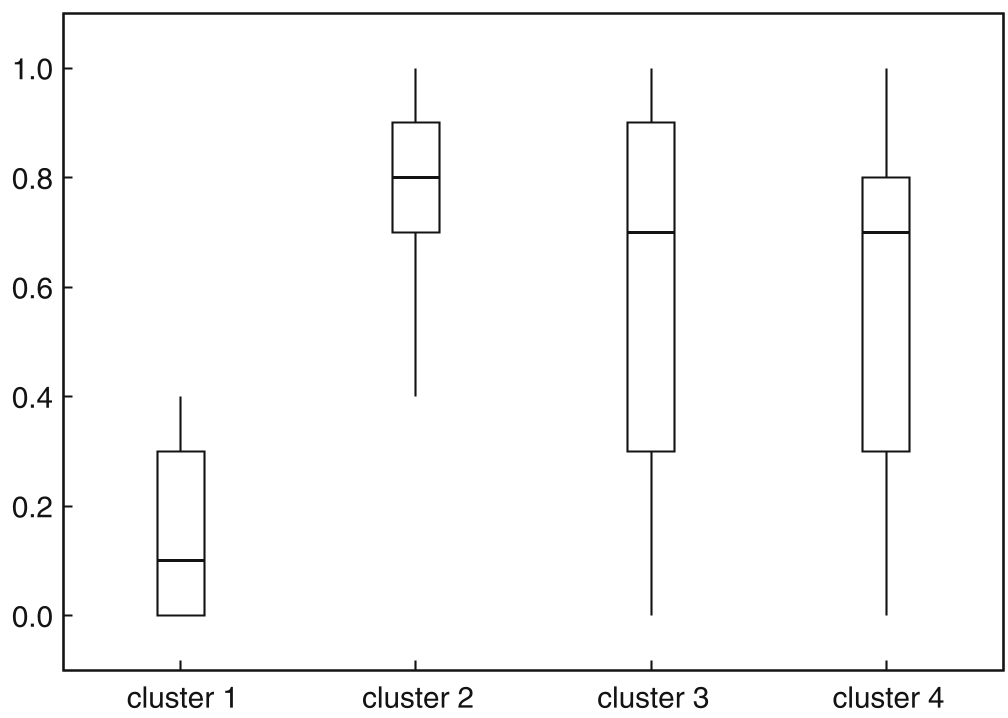
- The Minimalists (Cluster 1): Low friends (52), low data sharing (15%).
- The Standard Participants (Cluster 2): The largest group; moderate friends (124) but high data sharing (79%).
- The Socialites (Cluster 3): High engagement (2,183 comments).
- The Power Hubs (Cluster 4): The 0.1% with over 10,000 friends.

Experiments & Results: The "Long Tail" of Digital Popularity
The data confirms a heavy-tailed distribution (Power Law). While the average age is 27, the "youth bulge" (under 20) accounts for 25% of the platform and exhibits the highest "Friendship Velocity."
Key Insight: The Loyalty Metric
The study explores "Loyalty"—how many comments a user leaves per profile. Most users are "non-loyal," adding only 1-2 comments per friend. However, the "Super-Popular" users (Cluster 4) act as massive gravity wells, attracting thousands of comments from diverse, distinct users.
The Privacy Paradox
One of the most striking findings is the Amount of Details. As shown in the Box-and-Whisker plot below, Cluster 2 (the majority) has a median detail sharing of nearly 0.8 (80%). This suggests that in the early social media era, "Normal" users were significantly more likely to over-share than the "Power Users" of Cluster 4.
Critical Analysis & Conclusion
Takeaway
Massari’s work proves that social popularity and privacy are inversely correlated in complex ways. While power users have more "friends," the average user provides the richest dataset for potential non-ethical harvesting.
Limitations
The study is a "snapshot" in time (12 weeks). It treats the "Amount of Details" as a static metric without accounting for the truthfulness of the data—a common issue in self-reported digital profiles.
Future Impact
This paper laid the groundwork for modern Social Computing. Today’s algorithms on X (Twitter) or Instagram are essentially hyper-optimized versions of these clusters, designed to move users from "Minimalists" to "Socialites" to maximize the platform's data-driven value.
Editor's Note: This research serves as a reminder that the privacy risks we face today were baked into the architecture of social media over a decade ago.