
N2TM: Unmasking Sophisticated Crowdsourcing Spammers via Trust Topology
N2TM: A New Node to Trust Matrix Method for Spam Worker Defense in Crowdsourcing Environments
This paper introduces N2TM (Node to Trust Matrix), a novel defense mechanism designed to identify spam workers in crowdsourcing environments. By representing worker nodes as un-manipulable Worker Trust Matrices (WTM) and employing a CNN-based classifier (CLnet-6), the method achieves state-of-the-art performance in detecting sophisticated spammers who use collusive "guises" to mimic honest behavior.
TL;DR
Spam workers in crowdsourcing platforms have evolved. By colluding with "grey" requesters, they create fake reputations (guises) that bypass traditional filters. N2TM (Node to Trust Matrix) counters this by encoding a worker's entire trust network position into a matrix and using a CNN to sniff out the "structural tells" of collusion that no amount of fake ratings can hide.
The "Guise" Crisis in Crowdsourcing
Crowdsourcing platforms like Amazon Mechanical Turk are plagued by a trust crisis. The paper identifies two primary ways spammers trick the system:
- G1 (Manipulated Trust): Spammers perform "shadow tasks" for colluding requesters to inflate their approval rates.
- G2 (Fake Trust Link): Spammers link themselves to honest-looking nodes through intricate paths of collusion.
Most current SOTA defenses look at what a worker did (approval rates) rather than where they sit in the social fabric. This paper argues that while you can fake a rating, it is significantly harder to fake a global structural position in the network.
Methodology: From Graph to Matrix
The authors propose a bipartite Crowdsourcing Trust Network (CTN) where requesters and workers are nodes. The core innovation is the Worker Trust Matrix (WTM).
1. Generating Trust Traces
Instead of a single score, N2TM calculates a "Trust Trace" for every requester-worker pair across multiple "hops" (r-w-r-w).
- Positive Trust Indicators: Sum of trust values along trustworthy paths.
- Trust Penalties: Deductions for paths that end in a "distrust" edge.
2. The WTM Structure
By organizing these traces into a matrix, the authors create a "spatial" representation of a worker’s identity. The paper provides a mathematical proof for the Un-manipulable Gold Standard: Because a spam worker's behavior is fundamentally different from an honest worker's (they rarely succeed in truly honest tasks), their structural footprint in the WTM remains distinct.
 Figure 1: The general framework of N2TM showing the transformation from network nodes to WTM inputs for deep learning.
3. CLnet-6: The Neural Sieve
The authors treat the WTM as an "image" of trust. They use CLnet-6, a 6-layer CNN, to detect the latent structural patterns that characterize grey and spam workers. Max-pooling and standardization layers ensure the model is robust against local noise in the trust network.
Experimental Battleground
The researchers tested N2TM against classic baselines (AMT, H2010e) and graph-embedding methods (Deepwalk, SybilDefender) across four datasets including wiki-RfA and soc-sign-epinions.
Key Performance Metrics
- Spam Detection: On the wiki-RfA dataset, N2TM achieved an F-measure of 0.96, while competitive models like Deepwalk struggled at 0.0872.
- Resilience to Collusion: Even when 50% of a spammer's edges were fake (G2 guise), N2TM's precision remained remarkably high.
 Table 1: Performance comparison. Note how traditional trust-value models (AMT/H2010e) completely fail to identify spam workers when guises are present.
Why It Works: Academic Insight
The real "aha!" moment is the test error analysis. The authors compared the CNN-based CLnet-6 against Logistic Regression and Multi-Layer Perceptrons. The CNN significantly outperformed them because it could capture spatial correlations between different trust traces—essentially understanding how one requester's trust relates to another's distrust.
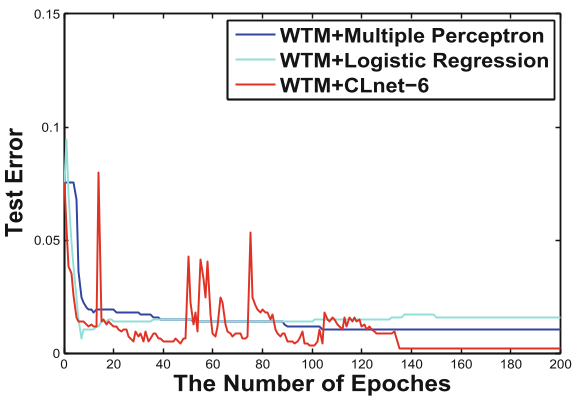 Figure 2: Convergence of CLnet-6 compared to simpler learning algorithms, demonstrating the value of capturing spatial trust features.
Conclusion & Future Outlook
N2TM shifts the paradigm from "behavior monitoring" to "structural auditing." While the current model is supervised (requires labeled data), it provides a powerful blueprint for future unsupervised systems. If you are building a marketplace, social network, or crowdsourcing platform, N2TM's approach to the "identity matrix" is the most robust shield currently available against coordinated collusion.
Limitations: The high computational cost of random walks for very large graphs and the reliance on labeled training data for the CNN are areas for future optimization.