
Positivity Pays Off: How Emotional Valence Shapes Twitter Relationships
Analyzing Influence of Emotional Tweets on User Relationships by Naive Bayes Classification and Statistical Tests
This study investigates how emotional tweet content influences Twitter user relationships by employing Naive Bayes Classification to categorize tweets as positive, negative, or neutral. Utilizing the Brunner-Munzel statistical test, the researchers found that positive users experience significantly higher fluctuations in followees, followers, and mutual connections compared to negative users.
TL;DR
Does being "positive" online actually help you make more friends? This study confirms that on Twitter, users who post positive content are significantly more successful at building mutual relationships than negative users. By leveraging Naive Bayes Classification and the robust Brunner-Munzel statistical test, the authors demonstrate that positive emotional expression acts as a catalyst for network growth, while negativity leads to stagnant social metrics.
Problem & Motivation: Beyond Keyword Matching
In the real world, a cheerful personality often attracts more friends. Does this "social law" translate to the digital sphere?
Previous attempts to answer this used simple keyword matching (e.g., checking if a tweet contains words like "happy" or "sad"). However, this approach is brittle because:
- It cannot handle words not present in a pre-defined dictionary.
- It misses the context-rich nature of Japanese particles and slang.
- It often fails to distinguish between a "neutral" statement and an "emotional" one.
The authors sought to move beyond these constraints by using machine learning to classify the underlying sentiment of a user's entire tweet history and then tracking how their follower/followee counts changed over time.
Methodology: The Core Framework
The researchers followed a multi-stage pipeline to bridge natural language processing (NLP) with statistical sociology.
1. Data Collection and Labeling
They sampled 600 Japanese users with 20-40 followers (aiming for "average" users rather than celebrities or bots). After manual labeling of a training set, they built a Naive Bayes classifier.
2. Emotion Scoring
User sentiment wasn't just a binary label. The authors calculated an Average Emotion Score:
- Positive (P) Tweet: +1
- Negative (N) Tweet: -1
- Neutral (Nt) Tweet: 0 (Excluded from final score calculation)
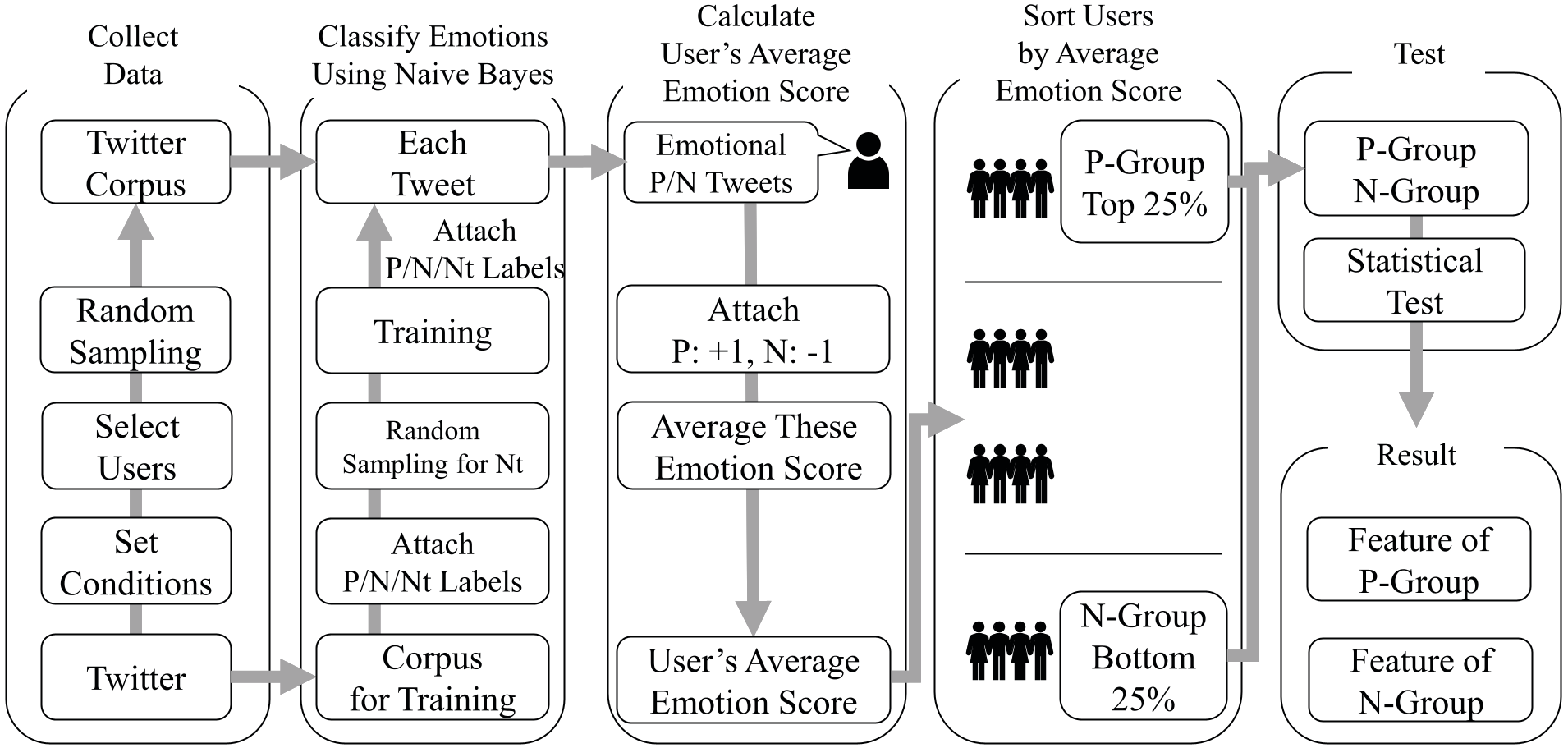 Fig 1: The workflow from tweet acquisition to P/N group classification.
3. The Brunner-Munzel Test
In social science data, "normality" is rare—data is often skewed. Instead of using a standard t-test, the authors utilized the Brunner-Munzel test, which is robust to unequal variances and non-normal distributions, to compare the P-Group (top 25% scorers) and N-Group (bottom 25% scorers).
Experimental Results: The Power of Positivity
The findings were striking. While the total number of tweets post by both groups didn't differ significantly, their social impact did.
| Metric | P-Group (Median) | N-Group (Median) | Significance |
|---|---|---|---|
| Followee Fluctuation | 2.000 | 0.000 | p < 0.01 |
| Follower Fluctuation | 1.000 | 0.000 | p < 0.01 |
| Mutual Follow Fluctuation | 0.000 (Mean 3.39) | 0.000 (Mean 1.35) | p < 0.01 |
 Table 1: Statistical comparison showing clear advantages for the Positive Group.
Key Insights:
- Bilateral Growth: Positive users don't just get followed more; they also follow back more. This suggests that positivity fosters a reciprocal loop where mutual relationships are constructed.
- Negativity Stagnation: Negative users showed near-zero median growth in relationships. Their content effectively acts as a deterrent to new connections.
Critical Analysis & Conclusion
This paper provides empirical evidence for the "socio-emotional" bias in network growth. However, there are notable limitations:
- Sparsity of Sentiment: Only about 1.2% of human-labeled tweets were clearly emotional, yet the Naive Bayes model classified nearly 50% as emotional. this "over-classification" suggests the model might be picking up on subtle linguistic cues that humans overlook—or it might be prone to noise.
- Neutral Ambiguity: 99% of training data was neutral. The authors handled this by downsampling, but moving to an "Uncertain" category for vague tweets could significantly boost future accuracy.
Takeaway: If you want to expand your social reach on platforms like X (Twitter), positivity isn't just a mood—it's a strategic advantage for building mutual, lasting digital relationships.
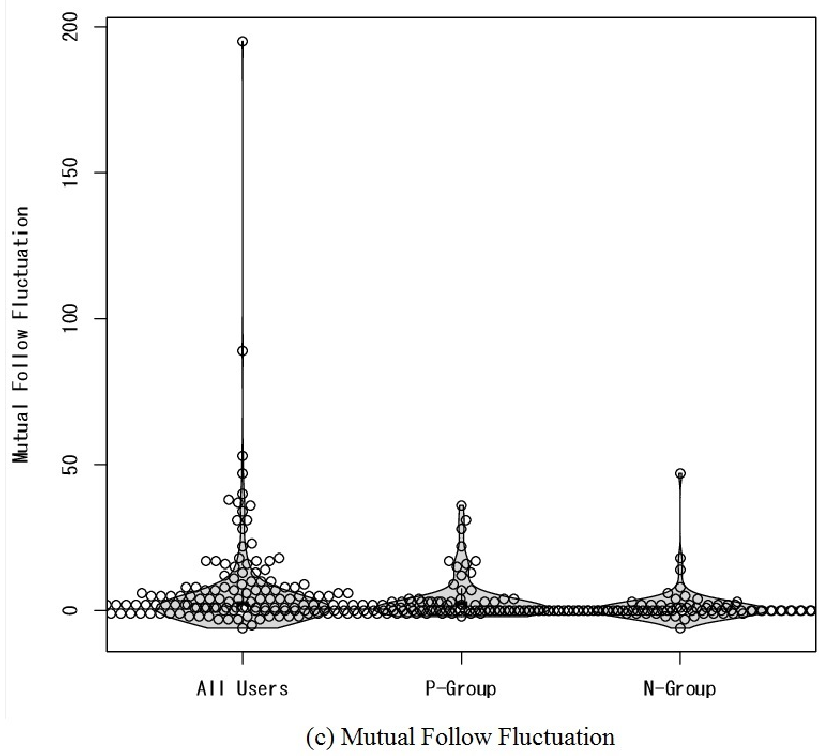 Fig 2: Distribution of data points illustrating the spread of relationship fluctuations in P vs. N groups.