
COCLU: Leveraging Information Compression for Dynamic Ontology Enrichment
A Name-Matching Algorithm for Supporting Ontology Enrichment
The paper introduces COCLU (COmpression-based CLUstering), a novel machine learning algorithm designed for name-matching to support ontology enrichment. It specifically targets the discovery of "synonymy" relationships by identifying orthographic and lexicographic variations of entity instances using information compression principles.
TL;DR
The paper presents COCLU (COmpression-based CLUstering), a partition-based clustering algorithm designed to automate the enrichment of domain ontologies. By measuring the "compression cost" of adding a new string to a cluster—represented by a Huffman tree—the system identifies synonymy relationships (e.g., "p2" vs "Pentium II") with high accuracy, even when starting with minimal prior data.
Problem & Motivation: The Fatigue of Ontology Maintenance
Ontologies are snapshots of knowledge, but language is fluid. In technical domains like electronics, a single product can have dozens of surface realizations due to abbreviations, typos, or brand variations.
The authors identify a critical gap: Ontology Maintenance—specifically identifying that two different strings refer to the same instance—is an expensive manual task. Traditional Information Extraction (IE) systems struggle with these "synonymy" relationships. The insight here is that while "Intel Pentium" and "P-II" look different, they often share a underlying "core" of frequent characters within a specific domain context.
Methodology: The Core of COCLU
COCLU deviates from standard distance metrics (like Levenshtein) by employing a Model-Based Learning approach anchored in Information Theory.
1. Huffman Trees as Cluster Models
Instead of storing all strings in a cluster, COCLU represents each cluster as a Huffman Tree. This tree acts as a codebook where frequently occurring characters in the cluster are assigned shorter bit-lengths.
2. CCDiff: The Scoring Function
The algorithm introduces Cluster Code Difference (CCDiff). When a new candidate instance is evaluated:
- It calculates the total length of the cluster's members when encoded by the current Huffman tree.
- It generates a new tree including the candidate instance and calculates the new total length.
- The difference determines "homogeneity." If a string like "Pentium" is added to a cluster already full of "Intel" variations, the "entropy" increases only slightly. If "Windows" is added to a "Processor" cluster, the codebook shifts significantly, yielding a high CCDiff.
3. Greedy Incremental Clustering
COCLU processes instances one at a time, using a Hill-Climbing search to decide whether to:
- Assign the instance to the cluster with the minimum CCDiff.
- Create a new cluster (starting a new concept) if the CCDiff exceeds a specific threshold.
Note: The paper utilizes a 4-layer architecture (Meta-conceptual, Conceptual, Instances, and Lexical) where COCLU operates primarily at the intersection of the Lexical and Instance layers.
Experiments & Results
The authors tested COCLU on the CROSSMARC laptop domain ontology, which includes attributes like Processor Name, Manufacturer, and Operating System.
Key Findings:
- Concept Generation: The algorithm achieved 100% Recall. It correctly identified when a new category of instance was introduced, though it occasionally over-segmented complex clusters (75% Precision).
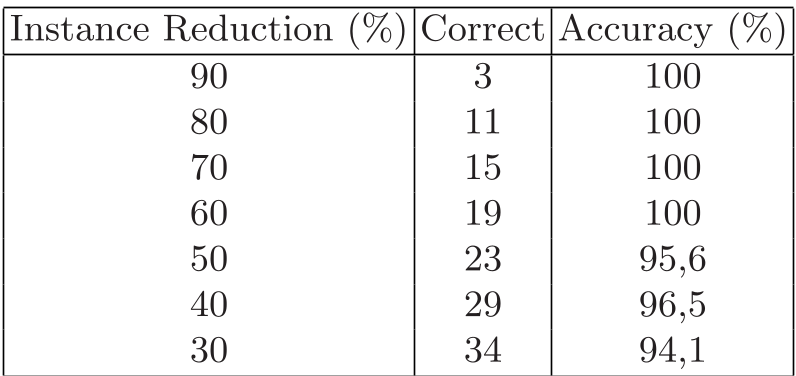
- Robustness to Sparse Data: The most impressive result is the "Instance Matching" scenario. As shown in the data below, even when the initial knowledge base was slashed, accuracy remained stellar.
| Instance Reduction (%) | Accuracy (%) |
|---|---|
| 0% (Full Knowledge) | 100% |
| 40% Reduction | 100% |
| 70% Reduction | 94.1% |
Critical Analysis & Conclusion
Takeaway
COCLU demonstrates that compression is a proxy for similarity. By quantifying how "surprising" a new string is to an existing model, we can effectively cluster technological synonyms without manual rule-writing.
Limitations
- Surface-Level Only: Since it relies on character distribution, it cannot catch semantic synonyms that share no characters (e.g., "Big Blue" for "IBM").
- Order Sensitivity: Like most incremental algorithms, the order in which instances are processed can affect the final cluster shapes.
Future Work
The authors suggest integrating contextual information (the words surrounding the instance in a text) to resolve homonymy (where the same word has two different meanings) and identify non-typographic synonyms. In the era of LLMs, this work remains a fascinating look at how lightweight, interpretable information theory can solve niche data-cleaning problems.