
Beyond Simple Strings: Scaling Named Entity Disambiguation with Wikipedia-Enrichment
Named entity disambiguation on an ontology enriched by Wikipedia
The paper proposes an unsupervised method for Named Entity Disambiguation (NED) that leverages an ontology-enriched knowledge base (KB) integrated with features from Wikipedia. It automatically generates a labeled training corpus by mapping KB instances to Wikipedia entries to overcome the scarcity of manually annotated data, achieving superior accuracy over existing systems like KIM.
TL;DR
Addressing the chronic shortage of annotated data in Named Entity Disambiguation (NED), this paper introduces a method to automatically generate training corpora by merging formal ontologies with the vast, semi-structured knowledge of Wikipedia. By enriching a Knowledge Base (KB) with Wikipedia-derived features (like categories and redirect links), the authors achieved accuracy scores of up to 97.5%—drastically outperforming industry-standard baselines.
The "Georgia" Problem: Why Identity is Hard
In the world of Natural Language Processing, "Georgia" is a nightmare. Is it a US state, a country in the Caucasus, or a small town in Vermont? Traditional systems often fail because their internal Knowledge Bases are "feature-poor"—they might know a person's name but not their colleagues, or a location's name but not its historical context.
The authors argue that high-performance disambiguation requires two things currently missing from most tools:
- Massive Scale: Hand-labeling millions of entities is impossible.
- Contextual Depth: We need more than just names; we need the web of relations surrounding an entity.
Methodology: The Fusion of Ontology and Wikipedia
The core innovation lies in the automated enrichment cycle. Instead of relying on a static KB, the system performs a three-step process:
1. Snippet Generation
The system traverses the KB and extracts class hierarchies (e.g., Scientist < Person) and property values.
2. Wikipedia Mapping
Using a TF-IDF based similarity metric, the system matches KB instances to their corresponding Wikipedia articles. Once a match is made, it "borrows" Wikipedia’s rich metadata:
- Redirects: Capturing synonyms and acronyms (e.g., "US" for "United States").
- Categories: Leveraging folksonomies (e.g., "1946 births", "Computer Scientists").
- Hyperlinks: Using inlinks and outlinks to build a relational context.
3. Ranking with Global Context
During disambiguation, the system doesn't just look at the words immediately surrounding the name. It uses a Global Context approach, extracting all recognized entities from the entire document to build a "context vector" that is compared against the enriched KB vectors.
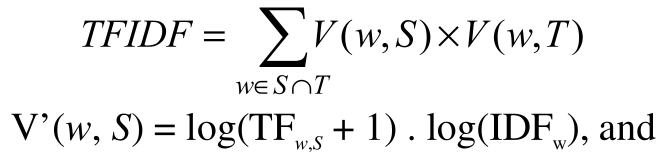 The TF-IDF formula used to calculate the similarity between text snippets and KB instances.
Experimental Showdown: Outperforming KIM
The researchers tested their approach against the KIM system using three notoriously ambiguous datasets: "John" (Person), "Georgia" (Location), and "Columbia" (Organization/Location).
| Dataset | KIM System | This Method (Enriched) |
|---|---|---|
| John | 28.89% | 89.28% |
| Georgia | 54.07% | 86.11% |
| Columbia | 67.88% | 97.50% |
The results were striking. The inclusion of wiki_feat (Wikipedia features) pushed performance from a mediocre ~50% baseline to a robust ~90% accuracy across the board.
 Our method significantly outperforms the KIM baseline across all datasets.
Critical Insight: Global Entities vs. Local NP
A surprising finding in the ablation study was that Base Noun Phrases (BaseNPs)—the common nouns near the name—actually hindered performance slightly. Conversely, Global Entities (other named entities in the same text) provided the strongest signals. This suggests that the identity of an entity is best revealed by its peers (e.g., seeing "Atlanta" anywhere in the text is a better indicator for "Georgia" than the word "professor").
Limitations and Future Outlook
While highly effective, the system assumes a mapping threshold (set to 0.1) that may occasionally link to the wrong Wikipedia entry if the KB is extremely sparse. Furthermore, the reliance on token-based vectors means it might miss nuances that a phrase-based or transformer-based embedding could capture.
Takeaway: This work proves that the Semantic Web doesn't need to be hand-built. By treating Wikipedia as a giant, unstructured feature set for structured ontologies, we can create disambiguation engines that are both wide-reaching and pinpoint accurate.