
Named Entity Recognition and Resolution: Architecting the Legal Knowledge Graph
Named Entity Recognition and Resolution in Legal Text
This paper presents a comprehensive framework for Named Entity Recognition (NER) and Resolution (NERes) specifically tailored for legal documents such as case law and depositions. By integrating lookup, contextual rules, and statistical models (CRFs and SVMs), the system identifies and links entities like judges and attorneys to authoritative databases with high precision.
TL;DR
This research by Thomson Reuters R&D tackles the two-fold challenge of Recognition (finding names) and Resolution (identifying exactly who they are) in the legal domain. By combining traditional rule-based logic with Conditional Random Fields (CRF) and Support Vector Machines (SVM), the authors built a system capable of reaching 98% precision in identifying legal actors and linking them to a database of over one million entities.
The "Mary Smith" Problem: Why Legal NER is Hard
In legal documents—depositions, pleadings, and case law—names are not just strings; they are pointers to professional histories. The problem is twofold:
- Ambiguity: A common name like "Judge Mary Smith" could refer to dozens of different people across various districts.
- Structural Complexity: Legal documents have "captions" (headers) with rigid but diverse formatting that contains the most vital identity cues.
Traditional NER systems often ignore the contextual cues—such as a law firm name appearing in the same paragraph—that are essential for disambiguation.
Methodology: The Hybrid Pipeline
The authors propose a sophisticated pipeline that moves from raw text to a "resolved" entity ID.
1. Zoning and Recognition
Before identifying names, the system performs Zoning to separate headers (captions) from the body. It uses a Conditional Random Field (CRF) to classify document segments based on N-grams and positional features.
For the actual NER, they use a "Toolbox" approach:
- Lookup: For unambiguous entities like specific courts.
- Contextual Rules: For Judges (e.g., if "Hon." precedes capitalized words, tag as Judge).
- Statistical Models: For titles and complex entities where rules are too brittle.
2. The Resolution Pipeline (Record Linkage)
This is where the paper shines. Once an "Attorney" is found, how do we know which one in the database he is?
- Blocking: To avoid comparing a name against millions of records, they "block" candidates by Last Name + First Initial, reducing the search space to roughly 7.6 candidates per mention.
- Feature Vectors: They calculate similarity scores based on First Name (including nicknames/initials), Middle Name, Law Firm TF-IDF similarity, and City-State proximity.
- SVM Classifier: A Support Vector Machine weighs these features to produce a "Match Belief Score."
Breakthrough: Surrogate Training
The most innovative part of this work is the Surrogate Training method. Manually labeling thousands of "correct matches" is expensive. The authors realized they could use rare names (names appearing <50 times in the US Census) as "ground truth" to automatically train the SVM. This approach achieved an F-measure of 0.92, nearly matching the 0.95 achieved with expensive manual labor.
Critical Insight: Beyond Content to Context
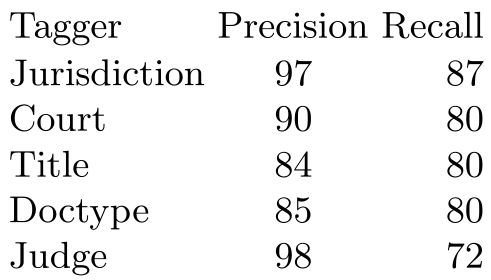
The high precision (90%+) of this system proves that in specialized domains, domain-specific heuristics (like identifying "Representation Paragraphs") are more valuable than raw model size. The system doesn't just look at the name; it looks at the "firm" and "jurisdiction" mentioned nearby to triangulate identity.
Limitations & Future Outlook
While the system is highly precise, its recall for judges (72%) suggests that non-standard honorifics or mentions in the body of text remain a challenge. In the era of LLMs, we might expect these "Context Rules" to be replaced by zero-shot reasoning, but the "Record Linkage" logic established here remains the gold standard for grounding AI in real-world databases.
Conclusion
This work provides a blueprint for turning unstructured professional text into a structured, searchable knowledge graph (like the Thomson Reuters Profiler). Its legacy is the demonstration that statistical matching, when guided by smart "blocking" and automated training data generation, can organize the world's most complex information.