
Automated vs. Manual: Are We Mapping Narrative Social Networks Correctly?
The one comparing narrative social network extraction techniques
The paper evaluates the reliability of three narrative social network extraction methods: manual, co-occurrence, and NLP-based extraction. Using a case study of the TV show Friends and a simulated in silico model, it demonstrates that automated methods yield highly correlated results for structural metrics like centrality and density.
TL;DR
Quantifying the "social life" of fictional characters is a booming niche in literary studies, but the labor-intensity of manual data collection is a major bottleneck. This paper demonstrates through a rigorous simulation of the TV show Friends that while automated extraction methods (Co-occurrence and NLP) introduce specific structural biases, they are highly reliable for ranking character importance and tracking global network trends.
Background: The Scalability Trap
In quantitative narrative analysis, we treat characters as nodes and their interactions as edges. The problem? Novels and scripts don't come in structured formats. Most researchers face a choice:
- The Manual "Gold Standard": Precise, but takes hundreds of hours.
- Co-occurrence: High-speed; assumes if two characters are in the same scene, they are interacting.
- NLP/Machine Learning: Uses entity linking and coreference resolution, but suffers from a ~30% error rate in character identification.
The authors ask: Does the method change the conclusion of the story?
Methodology: The In Silico Approach
To test this, the researchers didn't just look at real data; they built a simulator. By modeling the "ground truth" of Friends using a Two-Class Poisson Model (separating the 6 core "Friends" from guest stars), they could generate thousands of synthetic episodes.
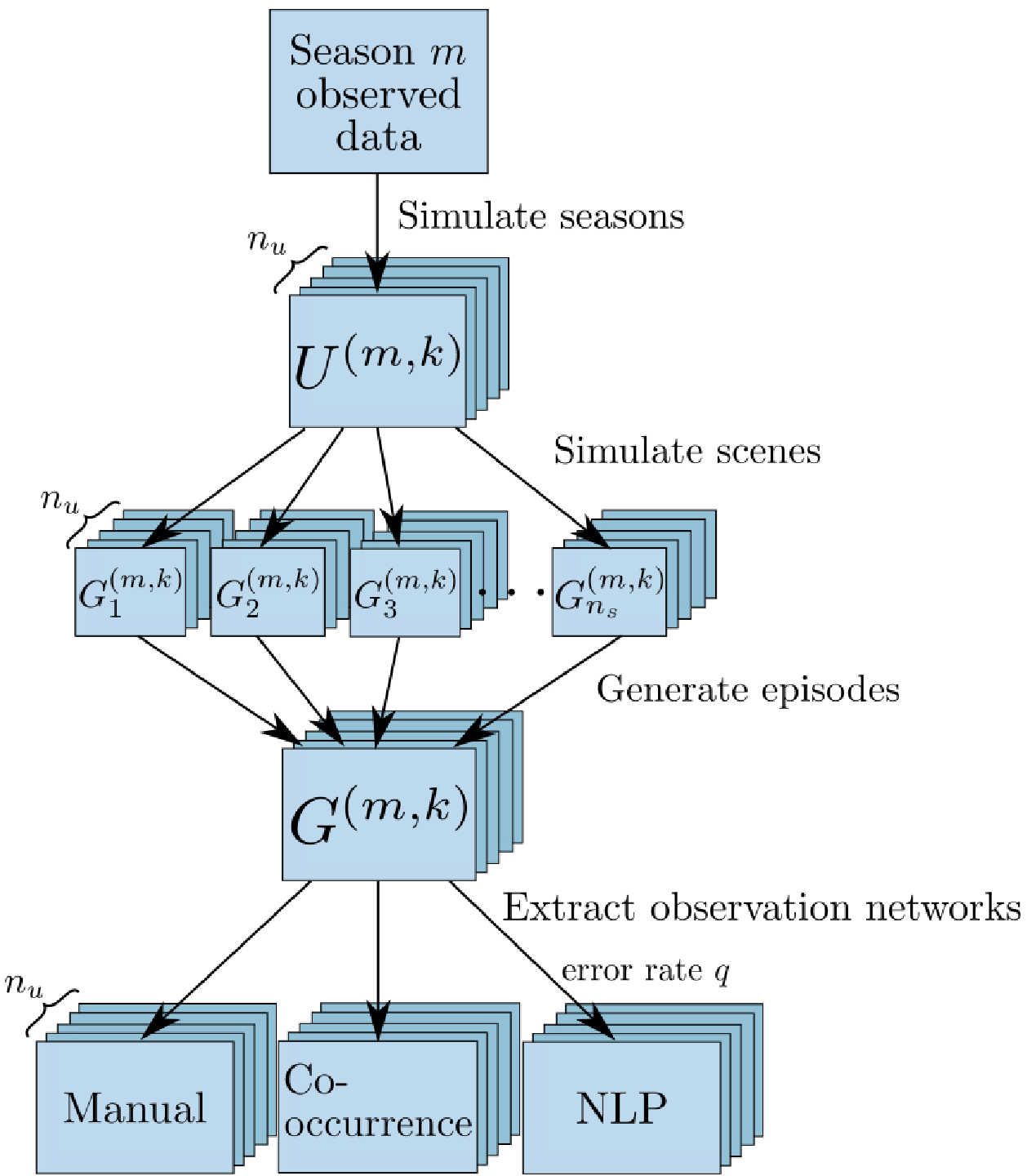
The simulation pipeline consists of:
- Season Simulation: Generating underlying relationship strengths.
- Scene Generation: Using a Random Walk where characters interact based on their centrality.
- Extraction Simulation: "Rewiring" edges to simulate NLP misidentification (setting error rate ) or creating cliques for co-occurrence.
Key Insights: What Works and What Breaks?
1. Centrality is Robust
Whether you use manual entry or a noisy NLP script, the rank of who is most important (Betweenness, Eigenvector, or Degree Centrality) remains remarkably consistent. If Joey is the "bridge" in the manual data, he almost certainly remains the bridge in the automated data.
2. The Clustering Distortion
The biggest failure point is the Clustering Coefficient. Because the co-occurrence method forces every character in a scene into a "clique" (everyone-connected-to-everyone), it artificially inflates clustering. If your research depends on finding "tight-knit communities" or "triadic closures," co-occurrence will lie to you.
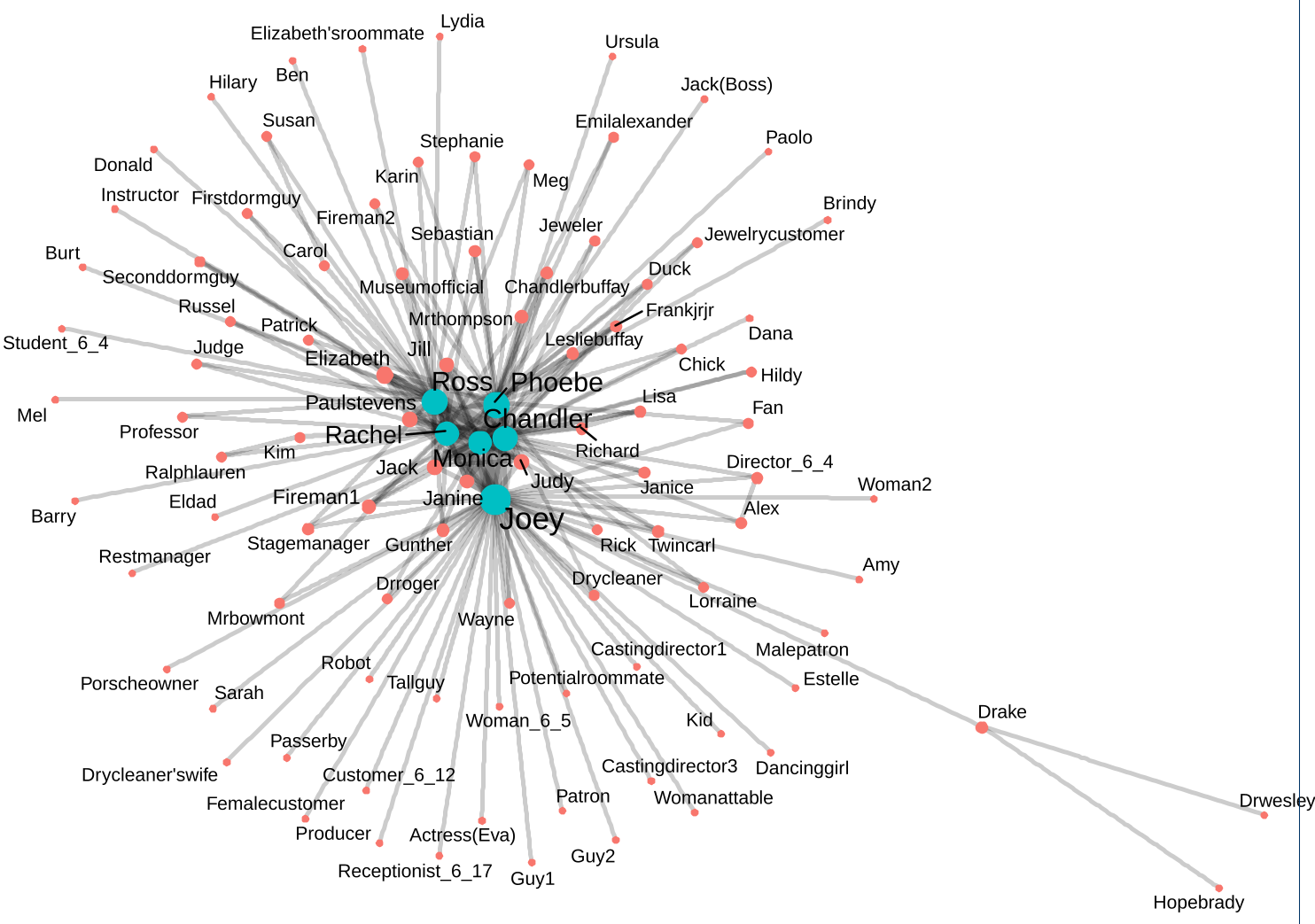
3. Edge Weight Reliability
For the "Core 6" characters, NLP extraction is actually more reliable than co-occurrence. This is because the main characters often share scenes without directly speaking to one another—co-occurrence counts these as "interactions," whereas NLP focused on "character mentions" captures the nuance of direct engagement more effectively.
Case Study: The "Less-Friendly" Friends
Applying these findings to 10 seasons of real Friends data, the authors uncovered a poignant trend: The core characters interact with each other less as the series progresses.
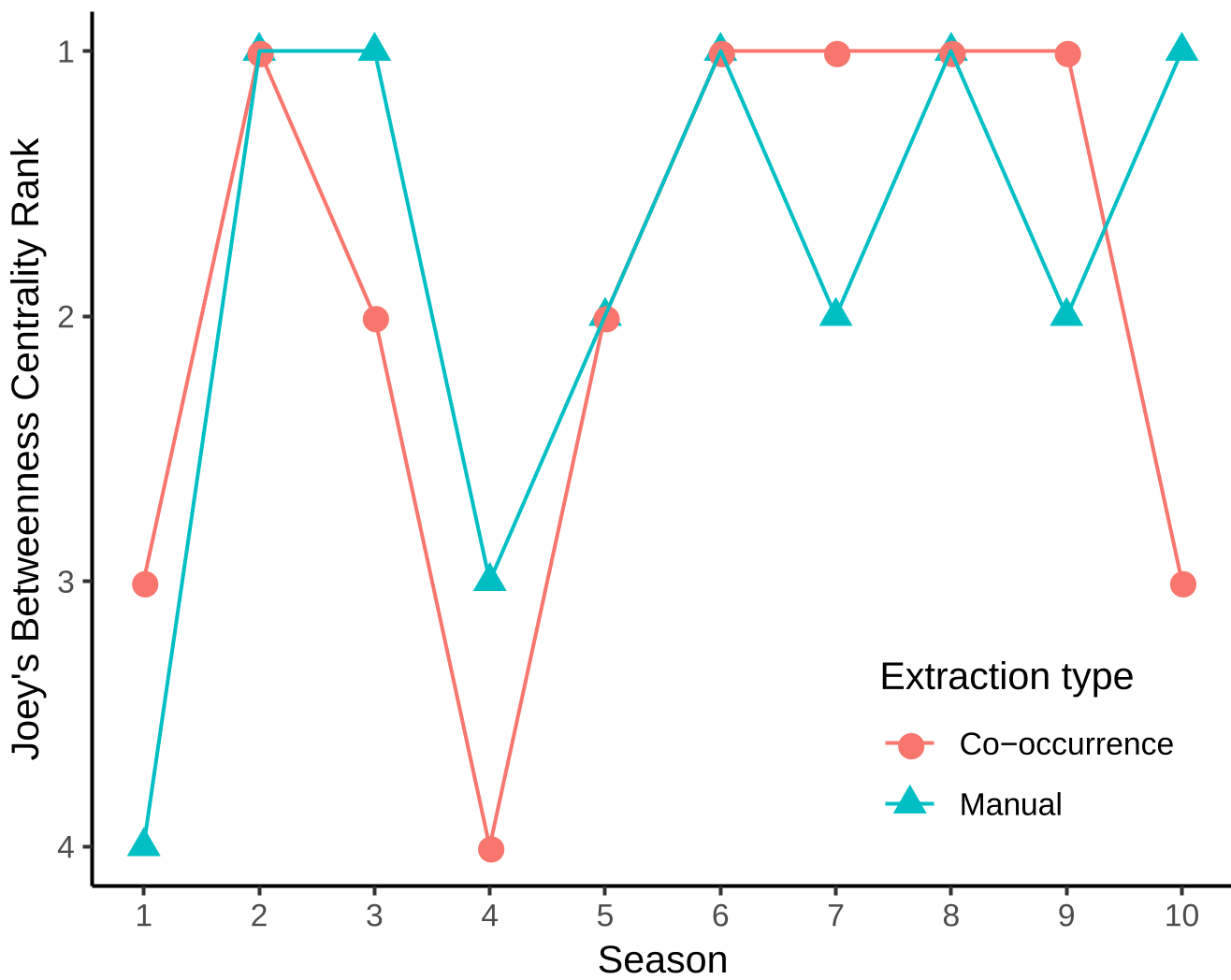
As the show evolved, the "internal" interactions of the group decreased to make room for external plotlines and guest characters. Crucially, this subtle narrative shift was detectable in both the manual and automated datasets, proving that automated tools are sensitive enough for longitudinal narrative study.
Conclusion
This work provides a green light for researchers to use automated extraction for large-scale "Big Data" literary studies. While you shouldn't trust the exact clustering score of a scene, the relative importance of characters and the evolution of their bonds remain valid even through the "noise" of modern NLP.
Future Outlook: The next step is applying these benchmarks to even more complex structures, like the sprawling "Stochastic Block Models" found in epic high-fantasy series or historical sagas.