
Beyond the Wall: How Narrowcasting Redefines Privacy and Engagement in Social Media
Narrowcasting in Social Media: Effects and Perceptions
This paper introduces a "Narrowcasting" prototype for social media, a technique for targeted content dissemination to specific audience segments. Evaluated through a four-week study on Facebook, the method utilizes demographic-driven filtering (Age, Location, Relationships) to enhance privacy and content relevance.
TL;DR
Social media is currently trapped in a "Broadcasting" trap—sharing everything with everyone. This paper proposes Narrowcasting: a mechanism that automatically segments your audience by demographics (Age, Gender, Location). Through a 54-participant study, the researchers found that making it easier to hide content doesn't stop people from posting; it actually makes them feel safe enough to post more, provided the interface follows an "optimistic" (show-all, hide-some) pattern.
The Problem: The "Context Collapse" Crisis
In the physical world, we behave differently around our bosses than we do around our college friends. In social media, these boundaries disappear—a phenomenon known as Context Collapse.
Current platforms fail to solve this because:
- High Interaction Cost: Creating "Friend Lists" manually is tedious.
- Binary Choices: Users often default to "Public" or "Friends" because fine-tuning is too complex.
- Privacy Fatigue: Constant updates to privacy settings often lead users to simply "overshare" and hope for the best.
Methodology: Automating the Filter
The authors built a prototype that sits on top of Facebook. Instead of asking users to sort friends, the system uses Metadata to auto-group them into six categories:
- Demographics: Age, Gender, Home Country.
- Dynamics: Current Location, Relationship Status.
- Tie Strength: Family and Significant Others.
Architecture and Interface
The prototype allowed users to toggle visibility for specific groups before hitting "Share." Importantly, once a post was made, the privacy settings were hardcoded, meaning even if a friend changed their profile info later, they wouldn't suddenly gain access to a post they were previously restricted from seeing.
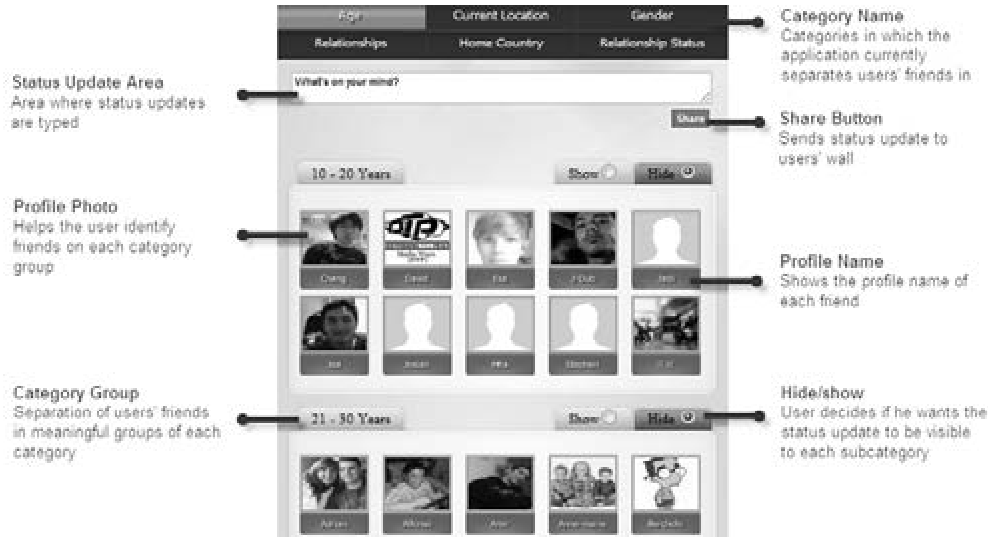 In the prototype, users could activate a category (like Age) and click buttons to "Show" or "Hide" the post from those specific subgroups.
Key Experimental Insights
1. The Interaction Pattern Effect
The study tested two mental models:
- Optimistic: Everyone sees the post unless you hide it.
- Pessimistic: No one sees the post unless you invite them.
The results were striking: The Optimistic group posted significantly more (increasing their average posts from 8.79 to 12.03 per fortnight). This suggests that users prefer the "safety net" of being able to exclude people rather than the "gatekeeping" burden of inviting them.
2. The Gender Privacy Gap
The research highlighted that Gender plays a massive role in how we use narrowcasting. While overall posting counts were similar, the intent differed:
- Males: Used narrowcasting primarily to hide content, especially from family and significant others (75.7% of "Relationship" category posts were hidden).
- Females: Used the tool more to target content toward specific groups, showing a higher tendency to share personal topics with close circles.
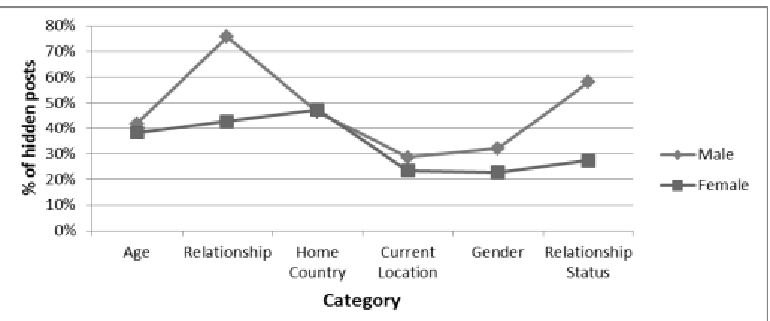 The chart above illustrates the percentage of posts hidden across different categories, highlighting the male tendency toward more restrictive sharing in relationship contexts.
Critical Analysis & Conclusion
This paper challenges the "Privacy Paradox"—the idea that users say they care about privacy but don't act on it. The authors prove that users do act on privacy when the Interaction Cost is low.
Takeaways for the Industry:
- UX is Security: Privacy tools fail not because users are lazy, but because the UI burden is too high.
- Nudging Matters: Defaulting to an "Optimistic" model with easy "one-click hide" buttons can actually increase platform retention and engagement.
Limitations: The study was conducted in 2013 on a university demographic. Today’s landscape with AI-driven "Close Friends" algorithms (Instagram) has adopted some of these principles, but the "demographic-driven" automation proposed here remains far more robust than current manual-list systems.
Future Outlook
The next step for narrowcasting is likely AI-Context Awareness. Instead of just "Gender" or "Location," future systems might use NLP to suggest an audience based on the content of the post (e.g., "This post looks like a professional achievement; should I hide it from your Saturday night party group?").