
Nash Bargaining Between Friends: Revolutionizing P2P Swarming with Social Intelligence
Nash bargaining between friends for cooperative data distribution in a social peer-to-peer swarming system
This paper proposes a cooperative data distribution framework for social P2P swarming systems by leveraging friendship ties within Online Social Networks (OSNs). It formulates bandwidth sharing as a Nash Bargaining Game between social peers to optimize file download efficiency and resource allocation fairness.
TL;DR
The paper introduces a game-theoretical framework for Peer-to-Peer (P2P) data distribution that exploits social relationships in Online Social Networks (OSNs). By replacing the traditional, often inefficient "tit-for-tat" strategy with a Nash Bargaining Solution (NBS), the authors demonstrate that social friends can cooperate to achieve faster download speeds and superior resource fairness compared to conventional non-cooperative swarms.
Background: When Social Ties Meet Data Packets
Traditional P2P systems like BitTorrent operate on a "zero-trust" basis. They use the tit-for-tat (TFT) algorithm to prevent free-riding, but this often leads to "under-utilization" where peers sit idle rather than helping a stranger.
The authors argue that in the era of OSNs (Facebook, Twitter), the "Social P2P" paradigm changes the game. Friendships and family ties serve as a natural inhibitor to free-riding—you don't want to ruin your real-world reputation by being a "leecher." This altruism opens the door for Cooperative Game Theory, where the goal shifts from individual survival to maximizing Social Welfare.
Problem & Motivation: The Efficiency Gap
Existing P2P systems suffer from two main issues:
- Efficiency Loss: Selfish rational behavior in distributed systems often leads to sub-optimal global outcomes (The Price of Anarchy).
- Rigidity of TFT: Tit-for-tat can be cheated by malicious users and often fails to stimulate cooperation when users have asymmetric resources.
The authors' insight is simple yet powerful: If two peers are "friends," they can enter a bargaining contract to share bandwidth optimally, treating their combined upload/download capacities as a single resource pool to be shared fairly.
Methodology: The Nash Bargaining Game
The paper models the interaction between two social peers as a cooperative game.
1. The Mathematical Framework
The utility for a peer is defined by: Unlike competitive games, the goal here is to maximize the Nash Product (NP): Where is the "disagreement point" (what the peer gets if they don't cooperate).
2. Architecture
The system maps social links to P2P overlay connections, allowing "friend coalitions" to prioritize each other over strangers.
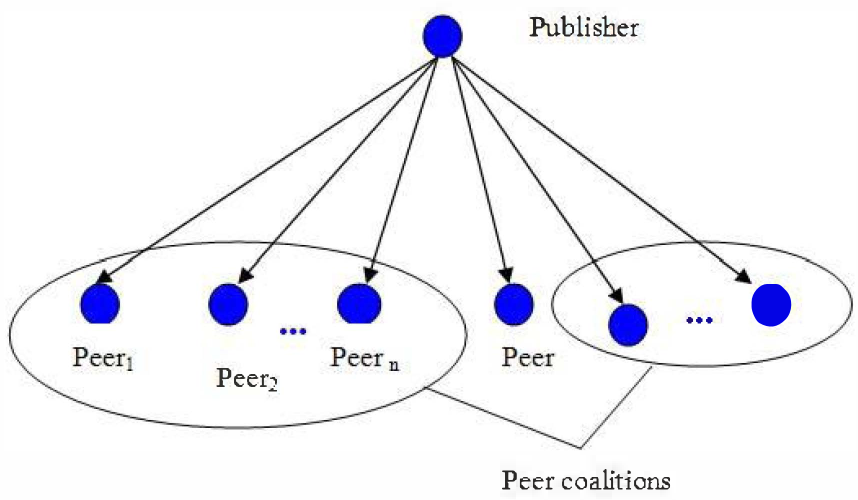 Figure 1: Conceptual view of social ties mapped onto a P2P overlay.
3. Optimization
By applying KKT (Karush-Kuhn-Tucker) conditions to the convex utility space, the authors prove that the unique Nash Bargaining Solution occurs when peers exhaust their upload capacities in a way that balances the Pareto efficiency and proportional fairness.
Experiments & Results
Through Poisson-process arrival simulations, the authors compared their NBS strategy against the industry-standard tit-for-tat.
Key Result 1: Reaching the Theoretical Limit
The NBS strategy allows the average download completion time to track the theoretical lower bound almost perfectly, even as file sizes increase.
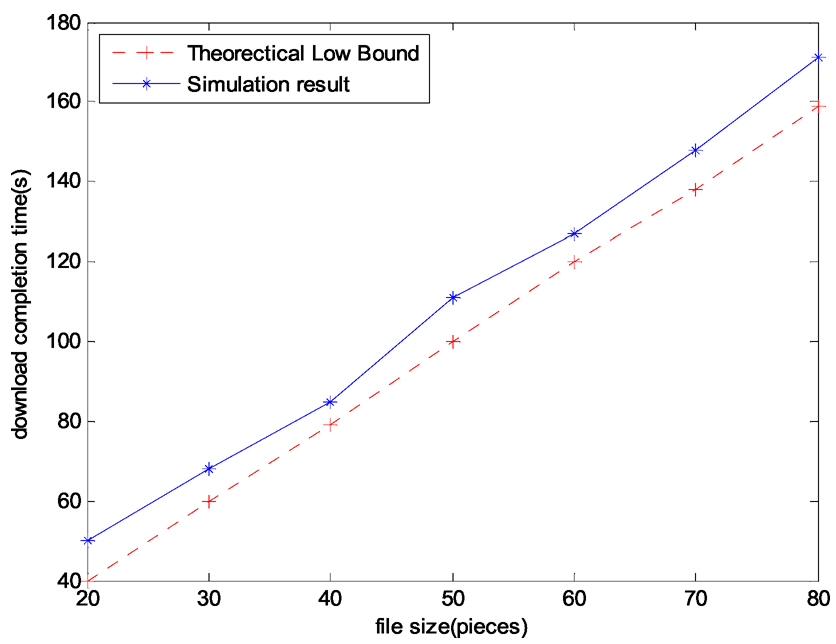 Figure 2: File download time versus theoretical limits.
Key Result 2: Superior Fairness
Using Jain’s Fairness Index, the study shows that NBS provides a significantly more equitable distribution of bandwidth than tit-for-tat. This is crucial because fairness ensures long-term system stability—users are more likely to stay in the swarm if they feel the resource allocation is just.
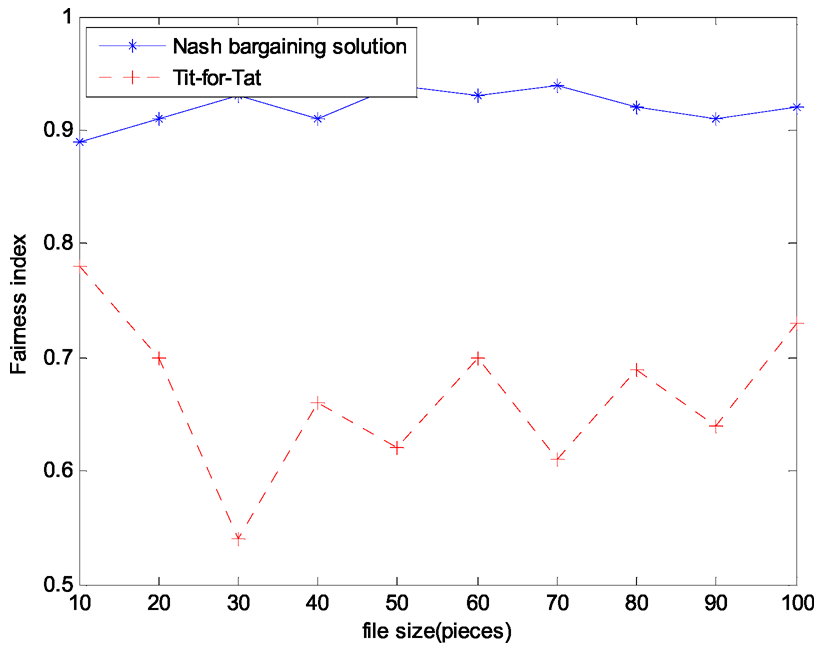 Figure 3: NBS fairness index vs. Tit-for-Tat.
Critical Analysis & Conclusion
Takeaway
The shift from non-cooperative to cooperative game theory in social networks isn't just a philosophical choice; it's a performance necessity. By leveraging the "Social Trust" as a mathematical constraint, we can build networks that are both faster and fairer.
Limitations & Future Work
While the two-player model is robust, real-world OSNs involve complex, multi-party coalitions. The authors acknowledge that moving to a multi-player scenario and incorporating real-time constraints for media streaming are the next frontiers for this research.
Conclusion
"Nash Bargaining Between Friends" proves that in the digital world, as in the real world, cooperation pays off. This research sets a strong foundation for future social-aware decentralization technologies.