
EHLM: Mining Hidden Social Links through the Lens of Nash Equilibrium
A Nash Equilibrium Based Algorithm for Mining Hidden Links in Social Networks
This paper introduces EHLM (Equilibrium based Hidden Links Mining), a game-theoretic approach to identify missing or invisible connections within social network communities. By modeling community stability as a Nash Equilibrium based on "k-hop Community Loyalty," the algorithm identifies unstable "active individuals" to predict hidden links, outperforming traditional similarity-based SOTA methods like Jaccard's Coefficient.
TL;DR
Social networks are rarely complete, with many relations "hidden" due to privacy or data collection gaps. This paper proposes a breakthrough approach: instead of just looking at who shares the most friends, it asks, "Is this community stable?" By applying the game-theoretic concept of Nash Equilibrium, the authors identify "unhappy" (active) individuals and predict hidden links required to restore community stability, significantly outperforming traditional link prediction benchmarks.
Background & Motivation: The "Selfish" Individual
In social network analysis, we often assume communities exist because people are similar. However, from an economic perspective, individuals are rational and selfish agents. We join communities because they provide a "gain" that outweighs the "loss" of participation.
The authors observe that existing SOTA methods for link prediction (like Jaccard’s Coefficient or Katz Index) treat the network as a static graph. They argue that a community in a real-world network should be in a state of Nash Equilibrium—a state where no individual has an incentive to leave their current group. If an individual appears "disloyal" based on observed data, it is likely because some links (which would provide the necessary loyalty/stability) are missing from the dataset.
Methodology: The Math of Loyalty
The core contribution is the k-hop Community Loyalty (k-HCL) and the definition of Active Individuals.
1. k-Hop Community Loyalty (k-HCL)
Loyalty isn't just about your direct friends; it’s about the "influence" of your neighborhood. The authors define k-HCL as: Where represents the ratio of in-community neighbors to total neighbors at hops. This recognizes that if your "friends of friends" are all in the same community, your loyalty remains high even if you have few direct links.
2. Identifying "Active" Nodes
A node becomes Active if there exists another community where its potential loyalty would be higher than in its current one (). These nodes are the "targets" for hidden link mining.
3. The T-SLM Algorithm
The Two-Stage Link Mining (T-SLM) algorithm follows a logical flow:
- Locate: Use Breadth-First Search (BFS) to identify the Active Individual Set (AIS) that breaks the Nash Equilibrium.
- Search: For these active nodes, calculate similarity scores within their community to find the most probable missing links.
- Update: Once a link is "predicted" (added), the algorithm recalculates the equilibrium, as one new link might stabilize multiple nodes.

Hardness Analysis
The paper provides a formal proof that finding a Strong Nash Equilibrium for graph partitioning is NP-hard. This justifies the use of their heuristic T-SLM algorithm to approximate the recovery of the equilibrium state through link addition.
Experiments & Results: Superior Precision
The authors tested EHLM against three major baselines: Random, Common Neighbors, and Jaccard’s Coefficient across four datasets: NetHEPT (citations), Enron (emails), Arenas, and American College Football (ACF).
Key Performance Metrics:
- ACF Dataset: At Rank 1 (top prediction), EHLM achieved 80.1% accuracy, while Common Neighbors only reached 54.2%.
- Enron Email: EHLM showed a significant lead, particularly in the top 16 predictions, outperforming similarity-based methods by nearly 15%.
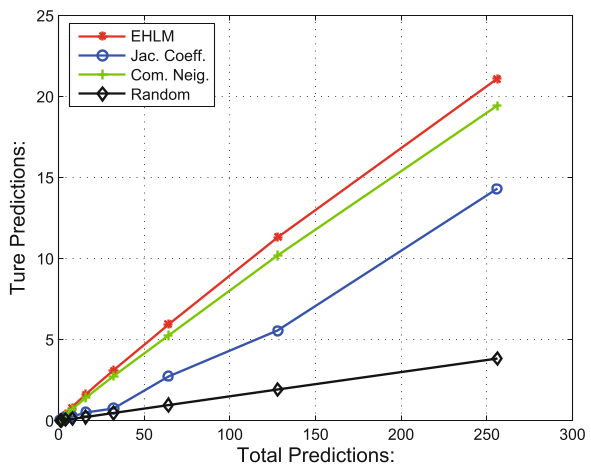 (Above: Comparison of True Predictions vs. Total Predictions across different networks)
Critical Insights & Conclusion
Why does it work?
Traditional methods fail because they are "local" (looking only at immediate neighbors). EHLM works because it considers the global stability of the community structure. By identifying nodes that should be more connected to their current group than they appear to be, EHLM narrows the search space to the most likely candidates for hidden edges.
Limitations & Future Work
- Community Dependency: The method's success depends heavily on the initial community detection quality. If the starting communities are poorly defined, the "loyalty" calculations will be skewed.
- Computational Complexity: While restricted to active nodes, calculating k-HCL for large in massive graphs remains computationally expensive.
- Future Path: Future research could integrate these game-theoretic constraints directly into Neural Link Predictors to act as a structural "regularizer."
Final Takeaway: This work brilliantly bridges economic theory and social network topology, proving that "Loyalty" is not just a human emotion, but a measurable mathematical property for predicting the invisible threads of our social fabric.