
OntoLearn: Bridging the Gap Between Raw Text and Semantic Ontologies
Natural Language Processing
The paper introduces OntoLearn, an automated ontology learning system that extracts domain terminology, performs word sense disambiguation via semantic interpretation, and organizes concepts into taxonomies. It notably applies these learned ontologies to the task of automated multiword term translation from English to Italian, achieving superior precision compared to frequency-based baselines.
TL;DR
OntoLearn is a pioneering framework designed to transform unstructured domain text into a structured, specialized ontology. By integrating statistical term extraction with deep semantic interpretation—identifying the exact "sense" of a word using WordNet—it overcomes the limitations of traditional keyword-based systems. Beyond just cataloging terms, it understands their relationships, successfully powering automated English-to-Italian translations for complex technical phrases.
Background: The Problem with Identifying "Concepts"
In the early days of the Semantic Web, the transition from words to knowledge was hindered by a fundamental ambiguity. A term like "Transport Company" could represent a "commercial enterprise" or an "overwhelming emotion" (the sense of being 'transported'). Most automated systems at the time ignored this, treating every string as a unique concept. OntoLearn’s main contribution is the realization that a domain ontology must be a specialized "view" of general lexical knowledge, requiring surgical precision in Word Sense Disambiguation (WSD).
The Architecture of OntoLearn
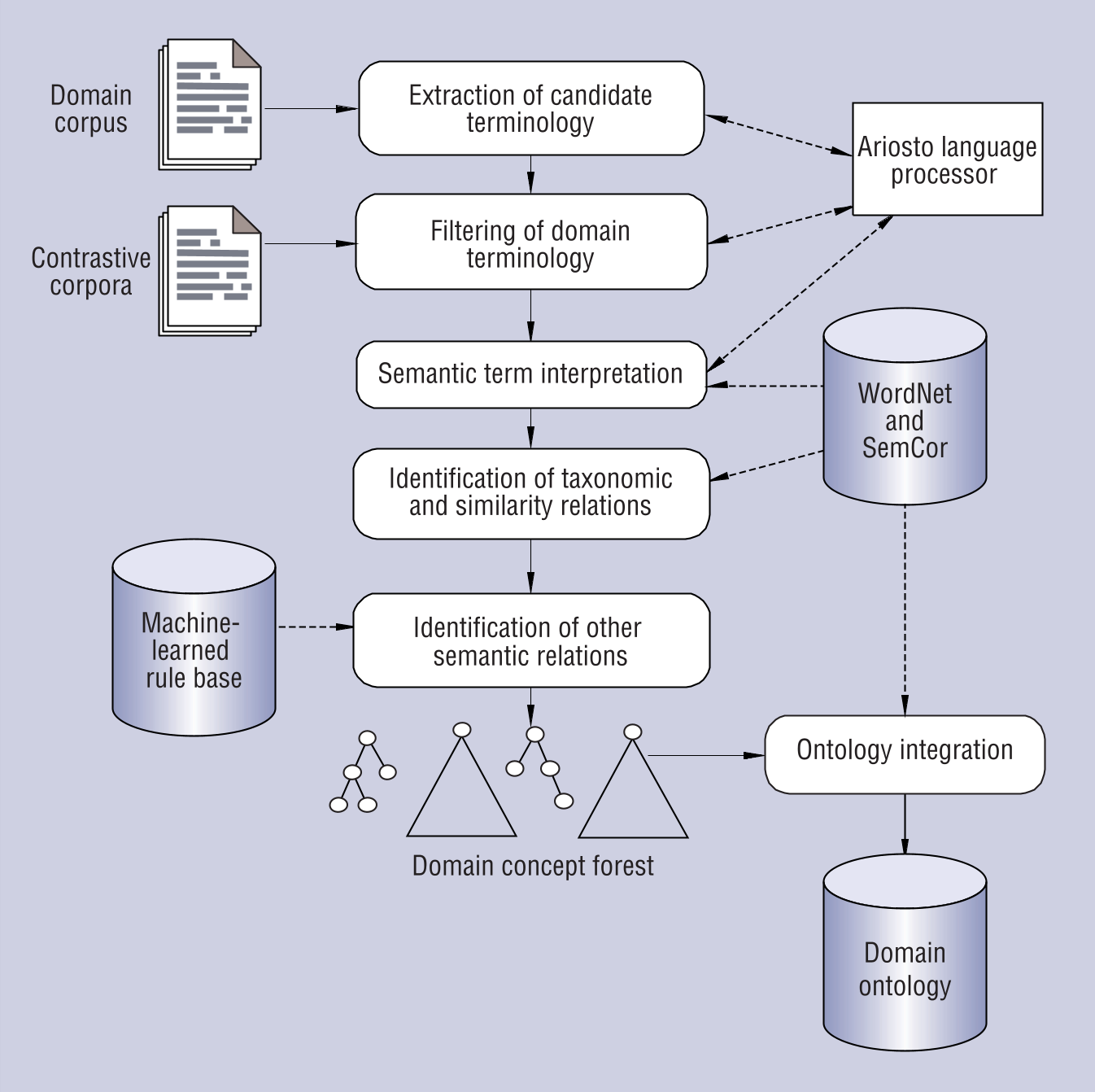
The system operates in a logical three-step progression:
1. Terminology Extraction
Before the system can understand concepts, it must identify which terms are relevant to the domain. It uses two key metrics:
- Domain Relevance (DR): Does this term appear more frequently in our target corpus (e.g., Tourism) compared to general text?
- Domain Consensus (DC): Is the term used consistently across many different documents within that domain?
2. Semantic Interpretation (The Core)
This is where the magic happens. OntoLearn creates "Semantic Nets" for every possible sense of a word in a multi-word term.
- It uses WordNet as the backbone.
- It looks for "Metapatterns"—specific paths in the graph (like "Gloss + Hyperonymy") that connect the senses of two words. If the gloss of "Company" mentions "Organization" and "Railway" is a type of "Organization," the system validates that specific sense combination.
3. Taxonomic and Semantic Relation Learning
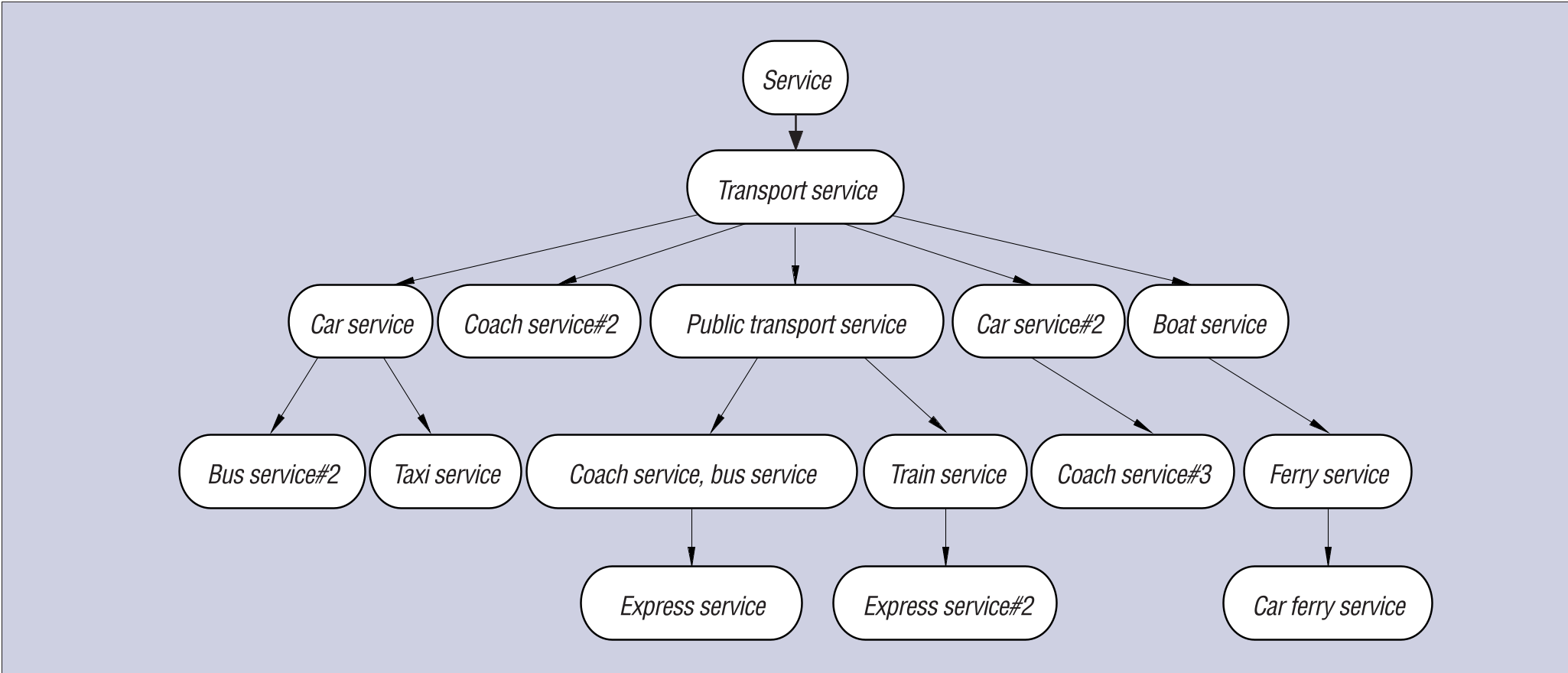
Once senses are pinned down, the system uses the C4.5 Inductive Learner to find deeper meanings. Does a "Room Service" imply a location (PLACE) or a goal (PURPOSE)? By learning from a small tagged set, the system generates human-readable rules to categorize these relationships across the entire domain concept forest.
Experiments: Real-World Utility in Translation
The authors tested OntoLearn by translating complex English tourism terms into Italian. This is notoriously difficult because prepositions in Italian (like di, in, per) change based on the semantic relationship.
Key Results:
- Ontology Growth: From 300 to 3,000 concepts in just six months.
- Translation Accuracy: Achieved a 74% "Good" rating on manually corrected inputs and 70% on fully automated inputs.
- Precision: The disambiguation process reached 84.56% precision, significantly higher than the "first-sense" baseline (75.06%).

Critical Analysis & Conclusion
OntoLearn succeeds because it doesn't try to "reinvent" the dictionary; instead, it uses general knowledge (WordNet) to prune and specialize domain-specific knowledge.
Limitations: The system relies heavily on the quality of the underlying lexical database (like EuroWordNet). In the experiment, the Italian EuroWordNet was significantly smaller than the English version, which limited the total number of terms that could be translated. Furthermore, it struggles with languages that have different structural logic (like German compound words) where a one-to-one word mapping fails.
The Takeaway: OntoLearn proves that automated ontology learning is not just a theoretical exercise for the Semantic Web—it is a practical tool for improving machine translation and information retrieval by providing the "context" that simple statistical models often miss.