
Scaling Knowledge: A Review of NLP Methods for Biomedical Ontology Learning
Natural Language Processing methods and systems for biomedical ontology learning
This paper provides a comprehensive methodological review of Natural Language Processing (NLP) and machine learning systems used for biomedical ontology learning from unstructured text. It categorizes existing techniques into symbolic, statistical, and hybrid approaches, specifically addressing tasks like term, synonym, and relationship extraction.
TL;DR
Biomedical ontologies like the Gene Ontology (GO) or SNOMED-CT are the backbone of modern bioinformatics, but they are expensive to build. This review explores the landscape of Ontology Learning (OL)—using NLP to automatically extract concepts and relationships from text. The verdict? While symbolic patterns and statistical clustering have made huge leaps (achieving up to 90%+ accuracy in specific tasks), human-in-the-loop systems remain the only viable path for high-fidelity clinical knowledge management.
The "Knowledge Acquisition Bottleneck"
The biomedical field is drowning in data but starving for structure. Ontologies provide the necessary semantic "labels" and "rules," but manual curation costs millions. For instance, the Gene Ontology Consortium received over $4 million in a single year just to maintain its data. The "bottleneck" is the human expert: they don't scale. NLP offers a way to mine the massive corpus of MEDLINE abstracts and clinical reports to discover new terms and connections automatically.
Methodology: How Machines "Learn" Ontologies
The paper categorizes the technology into three "philosophical" camps:
1. The Symbolic approach (Linguistic Rules)
This relies on Lexico-Syntactic Patterns (LSP). First pioneered by Hearst, these are "trigger phrases" like "...such as..." or "...including...".
- Intuition: If you see "Systemic granulomatous diseases such as Crohn’s disease," the machine can safely bet that Crohn's is a type of granulomatous disease.
- Strength: High precision.
- Weakness: Low recall—if the author doesn't use the specific "trigger" phrase, the machine learns nothing.
2. The Statistical approach (Corpus-based)
This treats words as vectors in a high-dimensional space. "A word is characterized by the company it keeps."
- Clustering: If "tumor" and "neoplasm" consistently appear near the verbs "biopsy" or "resect," the machine clusters them as synonyms even if it doesn't "know" what they mean.
- Machine Learning: Using HMMs (Hidden Markov Models) or SVMs (Support Vector Machines) to classify tokens based on features like capitalization, Greek letters, or surrounding parts-of-speech.
3. Hybrid Systems
Modern systems (like OntoLearn or Text2Onto) combine these. They use statistics to find candidate terms and symbolic rules to place them in a hierarchy.
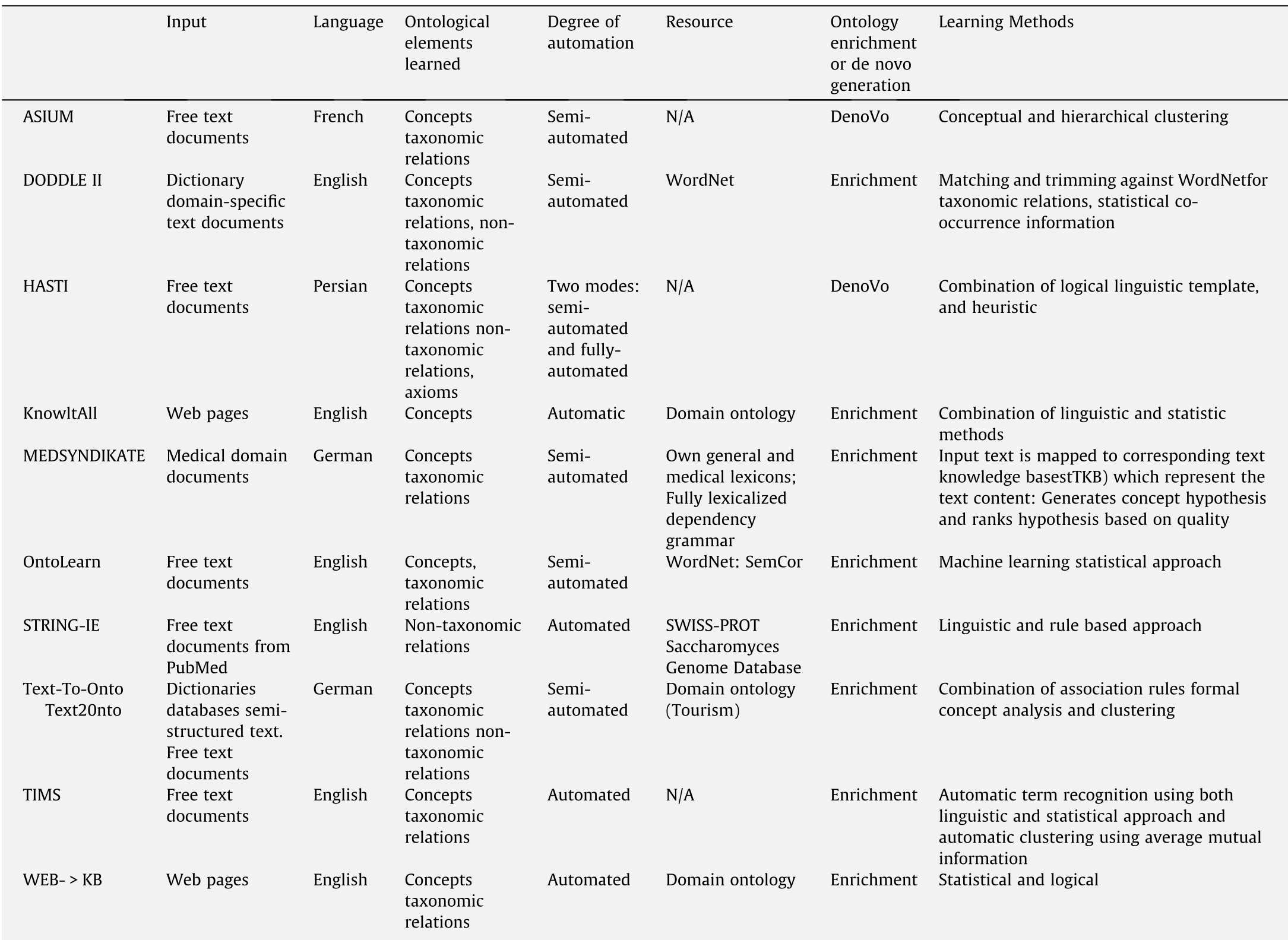 Table: Comparison of state-of-the-art OL systems showing their inputs and automation degrees.
Key Performance Benchmarks
The review compares several heavy-hitters in the OL space:
- STRING-IE: Exceptional for extracting regulatory gene networks, hitting 83-95% accuracy.
- HASTI: A Persian-language system that notably attempts to learn axioms (logic rules), boasting 97% precision on simplified texts.
- KnowItAll: Uses "Web-scale statistics" (treating the entire internet as a corpus) to assess the probability that an extracted fact is true.
The Biomedical Barrier
Why can't we just use general NLP tools? Biomedical text is a "sublanguage."
- Compound Nouns: Terms like "insulin-dependent diabetes mellitus" are long and hierarchical. A simple tokenizer might fail to see the relationship between the parts.
- Contextual Inference: Clinical reports often use headers (e.g., "DIAGNOSIS:") that change the meaning of everything following them.
- Ambiguity: Acronyms like "APC" can mean different things (Antigen-Presenting Cell vs. Adenomatous Polyposis Coli) depending on the sub-specialty.
Critical Insight: The Future is Semi-Autonomous
The authors conclude with a sobering but practical outlook. We are not yet at the stage of "Total AI" for ontology. The most successful implementations are those that:
- Bootstrap: Use a small set of "seed" words from a human to start the discovery engine.
- Empower Curators: Instead of building the ontology, the machine provides a "ranked list of suggestions," which the expert simply approves or rejects.
Conclusion
Ontology learning is shifting from a purely academic NLP exercise to a critical infrastructure task. By leveraging hybrid models—combining the surgical precision of symbolic rules with the massive scale of statistical clustering—we can finally begin to automate the map-making of human biology.
Takeaway for Researchers: Stop trying to build fully autonomous systems. Focus on ODIE-style (Ontology Development and Information Extraction) toolkits that enhance the productivity of human ontologists.