
NLP-Driven Service Composition: Bridging Environmental Expertise and Telco Infrastructure
Natural language processing based Services Composition for Environmental management
This paper presents a novel architecture for automated service composition specifically designed for Environmental Management, integrating Web Services with basic Telecommunications (SMS/Calls). The core method combines Natural Language Processing (NLP) for request parsing with AI Planning (PDDL) and execution monitoring to achieve dynamic service orchestration in converged networks.
TL;DR
Environmental management often requires rapid technical responses—such as calculating hydrological balances or issuing flood alerts—performed by experts who are not software engineers. This paper introduces an architecture that converts natural language requests into executable service plans by combining NLP, AI Planning (PDDL), and Execution Monitoring. It successfully merges traditional Web Services with Telecommunications (SMS/Calls) to create a robust, user-centric automation framework.
The Problem: The Technology Gap in Environmental Crisis
Environmental managers are usually ecologists, not developers. When a river flow exceeds a safety threshold, they need to "inform every farmer within 2 miles." Manually finding services for geo-mapping, farmer contact databases, and SMS Gateways is too slow and complex.
Existing solutions fall into two trap categories:
- Opaque Enterprise Tools: Rigid and difficult to customize for specific ecological sensors.
- Academic Prototypes: Often ignore "the real world"—where a web service call might fail or a network might be down, necessitating a dynamic re-plan.
Methodology: From Speech to Action
The proposed architecture operates on the principle of Intent Extraction. A user's informal request is decomposed through a multi-stage pipeline:
1. The NLP Analyzer
Utilizing tools like GateNLP and OpenNLP, the system performs segmentation, stemming, and stop-word removal. Crucially, it categorizes words into:
- Functional Words: Mapped to goals and parameters (e.g., "Zone 1" becomes coordinates).
- Control Words: Mapped to logical flow (e.g., "AND" indicates concurrent execution for the planner).
2. The Three-Layered AI Planner
The "intelligence" of the system resides in a hierarchical execution engine:
- Level 1 (The Brain): Generates the initial plan using PDDL (Planning Domain Definition Language).
- Level 2 (The Monitor): Watches the execution. If a service fails (e.g., an SMS gateway is unreachable), it triggers Level 1 to find an alternative.
- Level 3 (The Executor): Converts the abstract plan into BPMN and executes it via a JBPM engine, interacting with real-world endpoints.
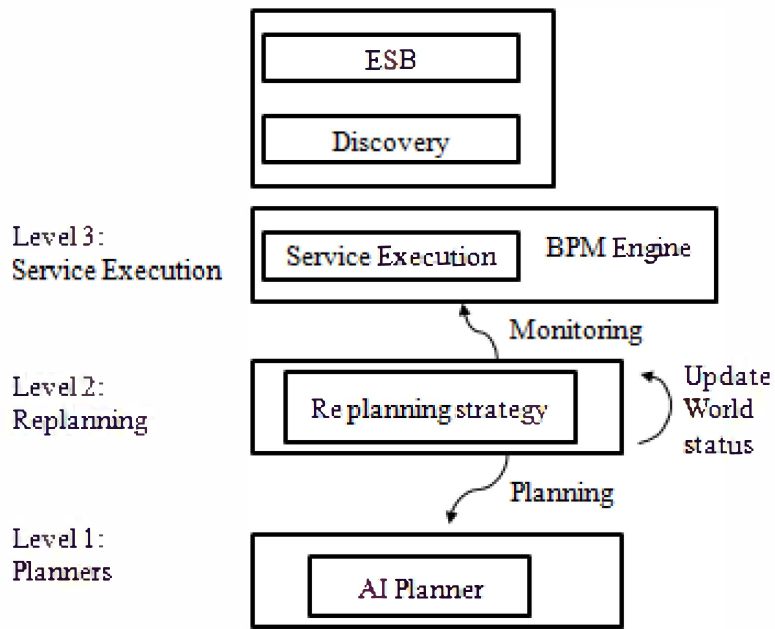 Figure: The internal architecture showing the interplay between logic, monitoring, and physical execution.
Context-Aware Intelligence
One of the paper's strongest insights is the Context Analyzer. It doesn't just look for any service; it looks for the right service based on the user's situation. Using the WURFL and CC/PP protocols, it identifies if the user is on a mobile device or a laptop and adjusts the output—choosing between sending a high-resolution map or a simple text alert.
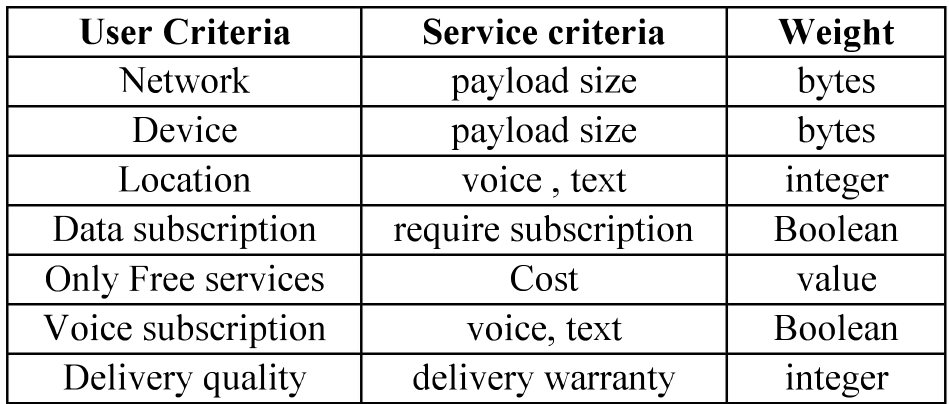 Table: Mapping user context (like location and network) to service selection weights.
Critical Analysis & SOTA Position
Compared to prior works like HSCEE (which relies on manual templates), this architecture is significantly more flexible. By using SESMA for semantic description, the authors provide a way to handle "non-deterministic" behaviors—essentially acknowledging that in telecommunications, things go wrong, and the system must be resilient.
Limitations: The current dependency on manual semantic annotations by experts remains a bottleneck. While it solves the "end-user" problem, it creates a "domain-expert-annotator" problem.
Conclusion: Toward a More Responsive Future
The integration of NLP with AI planning represents a significant shift toward "Intent-Based Networking" for social good. By abstracting the complexity of Telco and Web Service protocols, the authors have provided a viable blueprint for disaster management systems that prioritize human intent over technical configuration.