
[Ideology Detection: Decoding the Hidden Bias in Personalized Political News]
• Computing methodologies → Natural language processing; Supervised learning by classification
This paper introduces a novel task and dataset for detecting the political ideology of news coverage focused on specific political figures (personalization). It presents two large-scale datasets centered on Presidents Trump and Obama, utilizing five machine learning classifiers (SVM-SGD, Ridge, etc.) to achieve high-performance automated bias detection.
TL;DR
Can AI detect if a news article is "cherry-picking" facts to suit a political agenda? This paper (ICCDA 2020) tackles News Personalization—the practice of framing news around specific individuals to sway public perception. By building a massive new dataset of 178k+ articles and testing various classifiers, the research proves that the "hidden attributes" of political ideology are remarkably detectable via machine learning, even when the data is heavily skewed.
The Motivation: Facts ≠ Neutrality
In the post-2016 election landscape, it has become clear that reporting facts is not enough to guarantee bias-free journalism. Media outlets often shift focus from parties to individual candidates, using specific word choices and styles to frame them positively or cynically.
The author identifies a critical gap: while we have tools for "fact-checking," we lack automated systems to identify Ideological Framing. The challenge lies in the subjectivity—how do you train a model when the "ground truth" of bias is often a matter of perspective? The author's solution is elegant: rely only on news sources that openly state their political affiliation, removing the ambiguity of "mainstream" labels.
Methodology: From Raw Text to Ideological Vectors
The research follows a rigorous NLP pipeline to move from unstructured news copy to a predictive model.
- Data Acquisition: Articles were harvested based on coverage of Presidents Trump and Obama from seven highly partisan outlets (e.g., DailyWire vs. DailyKos).
- Preprocessing: Text was tokenized into 1-gram and 2-gram features, stripped of stop-words/punctuation, and transformed using TF-IDF (Term Frequency-Inverse Document Frequency).
- The Classifiers: The study compared traditional probabilistic models (Naive Bayes) against linear models (Ridge Classifier, SVM-SGD) and distance-based models (Nearest Centroid).
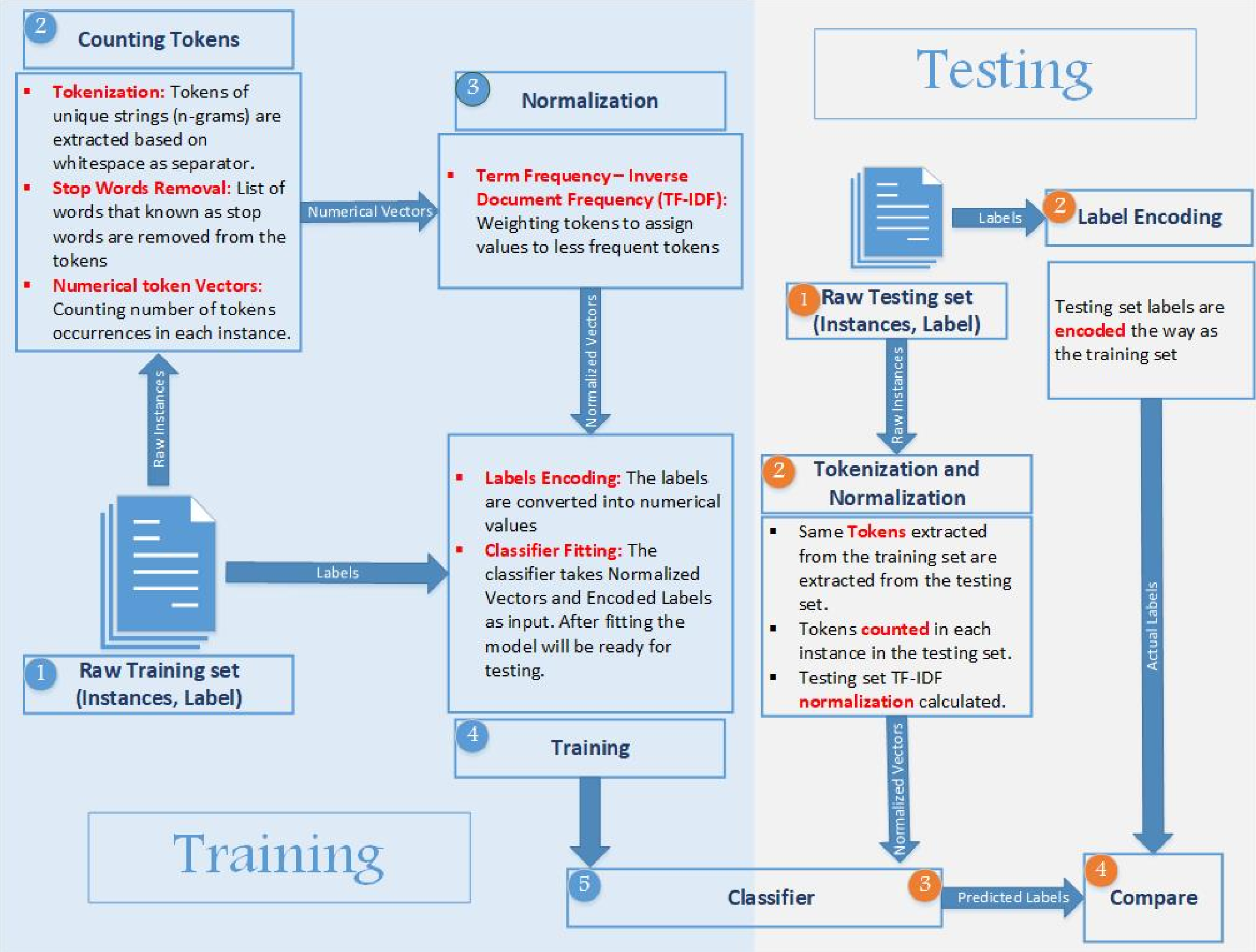 Figure 1: The standard NLP pipeline utilized for feature extraction and model training.
Experimental Results: Linear Models Reign Supreme
The experiments revealed a few fascinating insights into the nature of political text:
- Linear Dominance: Support Vector Machines (SVM) with Stochastic Gradient Descent (SGD) and Ridge Classifiers were the top performers. These models are particularly adept at handling high-dimensional, sparse data typical of text classification.
- The Imbalance Problem: The "Obama" dataset was significantly skewed toward Liberal sources (83%). While this initially threatened model accuracy, the SGD classifier proved highly resilient, maintaining an F1-score of 0.85 on the minority Conservative class.
- Trump vs. Obama Coverage: Interestingly, the models achieved more consistent performance on the Trump dataset, suggesting that conservative coverage of Trump might have a more distinct "ideological signature" compared to other figures.
 Table 3: The distribution of labels shows a significant "Liberal" skew, a common challenge in real-world political data collection.
Deep Insight: Why It Matters
This work moves beyond simple sentiment analysis. It suggests that ideology is embedded in the structure of language. Even if two articles report the same event, the "personalization" (the way the individual is treated) creates a statistical footprint that AI can track.
Key Takeaways:
- Automated Labeling: Platforms like YouTube or X (Twitter) could use these models to provide "perspective labels" to help readers realize when they are in an echo chamber.
- Editorial Audit: Newsrooms could use these tools to check for unintentional bias in their own reporting.
Limitations: The study relies on older ML architectures (pre-Transformer dominance). Future research should ideally leverage LLMs (BERT, GPT) to see if the "contextual" understanding of these models can further bridge the gap in imbalanced datasets.
Conclusion
The study concludes that personalized news is never truly neutral. However, by leveraging supervised learning on self-identified partisan data, we can build tools that act as a "bias-meter," giving readers the transparency they deserve in a polarized digital age.