
Decoding Cyber Credit: Measuring Seller Trust through the Lens of Social Capital
The nature of sellers’ cyber credit in C2C e-commerce: the perspective of social capital
This paper proposes a cyber credit assessment model for C2C e-commerce sellers using social capital variables from reputation systems and online social networks. By analyzing Alibaba's Taobao and Sina Weibo data, the authors demonstrate that integrating dynamic and diversified reputation effects provides a robust alternative to traditional financial-based credit scoring.
Executive Summary
TL;DR: In the world of C2C e-commerce, traditional financial metrics are often "invisible," making it difficult to judge a seller's credit. This research redefines Cyber Credit not just as a financial capacity, but as Social Capital. By weighing the recency of customer reviews and the disproportionate impact of negative feedback, the authors created a model that successfully predicts creditworthiness using social network signals (like Sina Weibo activity) as a benchmark.
Academic Positioning: This work bridges the gap between Social Capital Theory and Fintech. It moves beyond simple "star ratings" toward a dynamic, multi-dimensional assessment of integrity in big-data environments.
The Problem: The "Financial Blind Spot" in E-commerce
Why is it so hard to verify an online seller?
- Data Fragmentation: Credit-relevant factors are scattered across different platforms.
- Statistically Static: Traditional models treat a 5-star review from three years ago the same as one from yesterday.
- Sentiment Symmetry Fallacy: Earlier models often assumed a positive review cancels out a negative one. In reality, trust is "hard to gain but easy to lose."
Methodology: The Social Capital Framework
The authors argue that cyber credit is a "holographic" manifestation of social capital. They distinguish between:
- Cognitive Capital: Captured via reputation systems (customer reviews).
- Structural Capital: Captured via network centrality (followers, followings).
The Dynamic & Diversity Model
The core of the methodology lies in the adjustment of weights ( and ):
- Dynamic Effect ( value): Recent reviews (within 6 months) are given higher priority because they reflect current behavior.
- Diversity Effect ( value): Negative reviews are weighted more heavily than positive ones, acknowledging the "loss aversion" in human trust.
 Note: Model 1 was found to be the most indicative as it considered the total volume of reviews (T) as a proxy for sales experience.
Experiments: Validating with the "Social Graph"
The study analyzed 23,683 sellers on Taobao, linking their store performance to their Sina Weibo (micro-blog) presence.
Key Findings:
- The Popularity Dividend: A high number of Followers (X1) correlates strongly with high credit scores. People align themselves with honest entities.
- The Effort Proxy: Tweets (X3) and Active Days (X4) reflect a seller's investment in their brand's "Cognitive Capital." High-credit sellers tend to be more communicative.
- The "Desperation" Signal: Interestingly, the number of followings (X2)—how many people the seller follows—showed a negative relationship with credit. Lower-tier sellers often "spam-follow" others to drum up sales.
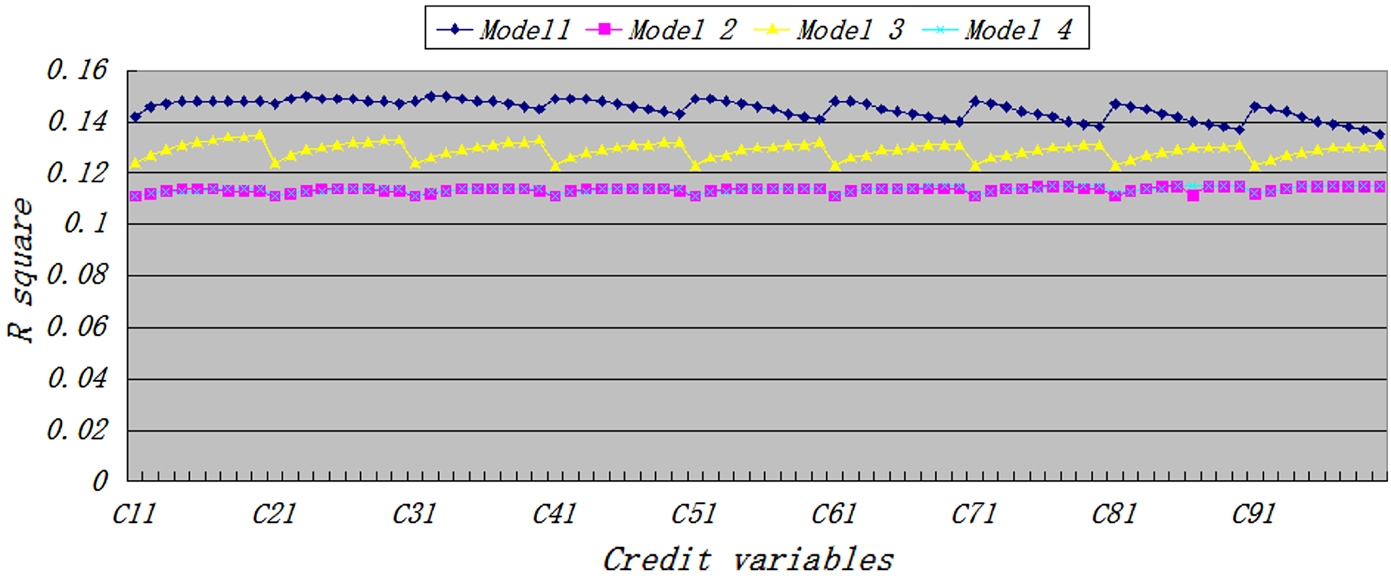 Figure 1: Comparison of R-squared values across different parameter settings, identifying the optimal weights for recency and sentiment.
Critical Insight & Conclusion
This paper proves that "Trust is Data." In the absence of a bank statement, a seller's social interactions—how they handle a complaint and how many people "vouch" for them via followers—provide a robust mathematical substitute for creditworthiness.
Limitations: The study is currently localized to the Alibaba ecosystem. However, the core logic—that social capital can be converted into a credit score—is a universal principle that can be applied to P2P lending, Crowdfunding, and the broader Gig Economy.
Future Outlook: The next evolution of this research will likely involve Deep Learning to analyze the textual sentiment of reviews rather than just the "positive/negative" labels provided by the platform.