
Structuring the Social IoT: Decoding Navigability and Friendship Types
Navigability in Social Networks of Objects: The Importance of Friendship Type and Nodes' Distance
This paper explores navigability in the Social Internet of Things (SIoT) by evaluating various relationship types (Ownership, Parental, Co-location, Co-work, and Social) and external metrics like geographical and similarity distances. Using the SWIM mobility model, the authors demonstrate that while Ownership relationships are vital for connectivity, Parental and Social links are essential for achieving small-world characteristics like short average path lengths and efficient service discovery.
TL;DR
Is your smart toaster "friends" with your smartwatch for a reason, or is it just noise? This paper investigates the navigability of the Social Internet of Things (SIoT). By simulating thousands of devices, the researchers identified that while Ownership links hold the network together, Parental and Social links are the "express lanes" that reduce search hops. Furthermore, they prove that knowing an object's brand or location (External Metrics) can drastically speed up information routing.
Background: Beyond the Silos
The Internet of Things (IoT) is currently plagued by "silos"—isolated ecosystems where data from one brand cannot communicate with another. The Social Internet of Things (SIoT) breaks these barriers by allowing objects to form autonomous social relationships, much like humans do. The ultimate goal is Navigability: the ability of any node to find a service or piece of data in the shortest number of hops possible.
The "Friendship" Taxonomy
The authors analyze five core relationship types:
- OOR (Ownership): Objects belonging to the same person.
- POR (Parental): Objects of the same model/manufacturer.
- C-LOR (Co-location): Stationary objects in the same place.
- C-WOR (Co-work): Objects meeting at a workplace.
- SOR (Social): Objects meeting frequently during social activities.
Methodology: The Architecture of Connection
To test these relationships, the study used the SWIM (Small World In Motion) model to generate realistic mobility and contact patterns for 14,079 devices.
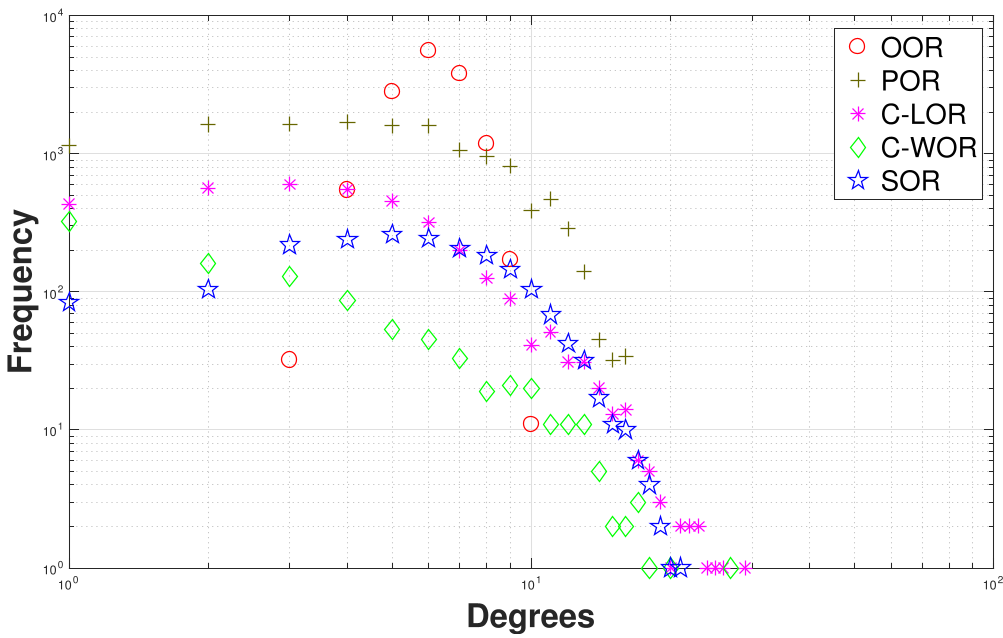 Fig 1: Degree Distribution across different relationship types, highlighting the scale-free nature of Social and Co-location links.
The researchers went beyond graph topology by introducing External Metrics. They developed a formula for Similarity Distance based on a hierarchical tree of object types (e.g., how "close" an iPhone 6 is to an iPhone 7 vs. a printer).
Experimental Results: Who Are Your Real Friends?
The simulation results (Table III in the paper) provided startling insights:
- OOR is the Backbone: Without Ownership links, the network collapses into tiny, isolated clusters. It connects only ~0.08% of nodes as a "giant component" on its own, but it is necessary for local routing.
- POR & SOR are the Bridges: These relationships create the "Small World" effect. When combined, they connect 100% of the network and reduce the Average Path Length to just 4.28 hops.
- C-WOR is Redundant: Interestingly, Co-work relationships contributed very little to the overall navigability compared to the highly efficient Social (SOR) links.
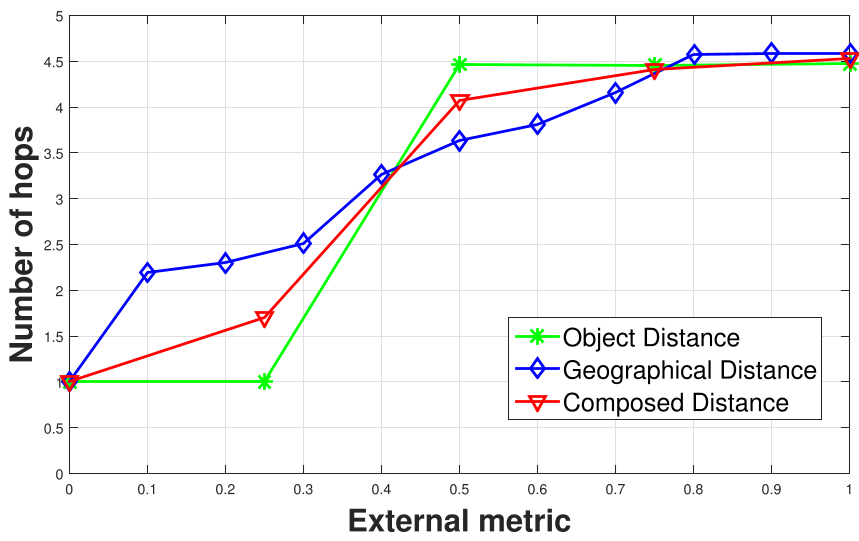 Fig 2: Evolution of Hop Counts based on Geographical and Object Similarity distances.
The study proved that as the "Object Distance" decreases (nodes become more similar), the number of hops drops significantly. When Geographical and Similarity metrics are combined (Composed Distance), we see the most efficient path markers for decentralized search.
Critical Insight & Conclusion
The genius of this work lies in the realization that SIoT navigability isn't just about how many friends an object has, but what TYPE of friends they are.
- The Role of POR: Parental links act as "long-range" shortcuts between otherwise distant clusters of owners.
- Scalability: The SIoT structure roughly follows a Power Law distribution (Scale-free), which is essential for the robustness of billion-node networks.
Limitations & Future Work
The study relies on synthetic mobility traces (SWIM), which, while accurate for humans, may not fully capture the unique movement patterns of specialized industrial IoT sensors. Future research should focus on Dynamic Service Discovery—how nodes can find specific capabilities rather than just specific objects.
Final Takeaway: To build a truly navigable SIoT, developers shouldn't just focus on connecting everything; they should optimize for Parental similarity and Social frequency to minimize the "degrees of separation" between data and the user.