
Navigating the Hybrid Web: How Social Links Save Mobile Networks
188_Navigating a mobile social network.
The paper introduces a unified model for Mobile Social Networks (MSNs) that integrates social links (Short-Range and Long-Range Connections) with an underlay wireless communication network. By applying greedy routing, it provides analytical formulations for average search delay and end-to-end success probability under realistic mobility and probabilistic link failure scenarios.
TL;DR
Researchers have developed a new mathematical framework to bridge the gap between social friendships and wireless signals. By treating social connections as "shortcuts" in a physical mobile network, the study proves that we can navigate complex environments with only local information, significantly reducing delays and keeping messages flowing even when the hardware connections are failing.
Context: When Friends are Closer than Neighbors
In the world of networking, being "close" is a dual concept. In a communication network, closeness is geographic (signal range); in a social network, it is about relationships. Most prior research treats these as separate entities. However, as we move through the world with smartphones, these two layers collide.
The authors argue that a realistic model must account for the fact that your "best" next-hop for a message might be a social friend far away (a Long-Range Connection or LRC) rather than a physical neighbor.
Methodology: The Combined Network Model
The core innovation lies in the combination of a random geometric graph (the communication layer) and a scale-free social graph.
The Four-Phase Time Slot
To handle the chaos of mobility, the paper defines a discrete-time operation:
- Decision: Choosing the next hop based on local destination knowledge.
- Transmission: Sending the data via a selected link.
- Move: Nodes shift positions according to a random waypoint model.
- Update: Neighbors exchange new location coordinates.
Mathematical Intuition
The paper derives the average delay () and success probability () using a system of recursive linear equations. The intuition is that since a node only knows its immediate neighbors (local information), it must make a "greedy" choice—selecting the neighbor that minimizes the remaining distance to the target.
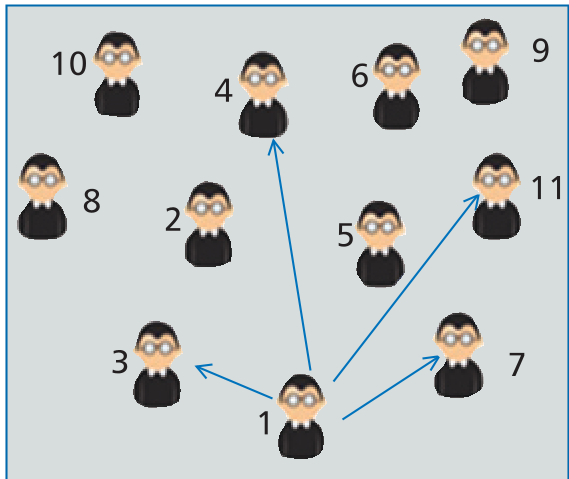 Figure 1: Illustration of (a) Communication links, (b) Social links, and (c) the Combined network where social connections act as shortcuts.
Experimental Insights: Does Social-Awareness Work?
The study compared four scenarios: static/mobile versions of communication-only and combined networks.
1. The Small-World Shortcut
In the combined network, social links act as the "six degrees of separation" shortcut. This results in the saturation of delay: even if the destination is much further away in terms of physical hops, the social LRCs allow the delay to flatten out rather than grow linearly.
2. The Impact of Mobility
Mobility is a double-edged sword. While it generally increases the average delay (due to nodes moving away from their intended targets), the effect is surprisingly limited. The paper notes that because mobility is "symmetric" (nodes move towards and away from targets with similar probabilities), the net negative impact is buffered.
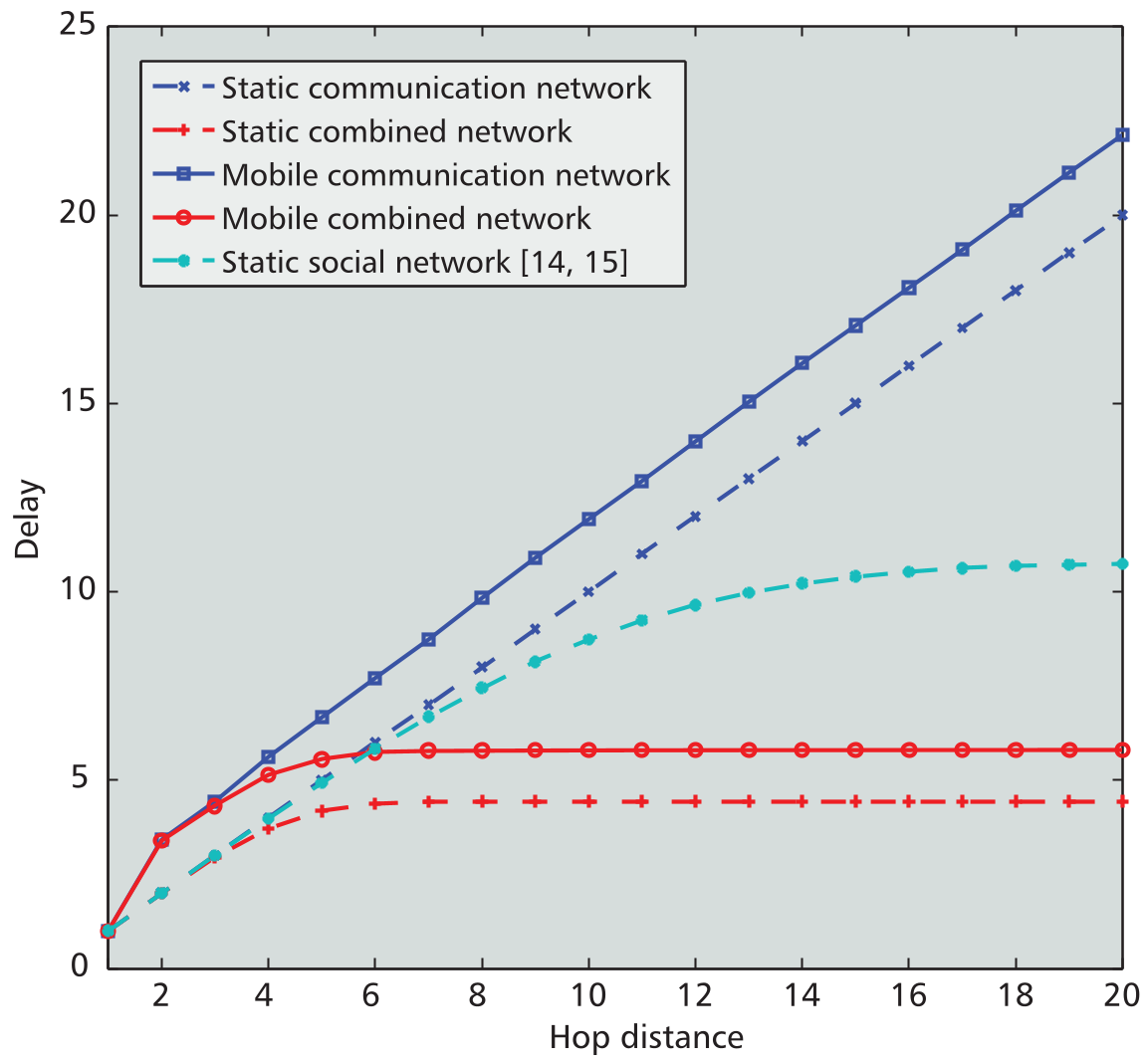 Figure 2: Average delay across different hop distances. Note the saturation in combined networks.
3. Reliability Over Hardware
Perhaps the most striking result is the Success Probability (S_k). In environments where wireless signals are unreliable (), a standard communication network's success rate drops to zero. However, when social links are integrated, the success probability stays high. Social "trust" and non-geographic links provide an alternative path that bypasses physical roadblocks.
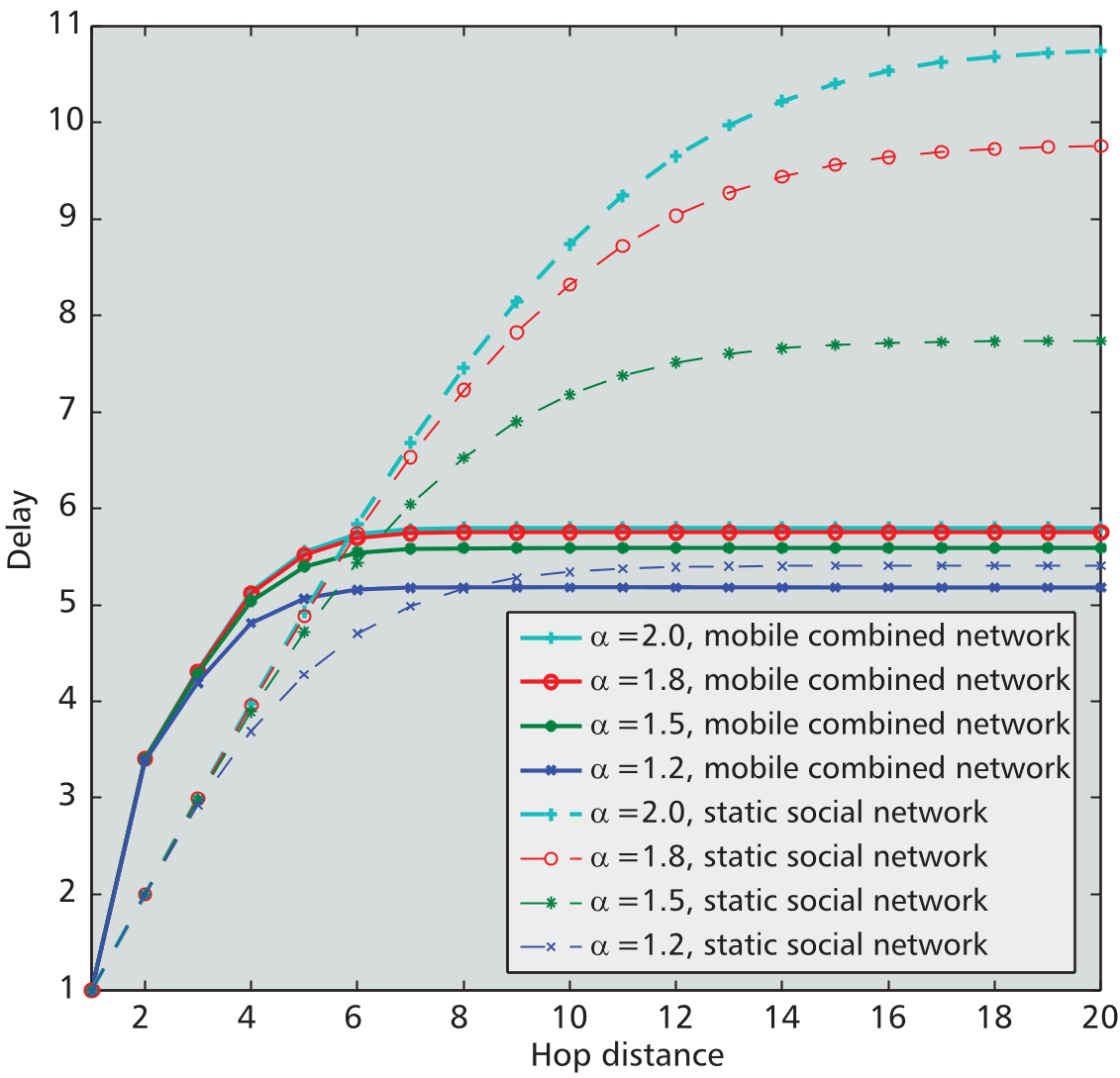 Figure 3: Search success probability. Social links sustain connectivity where physical-only networks fail.
Critical Analysis & Takeaways
The paper successfully demonstrates that Social Awareness is a vital Inductive Bias for mobile routing.
- The Strength: Using a continuum limit and linear algebra to solve for and provides a much more rigorous foundation than simple simulations.
- The Limitation: The model assumes "local information" (one-hop coordinates) is always available via GPS. In indoor or dense urban "canyons," this assumption might break down, adding "Coordination Delay" to the system.
- The Future: This work opens the door for Social-Physical Load Balancing, where network traffic can be offloaded from congested cellular backbones onto device-to-device (D2D) social links.
Conclusion: To navigate the future of mobile networks, we must look at the person holding the device, not just the device itself.