
DLA_N: Navigating the Social Web of Objects with Learning Automata
Navigation in the social internet-of-things (SIoT) for discovering the influential service-providers using distributed learning automata
This paper introduces DLA_N, a distributed navigation algorithm for the Social Internet-of-Things (SIoT) designed to discover influential service providers. By embedding Distributed Learning Automata (DLA) into smart objects and utilizing a custom centrality metric, the system learns optimal paths to high-impact nodes, achieving significantly lower search complexity and high scalability in large-scale IoT environments.
TL;DR
The Social Internet of Things (SIoT) turns inanimate objects into "social" entities. This paper presents DLA_N, an algorithm that uses Distributed Learning Automata and social graph theory to help IoT devices find the most influential service providers. By mimicking human social navigation, it cuts through search complexity, reaching the "top" providers in a massive network within just a few hops.
The Scalability Wall in IoT
As the IoT expands toward billions of devices, finding a specific service provider (e.g., a sensor with specific data) becomes a needle-in-a-haystack problem.
- Centralized engines are bottlenecks that can't handle the traffic.
- Random searches take too long and waste energy.
- Existing Heuristics often ignore the "influence" of a node—its ability to bridge different parts of the network.
The authors' insight? Use the Small World Phenomenon. Just as you are six handshakes away from anyone on Earth, an IoT device should be a few "social links" away from the best service provider.
Methodology: High-Logic Navigation
The DLA_N approach operates on two critical pillars:
1. The "Influence" Metric
The authors don't just look at how many connections a node has (Degree). They look at the Clustering Coefficient (how well a node's friends know each other) and give it triple the weight. This ensures the algorithm favors "hubs" that are truly central to the network's social fabric.
2. Learning via Automata
Every object in the SIoT is equipped with a Learning Automaton.
- Action: Choosing which "friend" to ask for a service.
- Feedback: A reward/penalty system based on the Maximum Path Centrality (MPC).
- Evolution: Over time, the probability shifts. The objects "learn" that asking Node A is more likely to lead to a high-value provider than asking Node B.
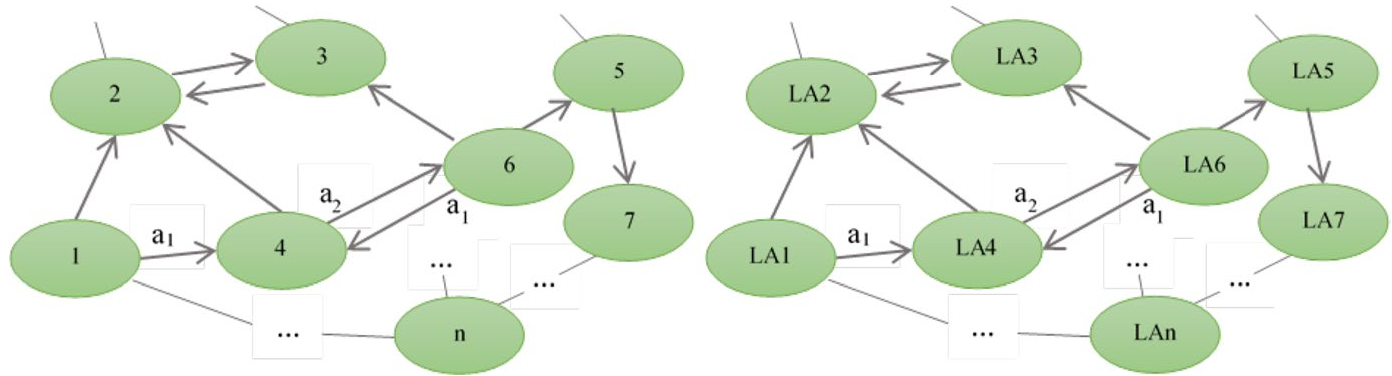 Figure 1: Each node acts as an automaton (LA), with outgoing edges serving as actions that activate subsequent automata in the navigation path.
Proving Influence: The SIR Model
To test if the "learned" nodes were truly influential, the authors used the SIR (Susceptible-Infected-Recovered) model—typically used to track disease outbreaks.
- If a "popular" node selected by DLA_N were "infected" with information, how fast would it spread?
- The Result: Nodes found by DLA_N reached a staggering 96% infection rate in the American Football Dataset, proving they are master distributors of information.
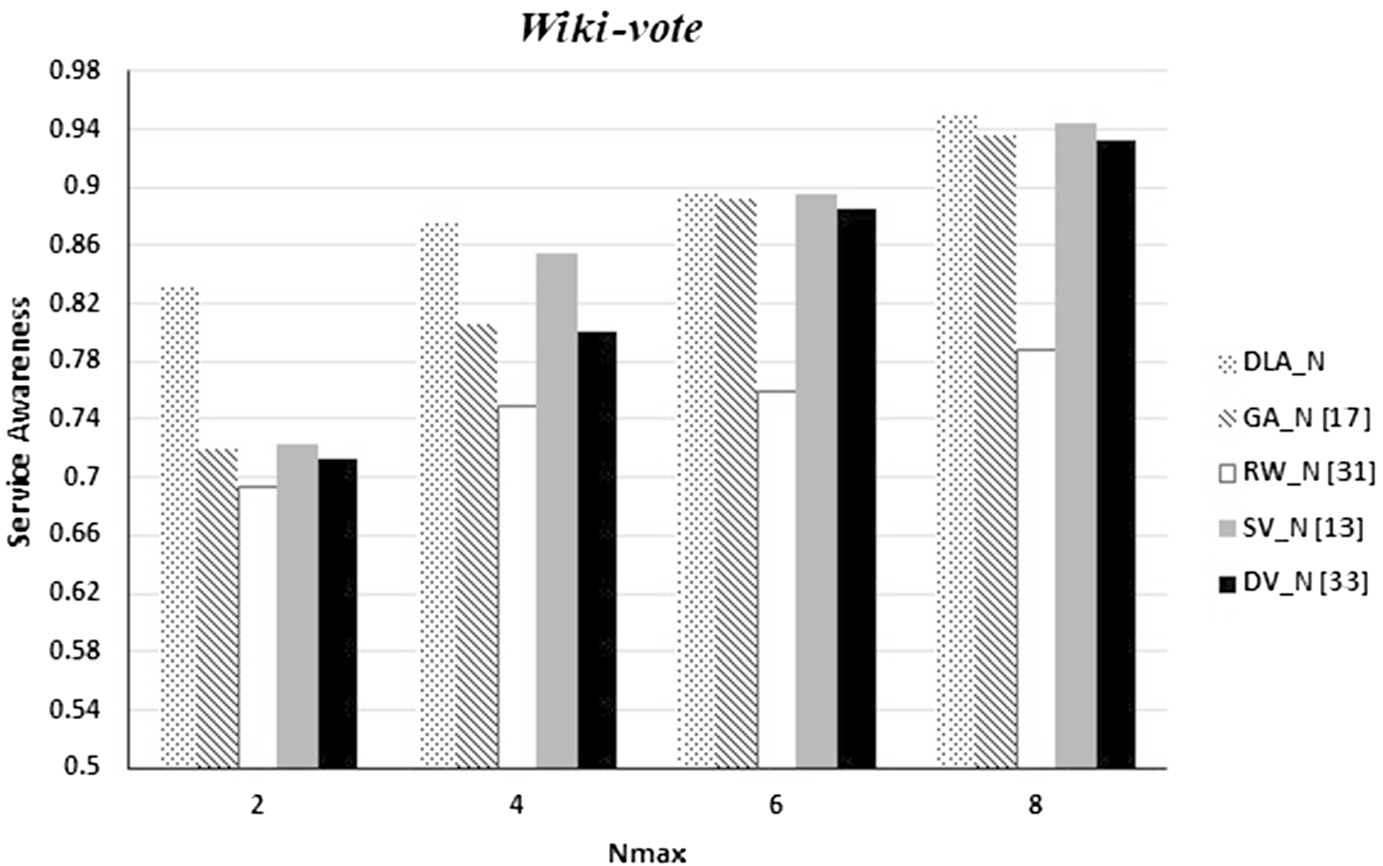 Figure 2: Probability of locating a service in various steps. DLA_N (Solid Blue) consistently outperforms Genetic Algorithms and Random Walks across different network types (Wiki-Vote, Twitter).
Critical Insight & Future Outlook
The beauty of DLA_N lies in its simplicity and locality. It doesn't need a global map of the internet; each device only needs to know its immediate neighbors and their updated probabilities.
Takeaway for the Industry: As we move toward "Smart Cities," DLA-based navigation offers a blueprint for decentralized resource management. However, future iterations must account for adversarial nodes—what if an "influential" node is malicious or compromised? Integrating Trust and Reputation into the centrality metric is the next logical step for a truly robust SIoT.
Conclusion
DLA_N moves SIoT navigation from static lookup tables to an adaptive, learning ecosystem. By prioritizing influential nodes, it ensures that even in a web of millions, the right service is only a few smart choices away.