
[ArXiv 2025] NaviRAG: Transforming Passive Retrieval into Active Knowledge Navigation
NaviRAG: Towards Active Knowledge Navigation for Retrieval-Augmented Generation
NaviRAG is a novel Retrieval-Augmented Generation (RAG) framework that replaces passive flat segment retrieval with a progressive "active knowledge navigation" paradigm. It organizes documents into a hierarchical semantic tree and employs an LLM agent to iteratively navigate from coarse-grained topics to fine-grained evidence, achieving SOTA performance on complex long-document QA benchmarks.
TL;DR
NaviRAG moves away from the traditional practice of searching for isolated text chunks. Instead, it organizes knowledge into a hierarchical "Knowledge Tree" and uses an LLM agent to actively navigate this tree. By traversing from broad summaries to specific details, it solves the context-versus-noise dilemma, boosting F1 scores by up to 4.8% on complex reasoning tasks while maintaining high efficiency.
Problem & Motivation: The Flat Retrieval Trap
Most RAG systems operate on a "flat" plane. They slice documents into chunks of fixed size (e.g., 512 tokens), embed them, and hope that a single vector similarity search catches the right evidence.
However, complex questions (e.g., "How many times did Chile adopt anti-Peru policies across this 100-page report?") require both Global Context (to know where to look) and Local Precision (to find the specific numbers).
- Small chunks lose the narrative "scent."
- Large chunks dilute the signal with noise.
Inspired by Information Foraging Theory, the authors of NaviRAG argue that humans don't find information in one jump; we follow a "scent" through a structure.
Methodology: Locate First, Then Forage
NaviRAG splits its logic into two distinct phases:
1. Hierarchical Knowledge Organization (Offline)
Instead of simple chunking, NaviRAG builds a Knowledge Tree.
- Top-Down Logic: An LLM generates a semantic outline.
- Bottom-Up Logic: Raw text segments are inserted into this outline, and summaries are generated for every intermediate node.
- Structure: Each node acts as a "semantic unit" containing a title, a summary, and links to children.
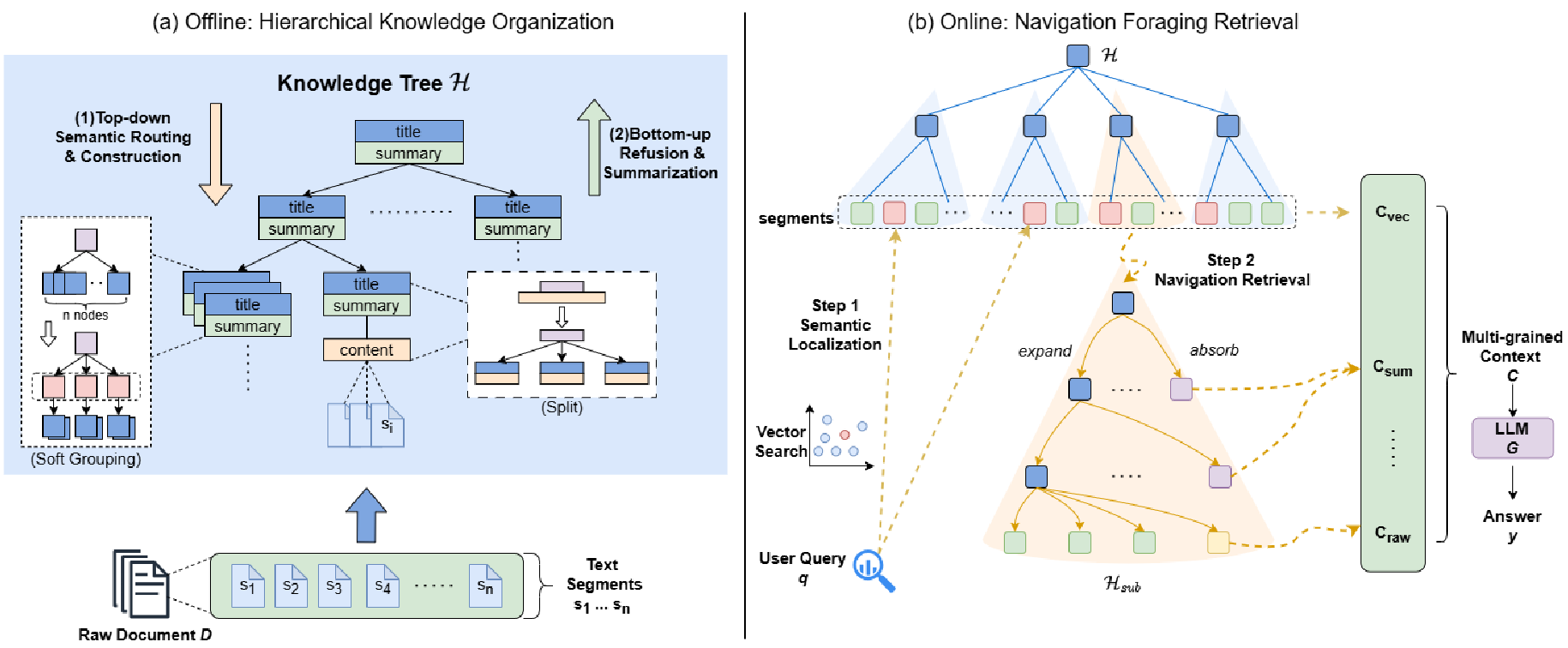
2. Navigational Retrieval (Online)
During a query, the system doesn't just return the best-matching chunk.
- Localization: It uses vector search to identify candidate "subtrees" (semantic regions).
- Navigation: An LLM agent starts at the top of these subtrees. For each node, it decides:
- INFO: The summary here is enough; stop and use it.
- EXPLORE: I need more detail; move to child nodes.
- TERMINATE: This path is a dead end.
Experiments: Superior Performance and Efficiency
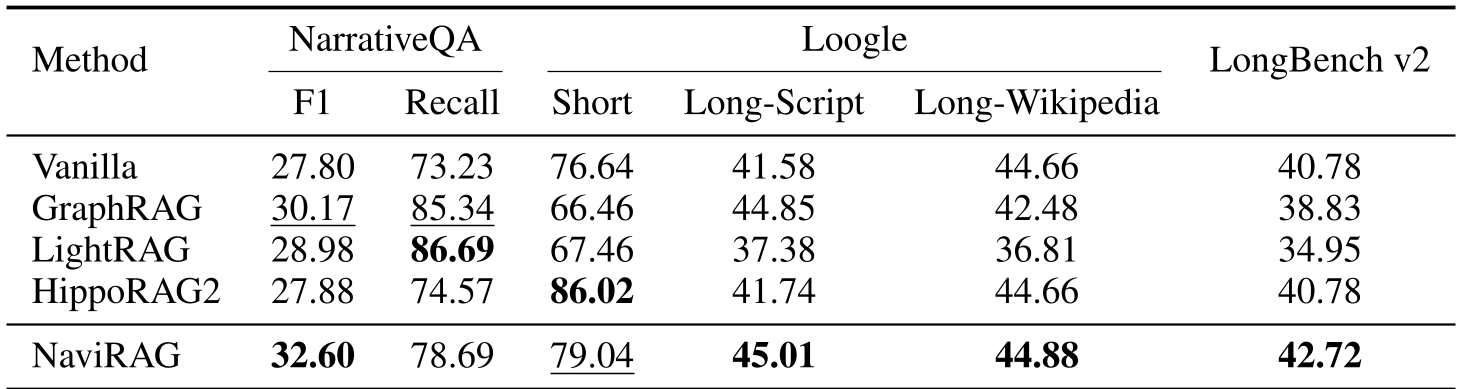
NaviRAG was tested against vanilla RAG and heavyweights like GraphRAG and HippoRAG.
Key Breakthroughs:
- Accuracy: It consistently outperformed vanilla RAG across NarrativeQA, LooGLE, and LongBench-v2.
- Efficiency: While frameworks like GraphRAG are famously slow due to global community summarization, NaviRAG is significantly faster because it navigates locally constrained subtrees.
- Context Power: NaviRAG with a
top-k=3setting outperforms a vanilla RAG setup withtop-k=15, meaning it finds the right information with far fewer tokens.
Deep Insight: Why Navigation Works
The "Ablation Study" (Table 3 in the paper) reveals a critical truth: Neither the tree structure nor the navigation works well alone. The tree provides the map, but the agent provides the intelligence to read the map. Without navigation, the tree is just a noisy set of nodes; without the tree, the agent has no path to follow.
The authors also explored a Memory Module, which allows the agent to remember what it has already found during a search. This prevents "double counting" evidence—a common failure mode in LLMs where they repeat the same fact multiple times when answering quantitative questions.
Critical Analysis & Conclusion
NaviRAG represents a shift toward Agentic RAG. Instead of making the retriever "smarter" (better embeddings), it makes the retrieval process more cognitive.
Limitations:
- It works best on narrative/continuous texts (like scripts or long reports).
- On modular texts like Wikipedia, where sections are totally independent, the benefit of "navigation" is lower because there is no continuous "scent" to follow.
Future Outlook: The next step for NaviRAG is likely Hybrid Retrieval—combining this vertical tree navigation with horizontal graph-like connections to allow the agent to "jump" between related topics without going back up to the root.