
Near-Optimal Targeted Marketing: How to Influence the Right People Without Wasting Budget
Near Optimal Strategies for Targeted Marketing in Social Networks
The paper introduces Targeted Influence Maximization (TIM), a novel social network marketing strategy using a discrete optimization objective that maximizes influence over a specific target set while minimizing "spillover" to non-target nodes. The authors propose the Sup-Sub procedure, an iterative algorithm that optimizes the difference between two submodular functions to achieve near-optimal seed selection.
TL;DR
Viral marketing isn't just about reaching everyone; it's about reaching the right people. This paper introduces Targeted Influence Maximization (TIM), a framework that maximizes impact on a specific demographic while penalizing spread to irrelevant users. By treating the problem as a difference of submodular functions, the authors provide an algorithm that offers provable guarantees in a domain where simple greedy approaches usually fail.
Background: The Precision Problem
In the classic Influence Maximization (IM) problem (pioneered by Kempe et al.), the goal is to find nodes that trigger the largest cascade in a social network. However, if you are selling luxury car insurance, a "viral" hit among teenagers (who don't own cars) is a waste of resources, especially if your marketing involves costly incentives like free trials or coupons.
The core challenge: How do you mathematically define "precision" in a way that remains computationally solvable?
Methodology: The "Sup-Sub" Approach
The authors define a new objective function:
- : Expected influence on the target set .
- : Expected influence on the non-target set (spillover).
- : A penalty parameter (the higher the , the more selective the algorithm).
The Optimization Hurdle
While and are both submodular (meaning they exhibit diminishing returns), the difference between two submodular functions is generally not submodular. This breaks the standard greedy guarantee.
To solve this, the authors utilize the Sup-Sub procedure. The intuition is to approximate the second submodular function () with a modular upper bound (a linear function).

The algorithm then iterates:
- Create a linear surrogate for the "penalty" term.
- Solve the resulting submodular maximization problem using a Randomized Greedy approach.
- Repeat until convergence.
Experimental Validation
The authors tested their method against a baseline called TD-MDH (Targeted-set restricted Discounted Maximum Degree Heuristic) on the Netscience network (a co-authorship graph).
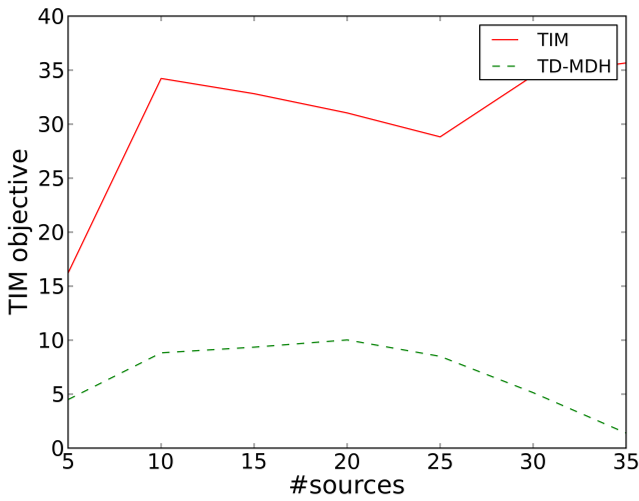
Key Findings:
- Scalability: The iterative Sup-Sub approach remained efficient enough for real-world graph structures.
- Accuracy: Unlike the baseline which only looks at graph degrees, the proposed method accounts for the actual probability of diffusion, resulting in higher objective scores across all seed budgets ( to ).
Critical Insight & Future Outlook
This paper is a significant contribution because it moves beyond the "more is better" mindset of early social network research. By introducing the penalty parameter , companies can tune their appetite for "noise" in their marketing campaigns.
Limitations: The current model assumes we know exactly who belongs to the target set . In reality, target labels are often "noisy" or probabilistic. Future work could incorporate latent variable models to estimate the target set membership while simultaneously optimizing the seed set.
Takeaway
If you are building an automated marketing tool, don't just optimize for clicks. Optimize for the Difference of Submodular Functions to ensure your budget is spent on conversion-ready users rather than accidental spectators.