
Nearby Friend Alert: Solving the Precision-Privacy Paradox in Mobile Networks
13643_Nearby Friend Alert Location Anonymity in Mobile Geosocial Networks.
This paper introduces an enhanced "grid-and-hashing" paradigm for privacy-preserving proximity detection in mobile geosocial networks. By implementing an optimal grid overlay and a multilevel grid scheme, the authors achieve high detection accuracy while significantly reducing wireless bandwidth consumption and server load.
TL;DR
In the world of geosocial networking (like Facebook or Foursquare), "Nearby Friend Alerts" are a double-edged sword: you want to know when friends are close, but you don't want a central server or untrusted parties knowing your exact coordinates. This paper proposes a high-accuracy, low-bandwidth system using optimal grid overlays and a multilevel hierarchical update mechanism to provide continuous proximity alerts without compromising location anonymity.
The Core Conflict: Grid Boundaries vs. Privacy
Most privacy-preserving location services use "gridding": partitioning the world into cells and hashing your cell ID. If two users have the same hash, they are in the same cell and likely "near."
However, there is a major technical flaw: The Boundary Problem. If two friends are 5 meters apart but separated by a grid line, their hashes won't match, resulting in a False Negative (FN). Conversely, making cells too large to avoid this leads to False Positives (FP). Previous works lacked a quantitative approach to minimize these errors without exploding the communication cost.
Methodology: The Two-Pillar Solution
1. Optimal Grid Overlay
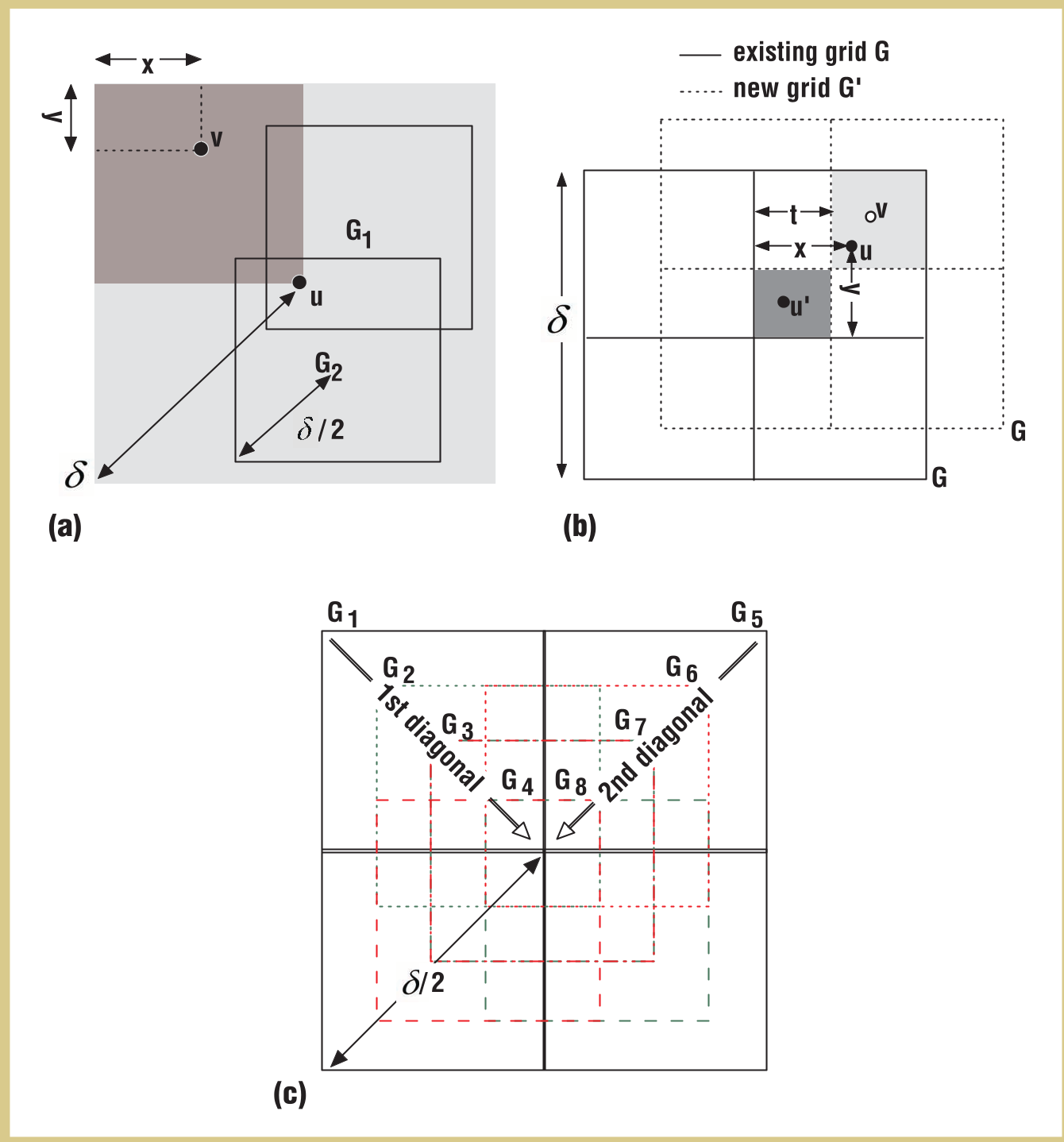
To kill the false-negative problem, the authors don't just use one grid; they use an overlay of multiple grids. By shifting these grids diagonally by specific offsets ( of the cell length), they ensure that if a pair of users is missed by one grid, they are caught by another.
The mathematical intuition is to minimize the overlapping "uncovered" area in the proximity region. The authors prove that an optimal diagonal shift is far superior to random shifting.
2. Multilevel Grid Hierarchy (The "Zoom" Logic)
Continuous tracking is a battery killer. The authors introduce a Multilevel Scheme where grid cells get larger at higher levels (Level 0, 1, 2... L).
- Logic: If a friend is 5km away, there is no need to update your location at a 500m-grid level. You only update at the level where you and your friend might share a "Common Signature."
- Outcome: As friends move closer, the system "zooms in" and updates more frequently. When they are far, updates are rare.
Experimental Validation
Using a simulator based on the German city of Oldenburg, the team tested the system with up to 100,000 users.
Key Findings:
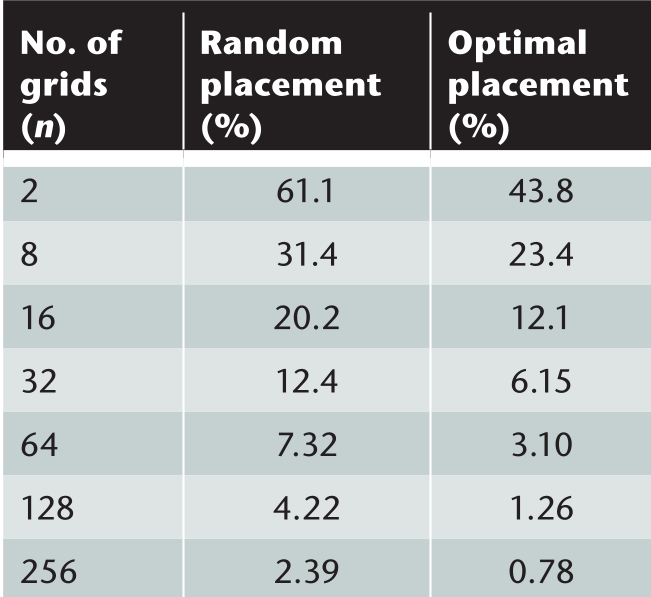
- Accuracy: With 128 optimal grids, the False Negative rate drops to a mere 1.26%, whereas random placement remains at 4.22%.
- Scalability: The server CPU time grows linearly with the number of users (), proving it can handle metropolitan-scale deployments.
- Efficiency: Even as group sizes (number of friends) increase, the communication cost stays flat because of the hierarchical update pruning.
Critical Insight & Conclusion
This work moves beyond simple "hiding" and treats location privacy as an optimization problem. By calculating the exact probability of detection failure (), the authors allow service providers to guarantee a certain Quality of Service (QoS) for alerts while maintaining a "semi-honest" security model.
Limitations: The current model uses Manhattan distance ( norm), which is great for grid-based cities but may need adjustments for Euclidean () circular proximity in open environments. Furthermore, while it protects coordinates, it doesn't fully address "velocity-based" attacks where a server might infer speed from update frequencies.
Future Outlook: This multilevel update logic is a precursor to modern "Edge Computing" strategies, where local proximity is handled differently from global tracking.