
MuLink: Transforming YouTube Playlists into Real-World Social Icebreakers
Nearby x Music: A Mobile Social Service in Proximity based on YouTube Hashtag and Playlist
The paper introduces MuLink, a Mobile Social Service in Proximity (MSNP) that facilitates localized music sharing and social interaction. By leveraging Bluetooth beacons and YouTube API data (hashtags and playlists), MuLink automatically identifies common music tastes and generates consensus-based playlists for users in the same physical space.
Executive Summary
TL;DR: MuLink is a geosocial networking system that bridges the gap between our digital music identities and real-world social interactions. By combining Bluetooth proximity sensing with YouTube data analysis, it creates shared environmental music and ranks social compatibility among strangers in the same room.
Context: Within the landscape of Mobile Social Networking in Proximity (MSNP), MuLink moves beyond simple data exchange to create a "shared experience" ecosystem. It targets the "introvert's dilemma" by using music as a computational tool for social lubrication.
The Problem: The "Digital Wall" in Physical Spaces
Despite being surrounded by people at a party or cafe, individuals often remain isolated within their smartphone screens. Public music is usually static or controlled by a single host, ignoring the collective preference of the crowd.
The authors identify a missing link in Geosocial Networks: the ability to automatically discover shared interests without the awkwardness of initial small talk. Previous efforts, such as AR-based social networks, often require high-end hardware like wearable glasses, making them impractical for casual social settings.
Methodology: How MuLink Orchestrates Social Harmony
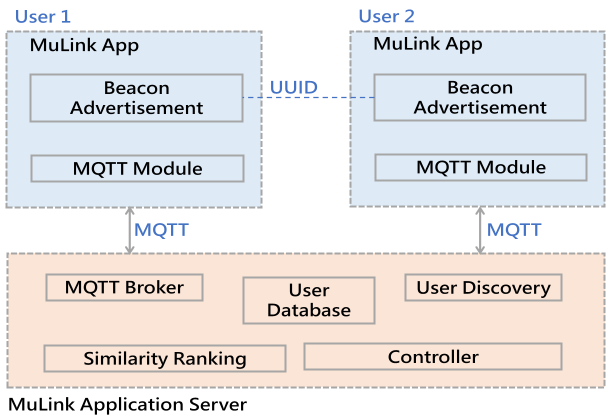
MuLink’s magic lies in its tripartite architecture, which synchronizes personal data with a physical environment:
- The Discovery Layer (Bluetooth Beacons): The MuLink App broadcasts an identity signal. Unlike Wi-Fi, which might cover a whole building, Bluetooth ensures that "Proximity" truly means "in the same room."
- The Analytical Layer (Cloud Server): This is the brain of the system. It fetches YouTube tokens, analyzes hashtags/keywords associated with a user's favorite videos, and calculates a Similarity Ranking.
- The Actuation Layer (MuLink Box): A hardware hub connected to speakers that listens to the server’s "Controller" and streams a consensus-built playlist.
Gamifying the Social Experience
The system doesn't just play music; it incentivizes interaction. By sharing links through the app, users "level up" their similarity scores with one another. This gamification turns the act of getting to know someone into a collaborative goal.
Experiments and Use Cases
The authors demonstrate the system via two primary scenarios that highlight its utility:
- Nearby-Play: In a party setting, the "MuLink Box" acts as an automated DJ. By aggregating the YouTube profiles of everyone present, it ensures the vibe of the room reflects the collective taste of the attendees.
- Nearby-Similarity: On a mobile interface, users can see a list of people nearby, ranked by how much their music tastes overlap. This provides an immediate "conversation starter"—e.g., "I see we both have a 90% similarity in Indie Rock playlists."
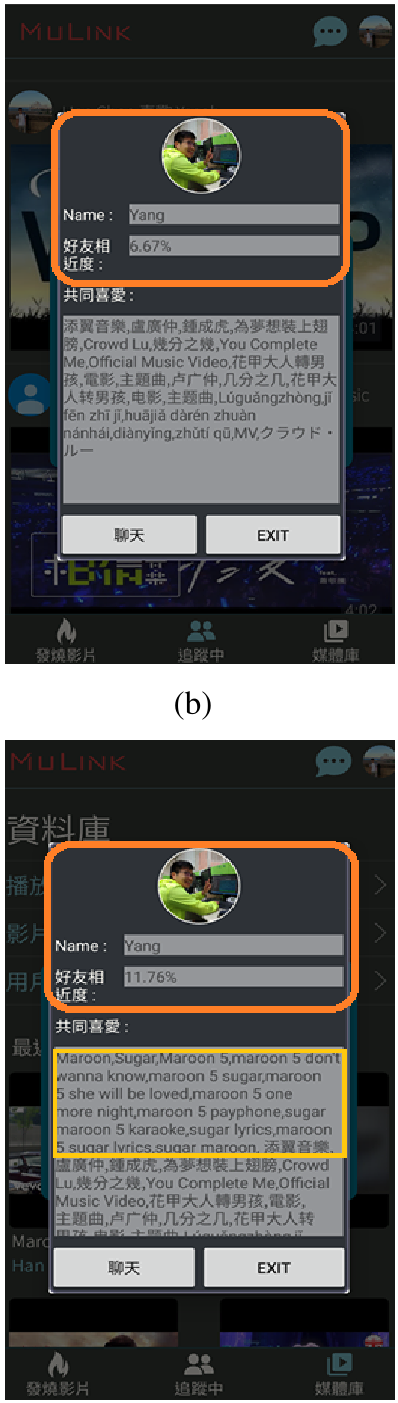 Fig 2: The mobile interface showing discovery (a), similarity ranking (b), link sharing (c), and resultant face-to-face interaction (d).
Critical Insight & Conclusion
MuLink’s core contribution is the realization that Proximity + Metadata = Opportunity. By offloading the "matching" phase of socializing to an automated system, it reduces the social anxiety associated with meeting new people.
Takeaways
- Privacy vs. Utility: While powerful, the system relies on access to YouTube tokens. Future iterations would need robust privacy controls to manage what specific hashtags are shared.
- The Future of Smart Spaces: This work hints at a future where our environments (shops, bars, offices) autonomously adapt their sensory output (light, music, temperature) to the average preference of the occupants.
MuLink successfully transitions conversations from the online world back into the real world, proving that technology can be used to tear down the very walls it helped build.
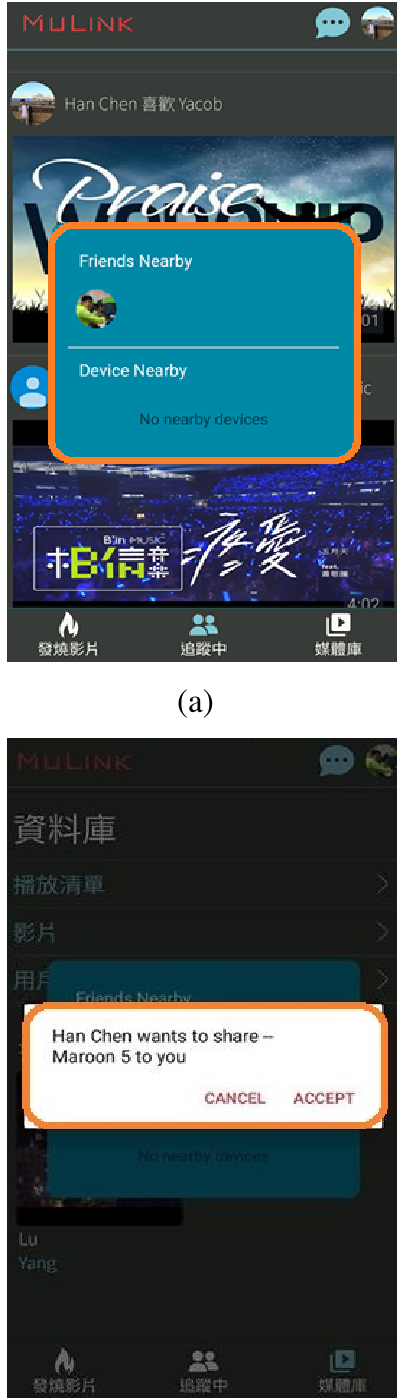 Fig 3: The physical MuLink Box that serves as the audio gateway for the localized group.