
Heat Diffusion: A Physical Approach to Solving the Social Recommendation Cold Start
Nearest neighbour based social recommendation using heat diffusion
This paper introduces a nearest neighbor-based Top-N social recommendation method that utilizes the physical phenomenon of Heat Diffusion to model user similarity and trust propagation. By representing user-item ratings and social trust as graphs, the system generates personalized recommendations that specifically address the limitations of traditional Collaborative Filtering in sparse data scenarios.
TL;DR
Recommender systems often struggle when users have little history (the Cold Start problem). This paper presents a novel approach by treating social networks and rating histories as a physical medium. By applying Heat Diffusion—simulating how heat flows from a source user to similar peers—the authors achieve a 47.3% improvement in recall for cold start users compared to standard collaborative filtering.
Context: Why Traditional CF Fails
Collaborative Filtering (CF) is the backbone of modern e-commerce, but it has a "data hunger" problem. It relies on overlapping ratings between users. If you are a new user, CF has nothing to anchor on. While social-based recommenders (using "trust" networks) were developed to bridge this gap, they often use simple Breadth-First Search (BFS) or heavy Matrix Factorization that doesn't scale well or capture the relative "strength" of connections accurately.
The Insight: Recommendation as Heat Flow
The authors suggest that trust and preference behave like heat. If you are the "heat source," the people you trust directly get the most heat. Their interests then "radiate" heat further to the items they like and the people they trust.
1. Graph Physics
The system models two graphs:
- User-Item Bipartite Graph: Users and Items are nodes; ratings are edge weights.
- Trust Network: A directed graph representing who trusts whom.
2. The Diffusion Process
Unlike a simple random walk, the Heat Diffusion model (specifically for directed graphs) considers the "thermal conductivity" of edges. The heat at a node at time is calculated via a discrete approximation: Where is the Laplacian-like matrix representing the graph structure.
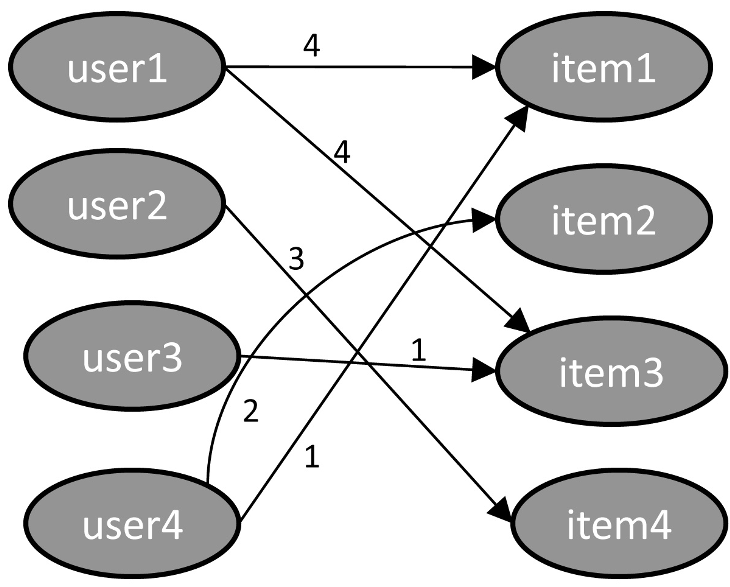 Figure: The bipartite user-item network (left) and the social trust network (right) used as the "conductive medium" for diffusion.
Methodology: Diffusion-CF-Trust
The algorithm works in three distinct steps:
- Local Heat Extraction: Instead of calculating the whole graph, it extracts a subgraph (depth 2 or 3) around the active user.
- Dual Diffusion: Heat is diffused separately in the User-Item network (to find similar tastes) and the Trust network (to find reliable influencers).
- Ranking: Items are ranked based on the final heat values of the users who rated them.
Experimental Breakthroughs
The researchers tested their model on the Epinions dataset (75k users, 104k items).
- The Baseline: Trust-CF (a then-standard combination of CF and BFS trust).
- Performance: The proposed Diffusion-CF-Trust reached a recall of 24.89% for the general population.
- Cold Start Victory: For users with <5 ratings, the recall was significantly higher than baselines, proving that social trust acts as a powerful proxy for preference when personal data is missing.
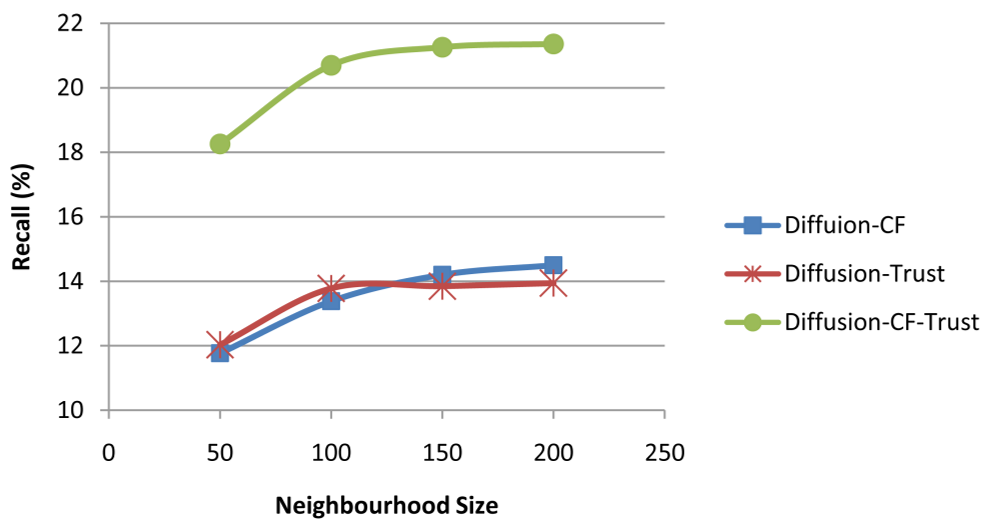 Figure: Performance for Cold Users. Notice how Diffusion-CF-Trust sustains higher recall as the neighbor count increases.
Critical Analysis & Future Outlook
Why does it work? Heat diffusion naturally captures transitivity. In social networks, trust is transitive but decays. The physics of diffusion perfectly mirrors this decay—heat dissipates as it travels further from the source, ensuring that "friends of friends" have less influence than direct "friends."
Limitations: The paper uses a discrete approximation to save time, but for massive graphs, even depth-limited subgraphs can become large. Additionally, the thermal conductivity is a hyperparameter that currently requires manual tuning.
The Takeaway: This paper serves as a bridge between physical modeling and social science. It reminds us that "influence" in a network is not a binary link but a flowing commodity. For modern developers, this logic is a precursor to modern Graph Convolutional Networks (GCNs).
Conclusion
By replacing rigid similarity metrics with a dynamic flow model, the authors turned the recommendation problem into a heat distribution problem, providing a more "organic" and effective way to help new users find what they love.