
Beyond the Like Button: Decoding the Friction Points of Social Network Services
The Negative Critical Incidents of Social Network Service: An Exploratory Study
This study investigates the negative critical incidents (NCIs) that drive user dissatisfaction and service discontinuance in Social Network Services (SNS). Using an empirical survey and quantitative analysis, the author classifies negative experiences into eight distinct categories, identifying "SNS Fatigue" and "Gossip" as emerging threats alongside traditional privacy concerns.
TL;DR
Social Network Services (SNS) are no longer in their "honeymoon phase." This study shifts the focus from why we use SNS to why we hate or avoid them. By identifying eight "Negative Critical Incidents" (NCIs), the research reveals that while privacy remains a titan of trouble, issues like SNS Fatigue, Gossip, and Social Fetter are becoming the primary drivers of user churn and latent user avoidance.
Background: The Friction of Connection
In the academic landscape of SNS research, most scholars are obsessed with the "why"—why do people join? What personality traits lead to Facebook addiction? However, this paper argues that the "why not" is equally critical. As millions of users began withdrawing from major platforms globally, understanding the friction points—or Negative Critical Incidents—became a survival requirement for digital service providers.
Problem & Motivation: The Discontinuance Gap
Previous research has largely ignored the "negative encounter"—the specific moment a service creates irritation or dissatisfaction. The author suggests that a typical dissatisfied user will tell up to 10 people about a bad experience. Furthermore, there is a massive "perception gap" between those who have integrated SNS into their lives and those who stand outside the circle (unexperienced users), which remains poorly understood.
Methodology: Categorizing the "Negative"
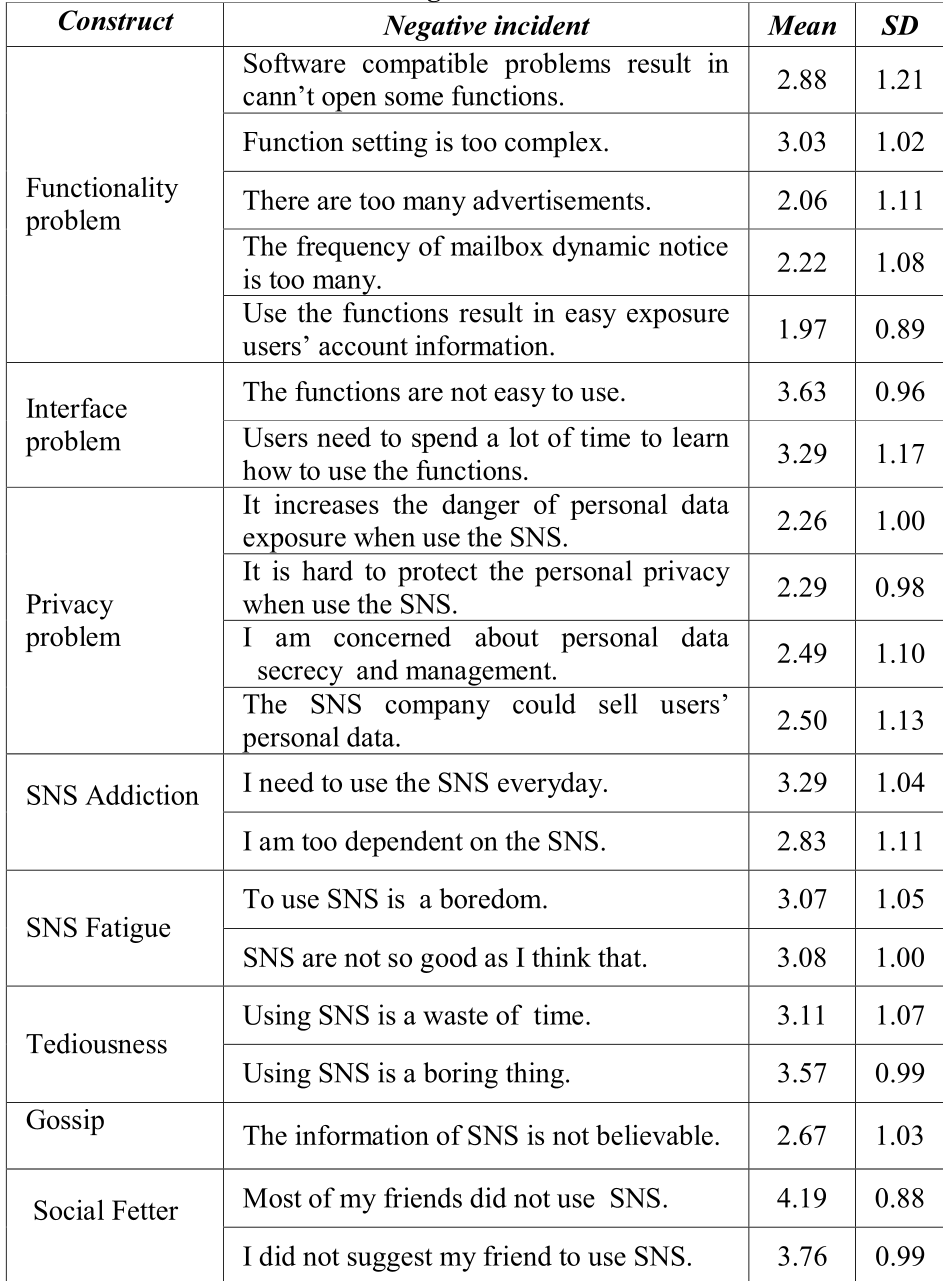
The study utilizes a survey-based quantitative approach to measure eight core constructs of negativity. These aren't just abstract feelings; they are categorized into specific technical and social failures.
The Eight Pillars of Negativity
- Functionality: Bugs, complex settings, and excessive ads.
- Interface: High learning curves and poor usability.
- Privacy: The pervasive fear of data exposure and corporate data selling.
- Addiction: The burden of dependency and daily usage.
- Fatigue: The loss of novelty; the "boring" factor.
- Tediousness: Feelings that SNS usage is a waste of time.
- Gossip: The acceleration of rumors and unbelievable information.
- Social Fetter: The pressure of social influence and the obligation to suggest the service to others.
Key Insights: Addiction vs. Fatigue
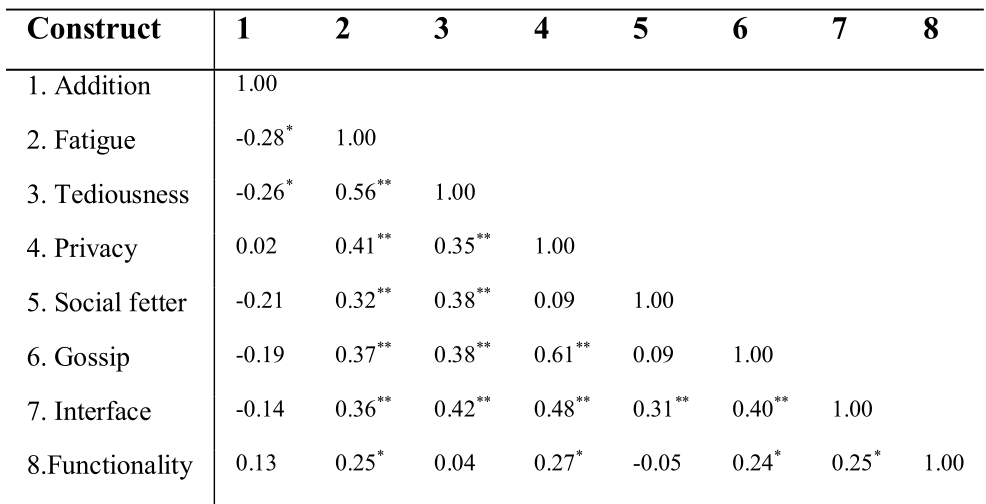
One of the most profound findings in the paper is the Pearson Correlation analysis between these constructs.
- The Addiction-Fatigue Inverse: There is a significant negative correlation between Addiction and Fatigue/Tediousness (-0.28). This suggests the user base is split into two camps: the "Addicted," who still find the service stimulating, and the "Fatigued," who find it burdensome.
- The Fatigue Cluster: Tediousness, gossip, social fetter, and privacy problems all show significant positive correlations with fatigue. Essentially, when a platform becomes a "rumor mill" or a "social chore," fatigue sets in rapidly.
The Perception Gap: Latent Users
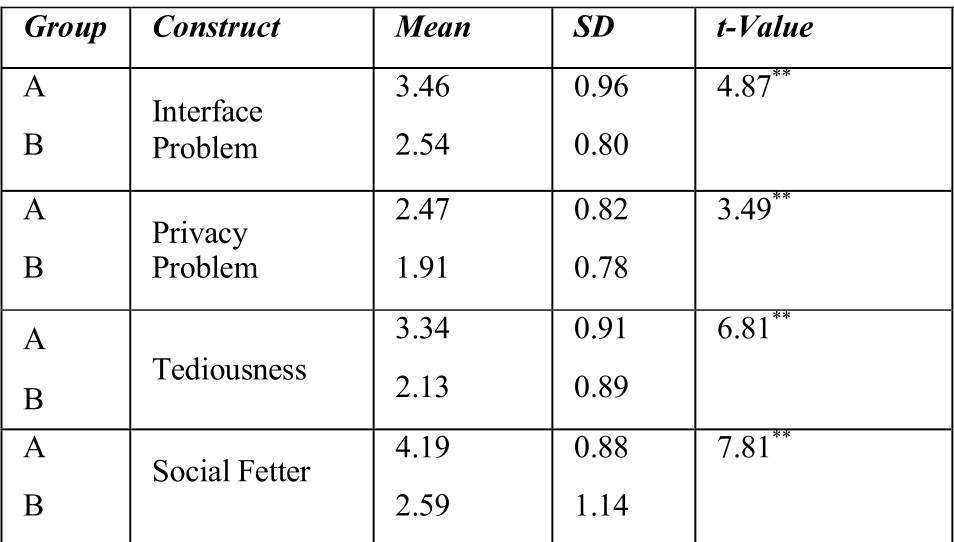
The study compares experienced (Group A) vs. unexperienced (Group B) users. The results are startling:
- Interface Barriers: Unexperienced users find the interface significantly harder to use (M=2.54 vs M=3.46).
- The Boredom Barrier: Latent users view SNS as fundamentally "boring" and a "waste of time" compared to those already using it.
- Heightened Privacy Fears: While everyone worries about privacy, the unexperienced perceive the threat as significantly more severe (M=1.91).
Conclusion and Future Outlook
The paper concludes with a warning: SNS are entering a period of maturity or even recession. To survive, administrators cannot simply rely on network effects. They must:
- Innovate Functionality: To combat "Fatigue" and "Tediousness."
- Verify Information: To mitigate the "Gossip" incident.
- Radical Transparency: To lower the "Privacy" barrier that prevents latent users from joining.
Limitations: The study’s sample size (n=113) and focus on a specific geographic region (Taiwan) mean that while the insights are high-quality, the cultural nuances of gossip and social fetter might vary globally. Nevertheless, it provides a vital blueprint for understanding the "Dark Side" of social networking.