
Beyond Keywords: Detecting Crisis through Chinese Social Media and Spatial Context
Negative Emotion Event Detection for Chinese Posts on Facebook
The paper introduces a specialized emotion analysis system designed to detect negative emotions in Chinese Facebook posts and extract associated geographic locations. By combining modified TF-IDF weighting, n-gram based word composition, and event-driven classification rules, the system achieves a negative emotion precision of 74.8% and a recall of 78.7%, significantly outperforming traditional SVM and Naïve Bayesian baselines.
TL;DR
In the wake of public tragedies, researchers are looking toward social media for early warning signs. This paper proposes a specialized system for Chinese Facebook posts that doesn't just look for "sad words," but analyzes the weight of emotions, the specific life events involved, and even the locations mentioned. By moving from simple keyword matching to an event-driven logic, the system achieves a nearly 79% recall rate in identifying negative emotions.
Context: This research serves as a bridge between traditional text mining and proactive public safety/mental health monitoring in the Mandarin-speaking social media landscape.
The "False Alarm" Problem in Chinese Sentiment Analysis
Most sentiment analysis tools treat text like a "bag of words." If it sees "kill" or "die," it flags it as negative. However, in Chinese social media, metaphors and hyperbolic expressions are common. A user might say "I'm dying of laughter" or use aggressive slang without being in a state of crisis. Traditional models like SVM (Support Vector Machines) and Naïve Bayesian often struggle with these nuances, leading to high false-positive rates or missing hidden cries for help that contain no obvious emotion keywords.
Methodology: Logic, Weight, and Location
The authors' approach is built on the intuition that emotion is contextual. They break down their methodology into three core innovative pillars:
1. The Dynamic Weighting & Composing Word Method
Instead of a static dictionary, the system uses a modified TF-IDF formula to calculate an Emotion Weight Function. It accounts for how often a word appears specifically in emotional versus neutral sentences. To handle the complexity of Chinese word segmentation, they use a "Composing Word Method" based on n-grams to ensure that phrases like "break up" (分手) are treated as a single emotional unit rather than isolated characters.
2. Rule-Based Event Extraction
The core of the system lies in its three-step classification rule:
- Rule 1: Direct detection of high-intensity negative words.
- Rule 2: Summing the weights of positive vs. negative tokens.
- Rule 3: The "Context Check"—searching for human-centric words (me, you) and specific negative events (e.g., bullying, unemployment).
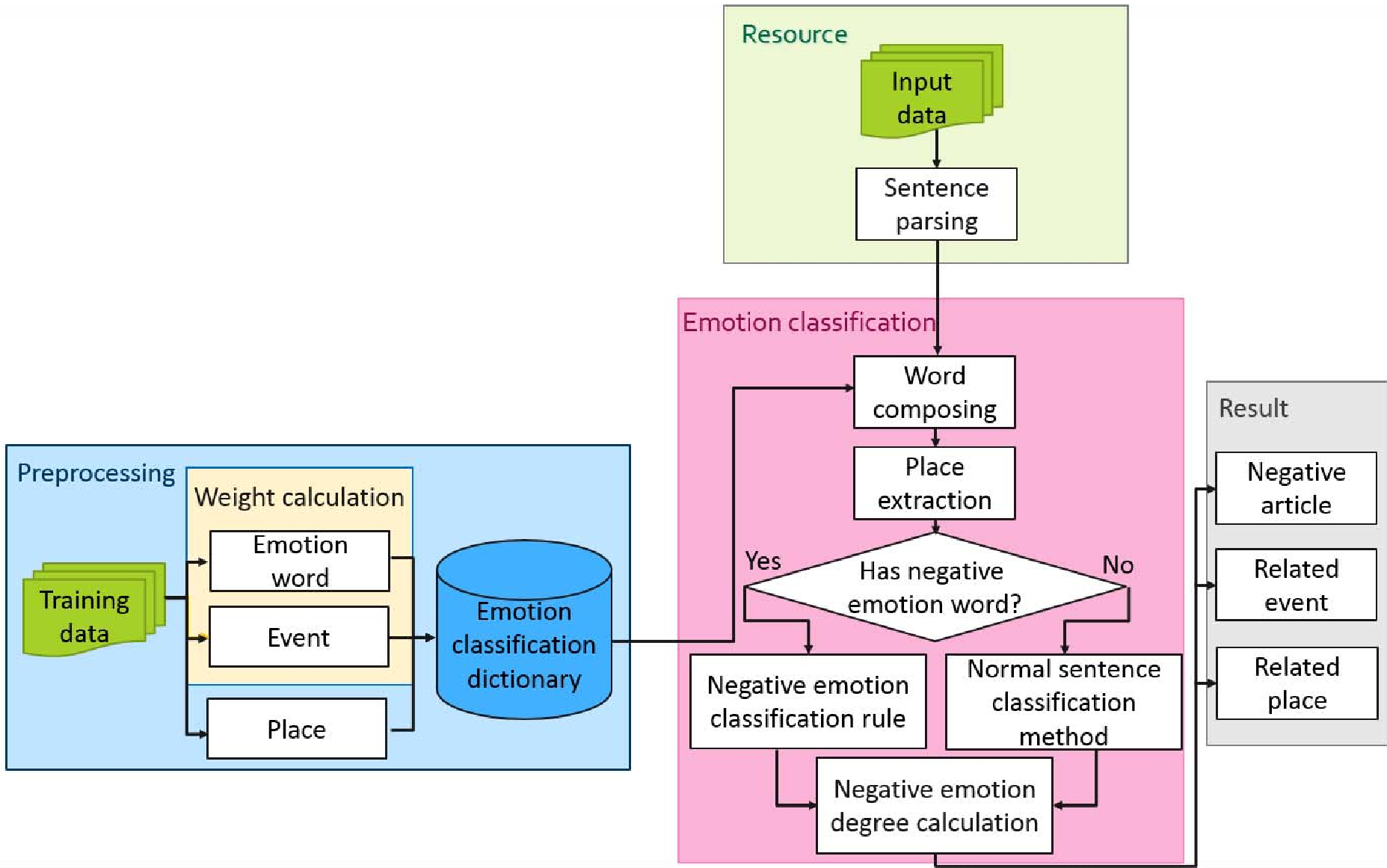 Fig 1: The architecture showing the flow from CKIP parsing to emotion/place extraction.
3. Spatial Awareness
A unique feature is the Place Extraction module. By looking for "movement words" and analyzing the Part-of-Speech (POS) tags that follow them, the system can identify where an event is happening, providing crucial data for emergency services or intervention teams.
Experimental Results: SOTA Comparison
The system was tested against over 2,300 Facebook samples. The performance gains were substantial:
| Metric | Proposed System | SVM | Naïve Bayesian |
|---|---|---|---|
| Negative Precision | 0.748 | 0.577 | 0.660 |
| Negative Recall | 0.787 | 0.689 | 0.704 |
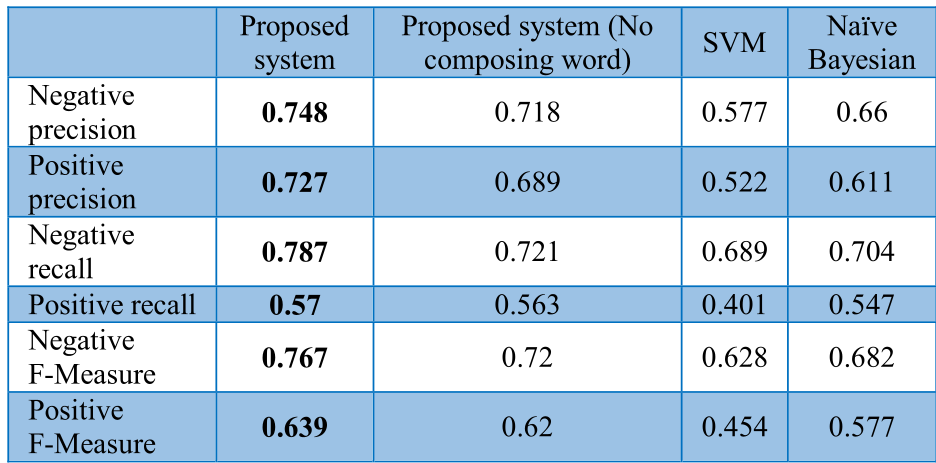 Table: Comparison demonstrating the superior F-measure of the proposed method.
The system also categorizes the severity of the negative emotion. For example, a post about a missing calculator for an exam is classified as "Weak," whereas a post containing keywords like "kill" or "bully" paired with high-weight human pronouns is categorized as "Danger."
Critical Insights & Future Outlook
Takeaway: The real value here is the shift from Statistical sentiment to Structural sentiment. By considering "who" is doing "what" and "where," the model approximates human understanding better than a simple word-count model.
Limitations:
- Language Evolution: The system relies on the CKIP parser and a pre-defined dictionary; it may struggle with rapidly evolving internet slang or "martian script" (火星文).
- Privacy: While theoretically useful for preventing tragedies, real-time monitoring of personal Facebook posts raises significant ethical and privacy concerns.
Future Work: Moving this logic into a Transformer-based architecture (like BERT-Chinese) could potentially automate the "Composing Word" process and capture even deeper semantic dependencies without manual rule-crafting.