
SocLS-Fact: Unveiling the "Invisible" Rivalries in Online Political Networks
Negative Link Prediction and Its Applications in Online Political Networks
The paper proposes SocLS-Fact, an unsupervised Non-negative Matrix Factorization (NMF) framework for predicting negative links in online political networks (e.g., Twitter). It integrates sentiment cues from conversations, platform-specific positive interactions (retweets/likes), and Social Balance Theory to infer antagonistic relationships without explicit "dislike" data.
TL;DR
Online political discourse is fueled by disagreement, yet platforms like Twitter only provide "positive" buttons (Like, Retweet). SocLS-Fact is a new unsupervised framework that uncovers hidden negative links—rivalries and oppositions—by combining the sentiment of tweets with the social logic of "the enemy of my enemy is my friend." By adding these "invisible" links back into the map, researchers can detect political communities with significantly higher accuracy.
The Problem: The "Dislike" Gap in Social Data
In the study of online polarization, we are often flying blind. While we can easily see who supports whom (via retweets or likes), there is no explicit button for opposition. Previous research often relied on niche sites like Slashdot or Epinions because they actually have "ignore" or "distrust" features. However, the real political action happens on Twitter and Facebook, where negative links are implicit.
The challenge is twofold:
- Lack of Ground Truth: There are no "negative labels" to train a standard machine learning model.
- Signal Noise: Negative sentiment in a tweet doesn't always mean a negative link between users (it could be two friends complaining about a third party).
Methodology: Triangulating Antagonism
The authors propose SocLS-Fact, an optimization framework based on Non-negative Matrix Factorization (NMF). Instead of just looking at sentiment, it forces the model to respect three pillars of social reality:
- Sentiment Lexicon: It uses a predefined list of "good" and "bad" words to anchor the latent dimensions of user interactions.
- Positive Anchors: If two users have retweeted each other, the model is penalized if it tries to label their relationship as negative.
- Social Balance (The Structural Constraint): This is the "secret sauce." Based on Heider’s Social Balance Theory, the model assumes that if User A and User B are friends (positive link), they should feel similarly about User C. The framework adds a regularization term to penalize "unbalanced" triangles.
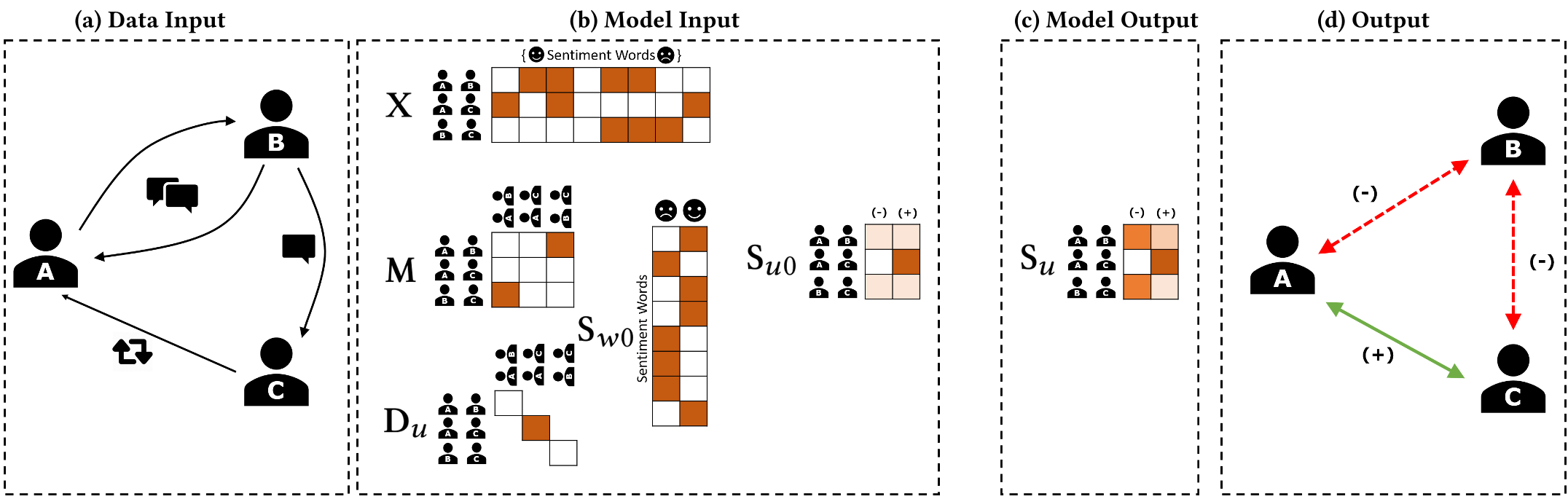 Figure 1: The framework factorizes textual interactions (X) into user link polarities (Su) and word polarities (Sw) while constrained by social balance (M).
Experiments: More Than Just Sentiment
The researchers tested SocLS-Fact on political Twitter datasets from the US, UK, and Canada.
1. Accuracy in Prediction
Compared to a "Sentiment Only" approach (which only looks at words), SocLS-Fact showed a massive leap in performance. Incorporating the Social Balance Regularizer () provided the final boost needed to reach a SOTA F-measure of ~0.71.
2. Community Detection: The "Signed" Advantage
The most striking result came from community detection. Traditionally, we use "unsigned" networks (only positive links). By adding the predicted negative links and using a Signed Spectral Clustering algorithm, the model's ability to identify real-world political camps skyrocketed.
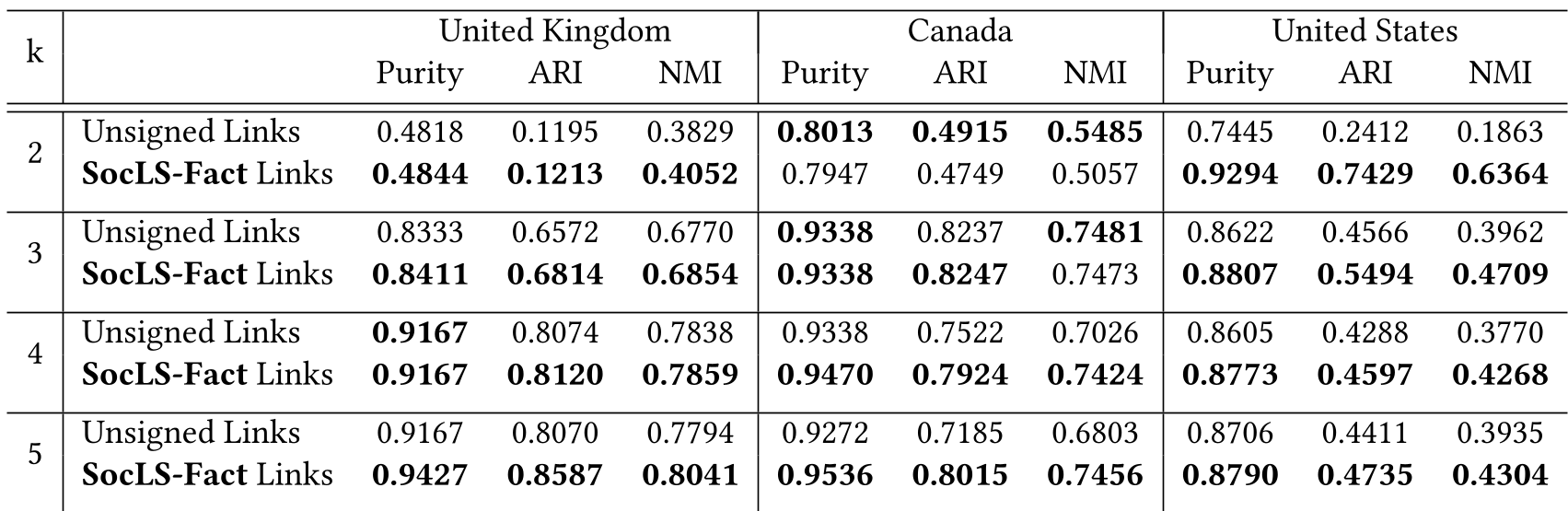 Table 4: Significant jumps in Purity and ARI (Adjusted Rand Index) when negative links are included, especially in the US dataset (ARI increased by 208%).
Tracking Polarization Over Time
The authors applied their model to the Brexit era. They found they could track how the Conservative Party's internal unity dissolved between 2015 and 2016 as members split over the EU referendum. SocLS-Fact effectively visualized these shifting "red" (negative) and "green" (positive) ties between parties, offering a window into political realignment that raw text alone couldn't provide.
Critical Insight & Conclusion
SocLS-Fact proves that structure and content are inseparable. You cannot understand a political network by looking only at the "fave" button, nor can you understand it by only doing sentiment analysis on the text. The real insight lies in the interplay: how the words people use are constrained by their social position and the "logic of enmity."
While the model is unsupervised, its reliance on a sentiment lexicon remains a potential bottleneck for slang-heavy or sarcastic discourse. Future iterations might benefit from integrating Deep Learning embeddings (like BERT) into the NMF structure to better capture nuanced political sarcasm.