
PriNego: Solving Social Media Privacy Conflicts Through Multi-Agent Negotiation
Negotiating Privacy Constraints in Online Social Networks
The paper introduces PriNego, a multi-agent negotiation framework designed to automate privacy protection in Online Social Networks (OSNs). By representing users as software agents that resolve privacy conflicts through a semantic negotiation protocol, the system ensures that content (like photos or posts) is only published after all affected parties reach a consensus.
TL;DR
Privacy in social networks is inherently collaborative—one person's post can violate another's boundary. PriNego shifts the paradigm from "post first, report later" to a proactive Multi-Agent Negotiation system. By using semantic reasoning and an iterative protocol, it ensures all tagged users agree on the audience and content before it goes live.
Background: The Failure of Static Privacy
Current OSN privacy models are broken by design. They treat privacy as a bilateral agreement between the user and the platform. However, social media is social. When Alice tags Bob in a party photo, her "Public" setting might conflict with his "Family-Only" boundary. Existing solutions like Facebook's reporting tool are "Too Little, Too Late"—the damage is done the moment the "Post" button is clicked.
The Core Insight: Privacy as a Negotiation
The authors argue that privacy is a dynamic constraint satisfaction problem. Instead of asking users to define every possible scenario up front, PriNego delegates this to autonomous agents.
How It Works: The Iterative Protocol
- Initiation: Alice’s agent proposes a
PostRequest(Media, Text, Audience). - Evaluate: Bob and Carol’s agents check the request against their SWRL Rules (e.g., "If context is 'Party' and audience includes 'Family', then Reject").
- Feedback: Instead of a simple "No," agents provide a Rejection Reason (e.g., "Remove Errol from audience").
- Revision: Alice’s agent adjusts the post (e.g., shrinks the audience or changes the photo) and re-proposes until consensus is reached.
Methodology: Semantic reasoning
The system’s "brain" is a Social Network Ontology. This allows agents to understand complex relationships (e.g., isColleagueOf) and contexts (e.g., Work vs Leisure).
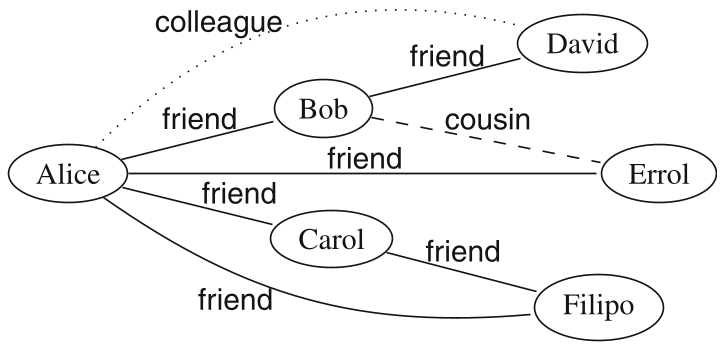
The use of SWRL (Semantic Web Rule Language) allows for sophisticated policies. For instance, a user can say "I don't like being seen by my boss in a bar," and the agent can infer the "Work" context from the location and audience members.
Experiments & Results
The authors tested PriNego against three major criteria: Automation, Fairness, and Protection. They compared it against existing systems like Primma-Viewer and FaceBlock.
Performance in Action
In a walk-through scenario involving Alice, Bob, and Carol, the system moved from a privacy-violating proposal to a mutually acceptable post in just two iterations.
| Iteration | Content | Audience | Result |
|---|---|---|---|
| 1 | Party Pic | Alice, Bob, Carol, Errol, Filipo | Rejected (Bob dislikes Family, Carol dislikes Filipo) |
| 2 | Party Pic | Alice, Bob, Carol | Accepted |
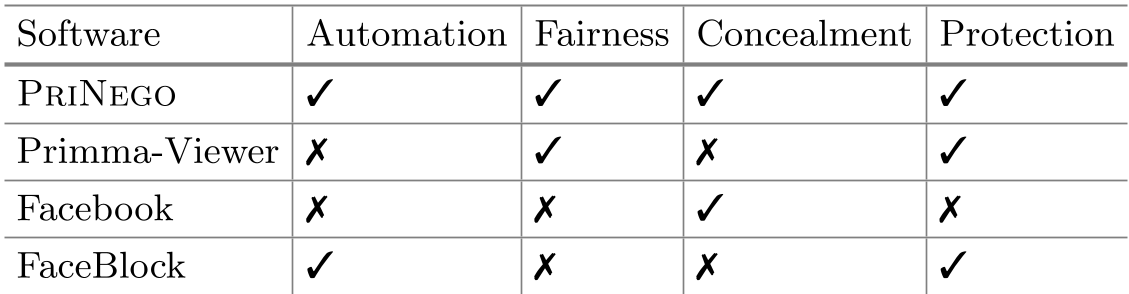
Unlike Facebook (which is reactive/unfair) or FaceBlock (which forces blurring), PriNego finds a "Fair" middle ground by adjusting the audience or selecting alternative media.
Critical Insight & Conclusion
PriNego's greatest strength is Concealment. A Participant Agent doesn't have to share its entire privacy policy with the Negotiator; it only shares the specific reason for a specific rejection. This "need-to-know" basis preserves the privacy of the privacy rules themselves.
Limitations: The current model assumes agents are honest and cooperative. Future work needs to address "adversarial" agents who might try to probe others' privacy boundaries through repeated proposals. Additionally, integrating Machine Learning could allow agents to "learn" their friends' preferences over time, reducing the number of negotiation rounds.
Takeaway: The future of privacy isn't more checkboxes; it's smarter delegation. PriNego proves that autonomous agents can navigate the complex social landscape of OSNs, protecting us before the first byte is ever shared.